Quranic Answer
In the Holy Quran, the profound relationship between divine guidance and human responsibility is articulated with clarity, offering deep insights into the nature of faith and the quest for truth. One of the most fundamental concepts that arise from the Quran is that God's guidance is rooted in His infinite wisdom and knowledge. As referenced in Surah Al-Baqarah, verse 272, Allah states that guidance is upon Him, and He guides whom He wills to the straight path. This notion places emphasis on the divine will, suggesting that while all of humanity has the potential for guidance, it is ultimately subject to God's choice and wisdom. This very statement not only reassures believers of Allah's continuous presence in their spiritual journey but also highlights the sovereignty of God in matters of faith and guidance. Furthermore, the Quran presents guidance as an integral aspect of the human experience. Surah Al-Isra, verse 15, reinforces this idea, promising that those who actively seek guidance will indeed be led by Allah. This is an important promise, as it underscores Allah's willingness to assist those who are earnestly searching for truth and righteousness. Such a declaration enhances a believer's motivation to pursue the path of spirituality and integrity, reassuring them that their efforts to seek divine guidance will not go unnoticed. The Quran highlights the unique potential for guidance inherent in every human being. Each person is portrayed as being endowed with a divine spirit, providing them with the capacity to connect with the truth and to grasp the divine signs manifest in the world around them. These signs, presented through nature, human experiences, and revelation, serve as reminders of God's presence and the truths of life. However, the realization of this guidance is not automatic. It necessitates an active engagement from individuals. The Quran indicates that those who are not in search of truth may find themselves distanced from Allah’s guidance. This illustrates a critical aspect of human agency—the decision of whether or not to pursue guidance and truth is ultimately left to individuals. In exploring this theme, the Quran emphasizes the importance of the human will in the process of receiving guidance. The choice to embark on this path of righteousness or to remain indifferent lies with each person, creating a personal responsibility that is both empowering and daunting. This element of choice is critical; it reinforces the philosophy that while Allah is the source of guidance, acceptance and the journey towards it rest with the seeker. Thus, the Quran presents guidance as both a gift and a responsibility—a divine blessing for those who diligently pursue a life of piety and truth. Another essential aspect of this discussion is the notion that divine guidance can manifest in various forms. The Quran employs a rich tapestry of metaphors and parables to elucidate the nature of guidance, often likening it to light. This comparison vividly portrays how guidance illuminates the path of life, allowing individuals to navigate through the challenges and darkness encountered in their lives. In this light, one can see the clarity that comes with faith, enabling seekers to distinguish between right and wrong, truth and falsehood. The Quran also acknowledges the significance of communal support in the pursuit of guidance. The community plays a vital role in fostering an environment conducive to the seeking of truth. The believers are encouraged to assist each other in their spiritual journeys, working together to create a collective pursuit of righteousness. This is encapsulated in the concept of Ummah, or community, where individuals are bound together by their shared faith and commitment to seek Allah's guidance. The Quran thus highlights that while personal effort is paramount, the support of a faith community can enhance the journey towards divine guidance. Moreover, the Quran reiterates the idea that guidance is not a one-time event but rather a continuous process. Life is presented as a journey filled with learning opportunities, and individuals are encouraged to remain vigilant and attentive to Allah's signs throughout their lives. The pursuit of truth is depicted as a lifelong endeavor, characterized by both struggles and victories, where the seeker is expected to evolve and grow in their understanding of faith. In conclusion, the exploration of divine guidance in the Quran reveals a complex interplay between God's will and human choice. The concept that Allah guides whom He wills sheds light on the divine wisdom involved in this process, while the acknowledgment that those who seek guidance will receive it emphasizes the importance of personal initiative and sincerity. The Quran provides a foundation for understanding that while everyone has the potential to achieve guidance, it is the pursuit of truth and piety that ultimately leads to this divine blessing. As humanity navigates through the myriad of challenges in the modern world, these teachings remain highly relevant. They remind believers that the quest for guidance is a personal journey, enriched by communal support and divine wisdom. By embracing this path with earnestness, one can hope to draw closer to the truth and attain the guidance that leads to a fulfilling and pious life.
Related Verses
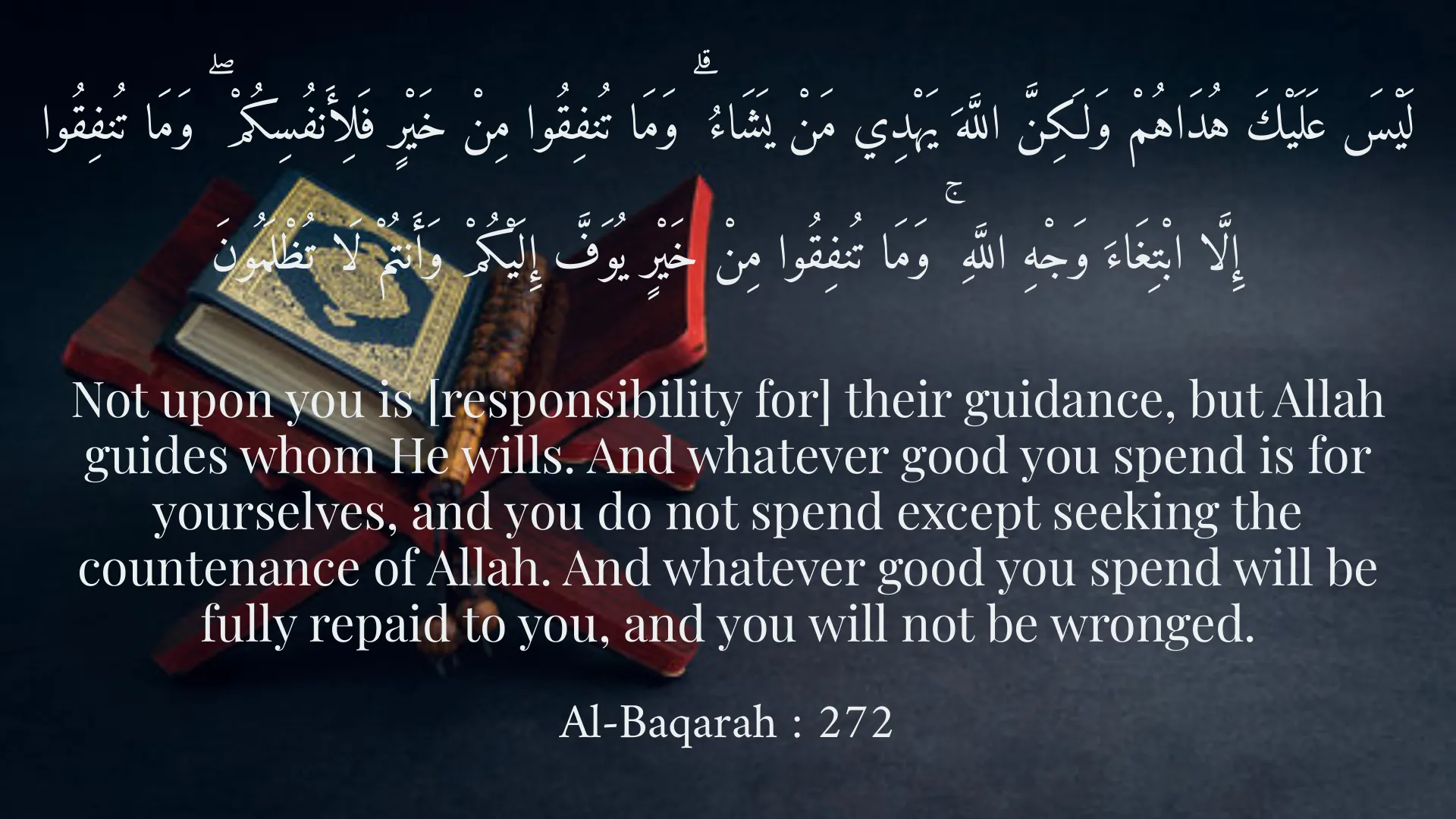
لَيْسَ عَلَيْكَ هُدَاهُمْ وَلَكِنَّ اللَّهَ يَهْدِي مَنْ يَشَاءُ ۗ وَمَا تُنفِقُوا مِنْ خَيْرٍ فَلِأَنفُسِكُمْ ۖ وَمَا تُنفِقُوا إِلَّا ابْتِغَاءَ وَجْهِ اللَّهِ ۚ وَمَا تُنفِقُوا مِنْ خَيْرٍ يُوَفَّ إِلَيْكُمْ وَأَنتُمْ لَا تُظْلَمُونَ
Not upon you is [responsibility for] their guidance, but Allah guides whom He wills. And whatever good you spend is for yourselves, and you do not spend except seeking the countenance of Allah. And whatever good you spend will be fully repaid to you, and you will not be wronged.
Al-Baqarah : 272
وَإِذَا جَاءَتْهُم آيَةٌ قَالُوا لَن نُّؤْمِنَ حَتَّى نُؤْتَى مِثْلَ مَا أُوتِیَ رُسُلُ اللَّهِ ۗ اللَّهُ أَعْلَمُ حَيْثُ يَجْعَلُ رِسَالَتَهُ ۖ سَيُصِيبُ الَّذِينَ أَجْتَرَحُوا سَيِّئَاتٍ ذُلًّا وَعَذَابًا شَدِيدًا
And when a sign comes to them, they say, 'Never will we believe until we are given like that which was given to the messengers of Allah.' Allah is most knowing of where to place His message. He will impose upon those who commit crimes a severe punishment.
Al-Isra : 15
Short Story
One day, a man named Ahmad was sitting in a garden, lost in thoughts. He wondered whether all humans were truly deserving of guidance or not. As he pondered, he recalled the verses of the Quran and decided to think more about guidance and truth. He soon realized that God is always in pursuit of guiding humanity, and they must prepare themselves for seeking truth. In the end, Ahmad concluded that anyone who desires can embark on the quest for truth and benefit from divine guidance.