Quranic Answer
In the Holy Quran, the themes of repentance (Tawbah) and the forgiveness of sins (Maghfirah) are of vital importance, reflecting the compassion and mercy of Allah towards His creation. Repentance is more than merely an act of seeking forgiveness; it embodies a transformative process whereby an individual recognizes their wrongdoing, feels genuine remorse, and actively seeks to amend their behavior. This complex concept is not only prominent in Islamic theology but is also an essential aspect of personal development and moral growth. Through various scriptures, Allah graciously assures believers that if they earnestly return to Him, their sins will be forgiven. The significance of this divine promise is illustrated in Surah Al-Furqan, verse 70, which proclaims: 'Except for those who repent, believe, and do righteousness. Those will enter Paradise and will not be wronged at all.' This verse emphasizes that sincere repentance involves not just an acknowledgment of past misdeeds but also a commitment to faith and righteous actions going forward. It serves as a potent reminder that achieving forgiveness is contingent upon a believer's intention and actions post-repentance. By coupling repentance with belief and good deeds, Allah expresses a path towards eternal bliss in Paradise, devoid of injustice. Moreover, Surah Az-Zumar, verse 53, further elucidates the concept of divine mercy: 'Say, O My servants who have believed, fear your Lord. For those who do good in this world is good; and the earth of Allah is spacious. Indeed, the patient will be given their reward without account.' This verse addresses the pious and those who strive to perform good deeds, underscoring the correlation between righteousness and the rewards they will reap in this life and the Hereafter. The notion of patience is particularly salient, as it highlights that while the path of repentance and righteousness may be fraught with challenges, the ultimate rewards are plentiful and unrestricted. The essence of repentance in Islam is not limited to verbal expressions of remorse but also necessitates fervent actions that manifest one's commitment to transformation. The teachings of Prophet Muhammad (peace be upon him) reinforce this idea further. One of his notable Hadith states: 'Repenting from sin is like killing the sin itself.' Here, the Prophet beautifully encapsulates the power of genuine repentance; he indicates that when one repents sincerely, they dissolve the very act of sin, transforming their state of being. Thus, the act of repentance is intertwined with emotions of guilt, hope, and a commitment to change. When individuals reflect on their misdeeds, they often recognize the weight and consequences of their actions, leading to a pivotal moment of realization. This emotional journey, if undertaken with sincere intentions, plays a critical role in shaping an individual’s relationship with Allah. In Islam, the doors of forgiveness are perpetually open; it is a recurring motif throughout the Quran that emphasizes Allah's attribute as the Most Merciful (Ar-Rahman) and the Most Forgiving (Al-Ghafoor). As indicated in Surah At-Tahrim, verse 8: 'O you who have believed, repent to Allah with sincere repentance. Perhaps your Lord will remove from you your misdeeds and admit you into gardens beneath which rivers flow.' This verse celebrates the hope that true sincerity in repentance can bring not just forgiveness but also profound rewards in the form of paradise, reinforcing the optimism in seeking Allah’s mercy. Furthermore, to achieve genuine repentance, certain conditions must be met, which include regret over the sin, a determination not to return to it, and an intention to fulfill obligations towards Allah and others. It is also essential to seek forgiveness from the individuals one might have wronged, thereby restoring both spiritual and social harmony. This holistic approach to repentance emphasizes that one's actions towards others are as significant as their relationship with Allah. Moreover, the timeline of repentance is significant in Islamic teachings. Unlike many belief systems that may impose a stringent time limit for atonement, Islam allows for repentance at any moment until death. The concept of "the last breath" signifies that a person may turn to Allah at any point, no matter how sinful their past may be. This aspect removes despair and instills a sense of hope and opportunity for individuals seeking redemption. In summarizing the concept of repentance in Islam, we find it richly layered with meanings that stretch beyond a mere apology. It is about a heartfelt journey of transformation, restoring one’s faith, and re-engaging with the divine purpose. In fostering a culture of repentance, communities not only encourage individual moral development but collectively pave the way for a society steeped in compassion, forgiveness, and understanding. Indeed, with true repentance and pure intention, all of a person's sins can be forgiven, and a path toward salvation is always within reach. By embracing repentance, individuals can foster inner peace, cultivate a renewed spiritual connection, and strive toward moral excellence. This essential tenet of Islam not only enriches the spiritual life of the believer but also contributes positively to the overall fabric of society, thereby manifesting the profound impact of forgiveness and the opportunity for transformation that is granted by Allah.
Related Verses
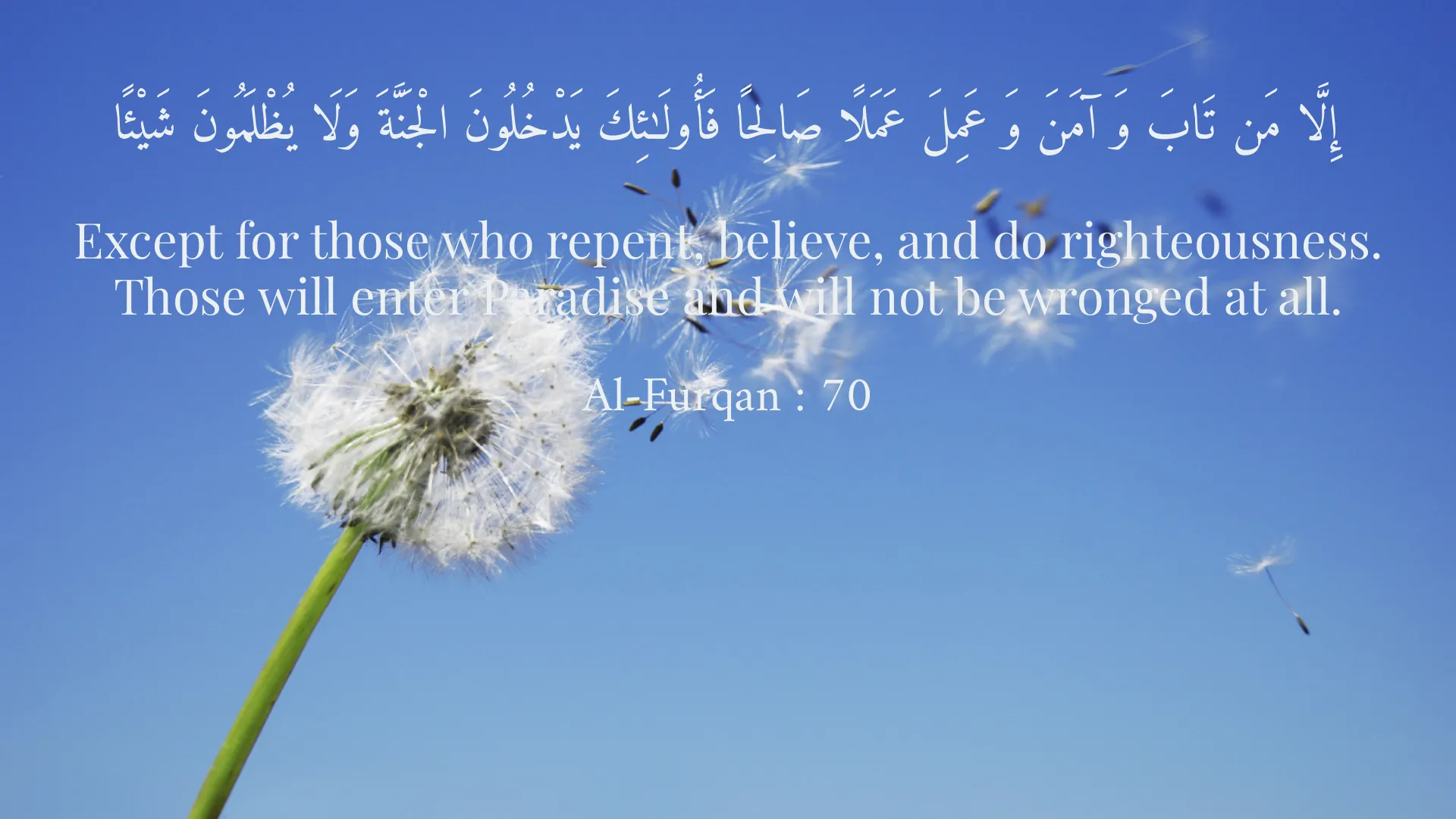
إِلَّا مَن تَابَ وَ آمَنَ وَ عَمِلَ عَمَلًا صَالِحًا فَأُولَـٰئِكَ يَدْخُلُونَ الْجَنَّةَ وَلَا يُظْلَمُونَ شَيْئًا
Except for those who repent, believe, and do righteousness. Those will enter Paradise and will not be wronged at all.
Al-Furqan : 70
قُلْ يَاعِبَادِيَ الَّذِينَ آمَنُوا اتَّقُوا رَبَّكُمْ لِلَّذِينَ أَحْسَنُوا فِي هَذِهِ الدُّنْيَا حَسَنَةٌ وَأَرْضُ اللَّهِ وَاسِعَةٌ إِنَّمَا يُوَفَّى الصَّابِرُونَ أَجْرَهُمْ بِغَيْرِ حِسَابٍ
Say, O My servants who have believed, fear your Lord. For those who do good in this world is good; and the earth of Allah is spacious. Indeed, the patient will be given their reward without account.
Az-Zumar : 53
Short Story
Once upon a time, there was a young man named Hossein who decided to change his life. He was deeply remorseful of his sins and promised himself to repent. Every day he engaged in prayers and supplications. After some time, he realized that his life had become brighter and more peaceful. Along this journey, Hossein experienced numerous positive transformations and inspired others.