Quranic Answer
The Holy Quran, which is regarded as the ultimate source of guidance for Muslims, provides profound insights into the nature of human life and the various challenges that individuals face. Among these pivotal teachings is the clear assertion that every human being will encounter tests and trials throughout their lives. These tests serve a divine purpose: to assess the strength of one's faith, the depth of patience, and the fortitude required to navigate the complexities of earthly existence. In this elaboration, we will delve deeper into the significance of tests in human life and analyze how they shape character and spiritual growth, drawing directly from the teachings of the Quran. One of the fundamental references to these tests can be found in Surah Al-Baqarah, verse 155, where Allah (SWT) explicitly states, 'And We will surely test you with something of fear and hunger and a loss of wealth and lives and fruits, but give good tidings to the patient.' This verse encapsulates the essence of human experience—fear, hunger, loss of wealth, loss of life, and the deprivation of various blessings. These trials are not arbitrary; rather, they are designed to elicit specific responses from individuals. It is in facing these challenges that a person’s true character is revealed. The Quran not only acknowledges the inevitability of these tests but also offers a sense of hope by promising 'good tidings to the patient.' This illustrates a critical aspect of Islamic belief: patience (Sabr) is a virtue that transforms suffering into a pathway to spiritual elevation. The Quran cultivates an understanding that tests are inextricably linked to one’s faith. Each trial serves to strengthen a believer's reliance on Allah and reinforces the understanding that worldly attachments are transient. The temporary nature of hardship leads to the cultivation of gratitude and the recognition of Allah’s infinite mercy. Through trials, believers learn to differentiate between the fleeting nature of worldly life and the eternal promises of the afterlife. The character-building aspect of such tests is beautifully illustrated in Surah Al-Mumtahina, verse 2, where Allah states: 'Indeed, the ones who believe in Our verses are those who, when reminded of them, fall down in prostration and exalt [Allah] with praise of their Lord, and they are not arrogant.' This verse highlights that true believers are marked by their humility and recognition of Allah’s greatness, especially during moments of provocation or distress. These verses collectively depict a comprehensive framework for understanding the purpose of tests in life as laid out in the Quran. Trials can be viewed as opportunities for individuals to grow in their faith. For instance, when faced with the loss of a loved one, believers are encouraged to seek solace in prayer and remembrance of Allah. Instead of succumbing to despair, they find strength in their faith, embracing patience and perseverance. Thus, individuals can perceive their hardships as passages toward spiritual refinement rather than insurmountable obstacles. Moreover, the Quran emphasizes that tests are not solely meant for believers but are a part of the universal human experience. Everyone, regardless of their beliefs, is subjected to life’s challenges. This universality reinforces the idea that suffering can lead to shared human experiences that foster empathy and understanding among people. Thus, while each test is unique to the individual, the collective experience of hardship unites humanity in its search for meaning and understanding. Additionally, testing can lead to greater social cohesion within communities. When believers face challenges together, they often find strength in mutual support, which can lead to stronger community bonds. This communal aspect is echoed in the Quranic injunctions that encourage believers to aid each other in times of adversity. Through acts of kindness and standing by one another during difficult times, communities embody the spirit of patience and support that the Quran advocates. On a practical level, the teachings of the Quran also guide individuals on how to respond to adversity. Believers are encouraged to maintain their prayers, engage in remembrance (Dhikr), and seek forgiveness during testing times. They are taught to understand that trials are a means of purging sins and drawing closer to Allah. Therefore, the character of a believer is shaped significantly by their response to adversity. Those who remember Allah in times of difficulty and practice patience receive divine support and guidance. In conclusion, tests and trials are an integral part of the human experience, as highlighted in the teachings of the Holy Quran. They serve to measure faith, cultivate patience, and promote spiritual growth. Through the lens of Quranic guidance, it is evident that while adversity may appear daunting, it also provides an opportunity for believers to deepen their connection to Allah and develop resilience. Ultimately, the Quran reassures us that every challenge carries the potential for growth and the promise of divine aid for those who remain steadfast. Thus, every trial faced is an invitation to rise above worldly concerns and strengthen one's faith, paving the way toward eternal salvation and fulfillment.
Related Verses
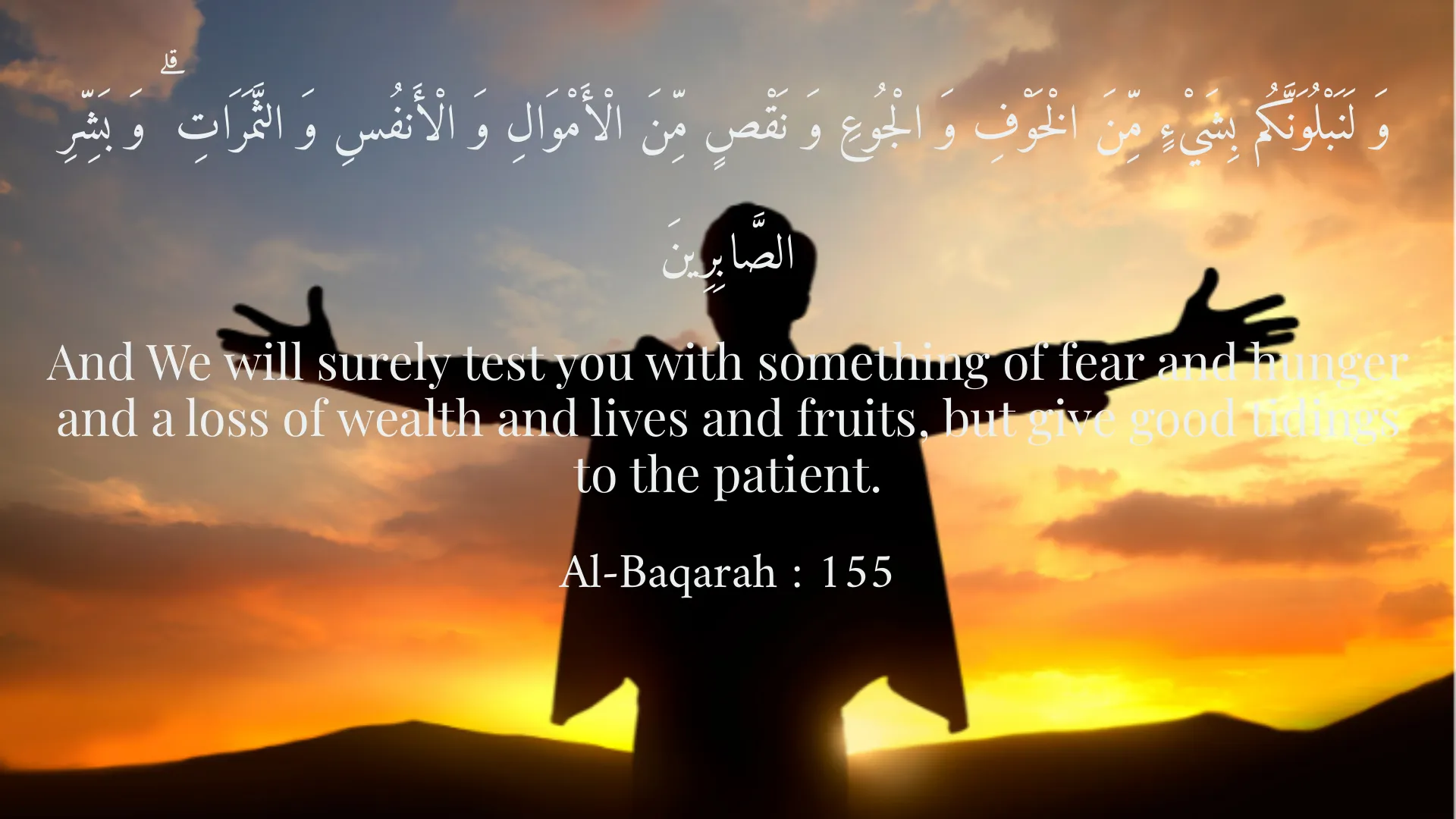
وَ لَنَبْلُوَنَّكُم بِشَيْءٍ مِّنَ الْخَوْفِ وَ الْجُوعِ وَ نَقْصٍ مِّنَ الْأَمْوَالِ وَ الْأَنفُسِ وَ الثَّمَرَاتِ ۗ وَ بَشِّرِ الصَّابِرِينَ
And We will surely test you with something of fear and hunger and a loss of wealth and lives and fruits, but give good tidings to the patient.
Al-Baqarah : 155
إِنَّمَا يُؤْمِنُ بِآيَاتِنَا الَّذِينَ إِذَا ذُكِّرُوا بِهَا خَرُّوا سُجَّدًا وَ سَبَّحُوا بِحَمْدِ رَبِّهِمْ وَ هُمْ لَا يَسْتَكْبِرُونَ
Indeed, the ones who believe in Our verses are those who, when reminded of them, fall down in prostration and exalt [Allah] with praise of their Lord, and they are not arrogant.
Al-Mumtahina : 2
Short Story
One day, a young man named Ali decided to face various challenges in his life. He encountered financial and family problems and felt that these tests were from Allah to help him grow in faith and patience. Relying on the verses of the Quran and showing resilience in the face of difficulties, Ali managed to overcome all challenges and ultimately became a successful individual.