Quranic Answer
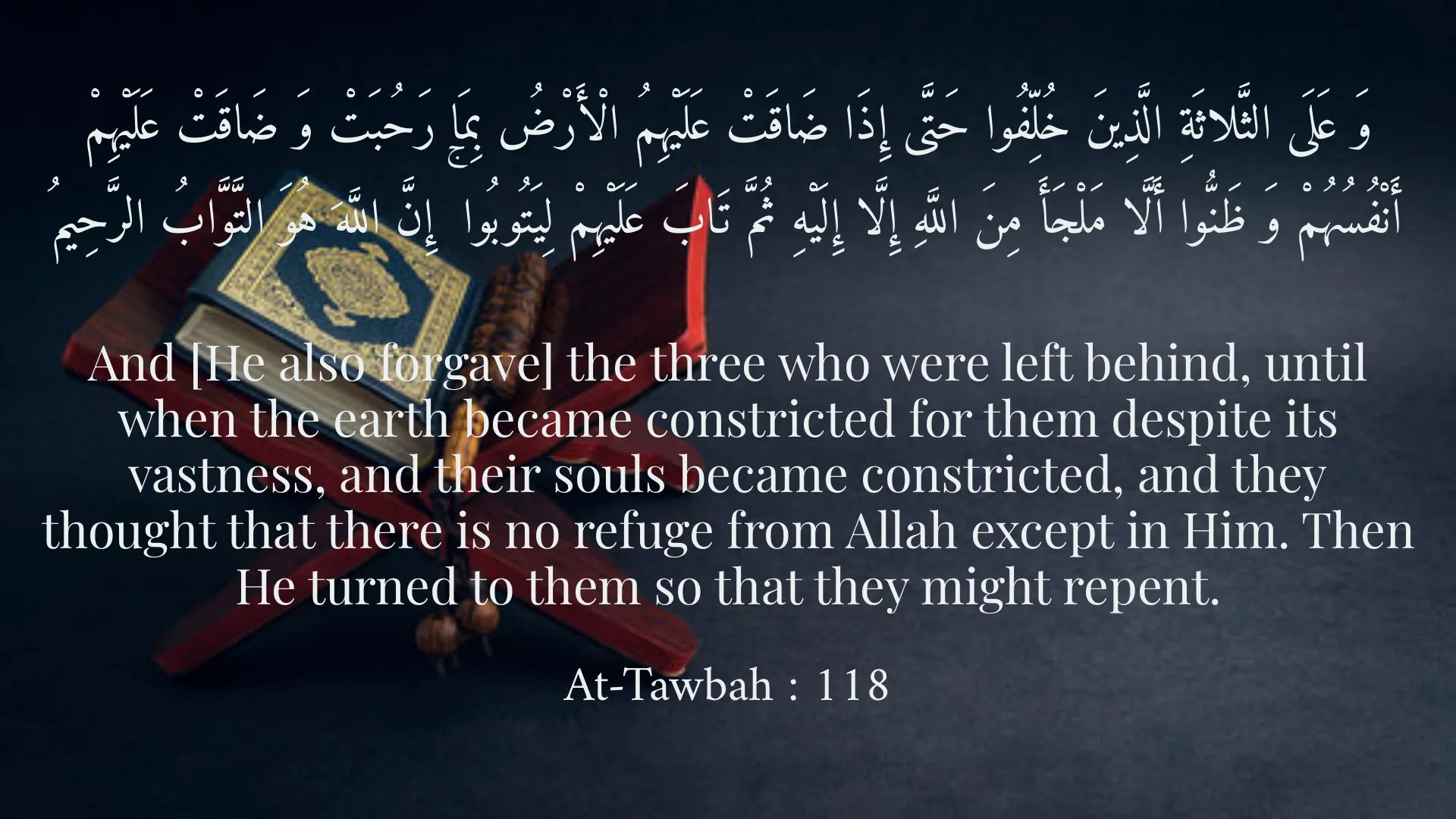
Throughout the Holy Quran, the profound love that Allah has for those who sincerely repent is articulated with striking clarity. The scripture conveys not only the attributes of Allah but also the deep emotional connection He maintains with humanity, especially with those who choose to return to Him after straying. This thematic exploration begins with the notable verses found in Surah At-Tawbah and Surah Al-Baqarah, which provide insightful reflections on the nature of repentance and divine mercy. In Surah At-Tawbah, verse 118, we are presented with a compelling narrative about three individuals who fell behind during a critical moment, experiencing a sense of desolation. The verse reads: 'And [He also forgave] the three who were left behind, until when the earth became constricted for them despite its vastness, and their souls became constricted, and they thought that there is no refuge from Allah except in Him. Then He turned to them so that they might repent.' This verse serves as a powerful reminder that Allah's mercy is accessible to those who sincerely seek forgiveness, regardless of their past transgressions. The imagery of the earth constricting, despite its vastness, symbolizes the overwhelming nature of despair and alienation that one feels when distant from the divine. However, it is precisely in this bleakness that the possibility of redemption emerges, showing that Allah waits patiently for His servants to return to Him. Furthermore, the verse highlights a crucial aspect of repentance: the individual's recognition of their helplessness and the realization that true refuge lies solely in Allah. The emotional turmoil experienced can be a catalyst for deep reflection and transformation, leading the repentant individual back to the right path. It emphasizes the merciful nature of Allah—upon realizing their missteps, God turns towards them willingly, motivating them to repent and reconcile. This theme of love for the repentant is further reinforced in Surah Al-Baqarah, verse 222, where Allah clearly states: 'Indeed, Allah loves those who repent.' This succinct yet powerful declaration conveys the immense value that God places on repentance. It distinguishes sincere repentance as not merely a corrective action but as a profound expression of love and commitment between the individual and the Creator. The act of turning toward God in humility and sincerity is rewarded with divine affection and acceptance. Repentance, in essence, transcends the act of begging for forgiveness. It symbolizes a transformative journey towards spiritual enlightenment and self-improvement. The Quran stresses that returning to Allah is not an act of shame but rather a testament to one’s desire to mend their relationship with Him. Through repentance, faith is renewed, and the bond between the servant and Allah is strengthened. Reflecting on this, it becomes evident that the Quran is imbued with lessons regarding forgiveness and mercy. Allah repeatedly demonstrates that regardless of one's past, the opportunity to turn back and heal is always available. It embodies the idea that every soul is worthy of love and compassion, encapsulating the very essence of what it means to be a believer—constantly striving for improvement and closeness to Allah. Moreover, the narratives of the prophets and the righteous individuals throughout Islamic history further illuminate this principle. Take, for instance, the life of Prophet Jonah (Yunus), who upon realizing his error while trapped in the belly of the whale, turned back to Allah in repentance. His story exemplifies hope and the promise of Allah's forgiveness even in the direst situations. Gods mercy extended to the prophets serves as a beacon of hope for all believers, emphasizing that no matter how lost one may feel, they can always seek solace in Allah’s love. It's important to elaborate on the process of repentance itself, as found in Islamic teachings. The steps of sincere repentance (Tawbah) traditionally include feeling genuine remorse for previous wrongdoings, immediately ceasing the sinful behavior, expressing a commitment to not revert to those actions, and seeking forgiveness from Allah. Some scholars even encourage the practice of making dua (supplication) for guidance and strength to uphold this commitment. This multi-faceted approach serves as a holistic framework for spiritual growth and self-awareness, emphasizing that repentance is not merely a transactional process, but a deep, introspective journey of the soul. The concept of returning to Allah and seeking forgiveness stretches beyond individual acts; it fosters a community of believers who support one another in their journeys. Engaging in acts of kindness and compassion helps reinforce the idea of collective repentance, where communities uplift each other and cultivate an environment of forgiveness and mercy. Through charitable deeds, shared knowledge, and mutual support, believers can reflect Allah's love and mercy among themselves, thereby creating a sanctified space for everyone to return and grow. In summary, the love of Allah for those who repent is not just a theme confined to verses but an overarching principle within Islamic belief that illustrates the depth of divine mercy and compassion. The Quran makes it abundantly clear that Allah welcomes those who seek forgiveness with open arms, showering them with mercy and love. The willingness of individuals to repent reflects an earnest desire for improvement and enlightenment—a pursuit that Allah deeply cherishes. From the verses mentioned, it is evident that Allah leaves the doors of forgiveness wide open, reassuring His servants that they are never beyond redemption. As believers navigate life's challenges, these teachings provide a source of comfort and hope, reminding them that true salvation lies in the bosom of divine mercy.
Related Verses
وَ عَلَى الثَّلاثَةِ الَّذِينَ خُلِّفُوا حَتَّى إِذَا ضَاقَتْ عَلَيْهِمُ الْأَرْضُ بِمَا رَحُبَتْ وَ ضَاقَتْ عَلَيْهِمْ أَنْفُسُهُمْ وَ ظَنُّوا أَلَّا مَلْجَأَ مِنَ اللَّهِ إِلَّا إِلَيْهِ ثُمَّ تَابَ عَلَيْهِمْ لِيَتُوبُوا ۚ إِنَّ اللَّهَ هُوَ التَّوَّابُ الرَّحِيمُ
And [He also forgave] the three who were left behind, until when the earth became constricted for them despite its vastness, and their souls became constricted, and they thought that there is no refuge from Allah except in Him. Then He turned to them so that they might repent.
At-Tawbah : 118
إنَّمَا التَّوْبَةُ عَلَى اللَّهِ لِلَّذِينَ يَعْمَلُونَ السَّيِّئَاتِ بِجَهَالَةٍ ثُمَّ يَتُوبُونَ مِن قَرِيبٍ ۗ أُولَـٰئِكَ يَتُوبُ اللَّهُ عَلَيْهِمْ ۗ وَكَانَ اللَّهُ عَلِيمًا حَكِيمًا
The repentance is not for those who continue to do evil until death approaches one of them and then he says, 'Indeed, I have repented now.' Nor for those who die while they are disbelievers. Those are the ones for whom We have prepared a painful punishment.
Al-Baqarah : 222
Short Story
Once upon a time, there was a man named Hasan who always sinned in his life. However, one day, upon hearing the verses of the Quran, he realized that repentance was the way to salvation. He decided to return to Allah and seek forgiveness for his sins. The next morning, he felt peace in his heart and realized that Allah welcomed him with love and mercy, and from that day on, his life changed.