Quranic Answer
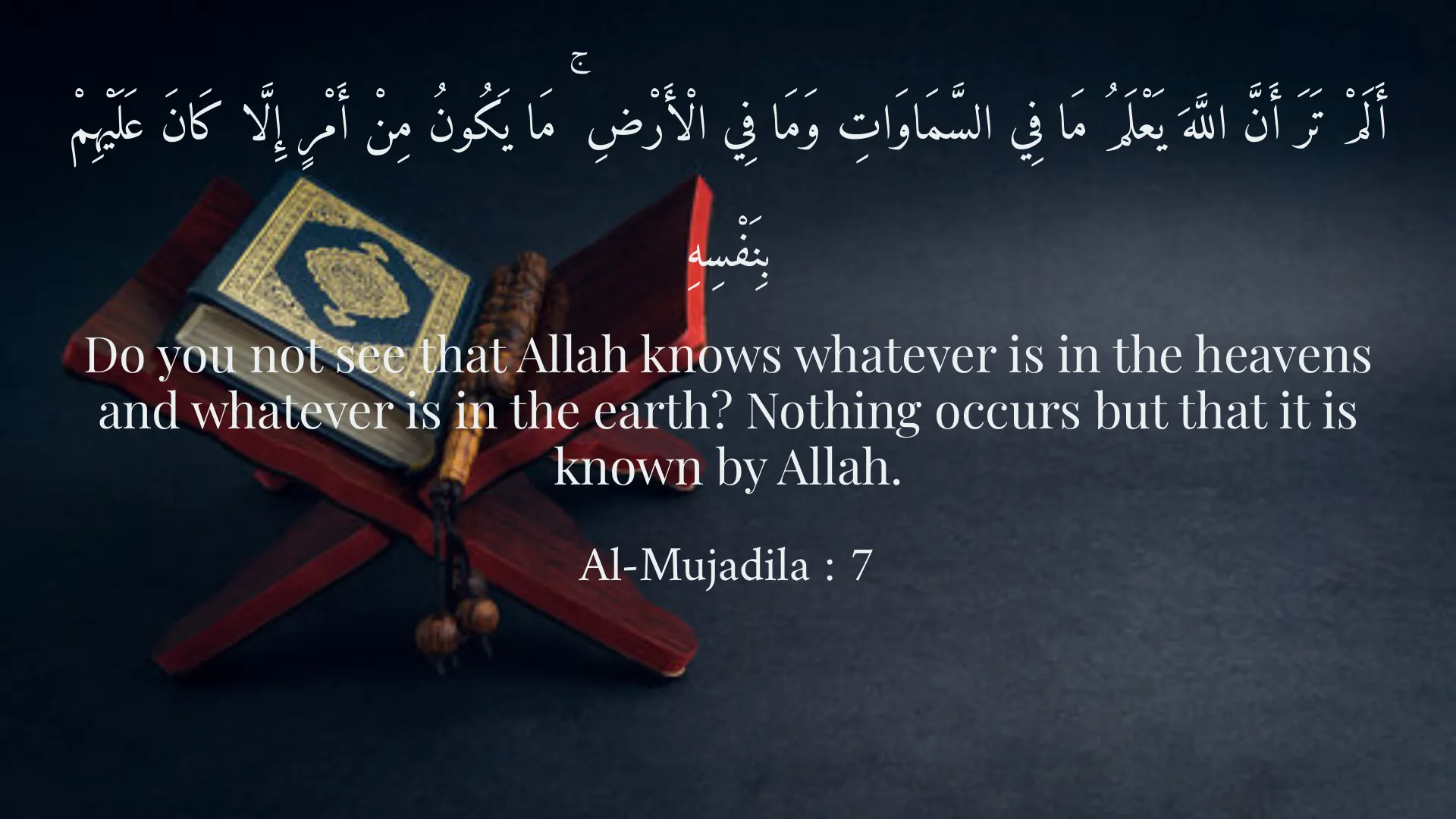
The concept of divine knowledge in Islam is one of the most profound and pivotal tenets that permeates throughout the Holy Quran. Allah, in His infinite wisdom, consistently underscores His omniscience—His complete and unlimited knowledge of everything within existence. This characteristic of Allah serves not only to affirm His divinity but also to remind humanity of their moral responsibilities and the inherent accountability that comes with free will. The emphasis on Allah's awareness and understanding is evident in several verses, which continually reiterate that nothing escapes His sight, neither the vastness of the heavens nor the intricate details of earthly life. In Surah Al-Mujadila, verse 7, the Quran states: "Do you not see that Allah knows whatever is in the heavens and whatever is in the earth? Nothing occurs but that it is known by Allah." This verse signifies the totality of Allah's knowledge—nothing is too minor or too grand for His comprehension and observation. Every single aspect of creation, including thoughts, feelings, actions, and intentions, is meticulously known by Allah. This acknowledgment is significant because it places Allah not just as a distant observer but as an intimate participant in our lives, one who understands us on a level far deeper than we might comprehend ourselves. Further illustrating this theme, Surah Qaf, verse 16, articulates: "And We have certainly created man and We know what his soul whispers to him." This indicates that Allah is not simply aware of our deeds but is also privy to our innermost motivations and desires. The recognition that God knows our thoughts and inclinations can foster a profound sense of humility and reflection. As individuals, we are often led by our desires and urges, yet knowing that someone is eternally aware can instill a sense of caution and deliberation in our actions. The Quran describes Allah as the 'Watcher' of both this world and the Hereafter, instilling a consciousness of our accountability in both realms. The divine watchfulness encourages believers to conduct themselves with sincerity and integrity, prompting a moral compass that aligns with righteous behavior. When one is conscious of a watchful presence, the inherent inclination may be to adhere to a path of virtue, even in instances where moral dilemmas may arise. Thus, the awareness of God's omniscient gaze acts as a guiding light towards ethical conduct. In a practical sense, the concept of divine knowledge can have an interesting effect on a believer’s psyche and ethical behavior. The idea that our actions and intentions are not hidden from Allah can serve as a restraint against wrongdoing and a beacon for corrective action. This intrinsic motivation may lead to increased acts of worship, charity, and help toward others, knowing that each small deed is acknowledged and valued by the Almighty. It creates a societal fabric where individuals strive to uplift one another and display the best of their character since they realize that their actions resonate beyond the immediate sphere. Additionally, the impact of the acknowledgment of Allah's knowledge extends beyond individual practice. It transforms communal interactions and relationships among believers. When a community embodies this awareness, it cultivates an environment steeped in righteousness, honesty, and mutual respect. In essence, the collective acknowledgment that God observes all actions can work towards building societies founded on justice, compassion, and moral uprightness. Moreover, believing in Allah's comprehensive knowledge fosters resilience among believers. Life is replete with challenges, and human beings often find themselves in perplexing situations where the right course is unclear. The assurance that Allah understands our struggles and the intentions behind our actions can provide comfort and positive reinforcement. It alleviates the burden of doubt and anxiety, fostering a steadfast faith that God’s plan encompasses the seen and unseen. In navigating the complexities of life, this divine oversight can guide the journey of self-improvement. It encourages believers to strive for excellence and moral integrity. Instead of seeking approval solely from societal standards, individuals focused on God’s knowledge may pursue genuine virtues. Possessing the awareness that one is always under Allah’s watchful eyes can facilitate a form of personal accountability that inspires positive change. Furthermore, this concept extends to the realm of teaching and guidance. By educating individuals on the existence of Allah’s comprehensive knowledge, community leaders and scholars can cultivate awareness in future generations. This moral education could help instill values that reject dishonesty, selfishness, and harm toward others, nurturing a society that honors integrity and generosity. As believers reflect on Allah's attributes, it becomes clear that the focus on divine knowledge is not merely theological but practical. It inspires an alignment of intentions with actions, prompting individuals to undertake righteous deeds. The realization that our actions are continuously witnessed cultivates an environment that encourages ethical behavior and deepens spiritual connections. In conclusion, the emphasis on Allah’s knowledge and awareness in the Quran serves a multifaceted role in the lives of believers. It establishes a profound sense of responsibility, reshapes societal constructs, and nurtures individual moral growth. The omniscient nature of Allah, as portrayed in Surah Al-Mujadila and Surah Qaf, underscores an essential principle that acts as both a reminder of divine oversight and a catalyst for righteous action among humanity. Hence, this invitation towards maintaining ethical behavior resonates profoundly, encouraging each individual to strive for a life steeped in consciousness of Allah’s presence and a commitment to virtue.
Related Verses
أَلَمْ تَرَ أَنَّ اللَّهَ يَعْلَمُ مَا فِي السَّمَاوَاتِ وَمَا فِي الْأَرْضِ ۚ مَا يَكُونُ مِنْ أَمْرٍ إِلَّا كَانَ عَلَيْهِمْ بِنَفْسِهِ
Do you not see that Allah knows whatever is in the heavens and whatever is in the earth? Nothing occurs but that it is known by Allah.
Al-Mujadila : 7
وَلَقَدْ خَلَقْنَا الْإِنْسَانَ وَنَعْلَمُ مَا تُوَسْوِسُ بِهِ نَفْسُهُ
And We have certainly created man and We know what his soul whispers to him.
Qaf : 16
Short Story
One day, a man felt lonely and wondered if anyone understood him. He recalled the Quranic verses highlighting God’s knowledge and awareness of us. In this moment of serenity, he decided to dedicate more time to connect with God and keep Him in mind in everything he did. From then on, whenever he sought advice, he turned to God and felt he was never alone.