Quranic Answer
In the life-giving school of Islam, and based on the luminous verses of the Holy Quran, the answer to the question of whether God forgives our past mistakes is unequivocally and entirely affirmative. God, known by the beautiful names of 'Al-Ghafoor' (The All-Forgiving), 'Al-Ghaffar' (The Repeatedly Forgiving), 'Ar-Rahim' (The Most Merciful), and 'At-Tawwab' (The Accepter of Repentance), is inherently forgiving and merciful, and His mercy precedes everything. This is one of the greatest tidings and sources of hope for human beings who feel regret and shame due to their past errors and sins. The Holy Quran explicitly and in a gentle tone declares the door of repentance and return to be always open. Perhaps the most hopeful verse in this regard is Surah Az-Zumar, verse 53, where Allah Almighty says: "Say, 'O My servants who have transgressed against themselves [by sinning], do not despair of the mercy of Allah. Indeed, Allah forgives all sins. Indeed, it is He who is the Forgiving, the Merciful.'" This verse clearly indicates that sin, no matter how great, is forgivable as long as the individual repents from it and turns back to God. Even sins that lead one to the brink of despair will be covered by the vast divine mercy. The word 'jamee'an' (all) in this verse emphasizes the comprehensiveness and universality of divine forgiveness. However, this divine forgiveness comes with conditions, which are manifested in the concept of 'Tawbah' (repentance). Tawbah is not merely uttering 'Astaghfirullah' (I seek forgiveness from Allah); rather, it is a heartfelt transformation and a firm resolve to rectify the past and refrain from returning to sin. The pillars of true repentance include: firstly, genuine regret for the sin committed; secondly, immediate cessation of that sin and severing ties with it; thirdly, a serious determination not to repeat the sin in the future; and fourthly, making amends for 'Huquq al-Nas' (rights of people) if the sin involved injustice to another person. For instance, if someone's property was usurped, it must be returned or forgiveness sought. If backbiting occurred, forgiveness must be sought, or if that's not possible, prayers for forgiveness should be made for the person who was backbitten. Allah forgives His own rights through sincere repentance, but He does not forgive the rights of people unless those people forgive or restitution is made. Another verse emphasizing the acceptance of repentance is Surah An-Nisa, verse 17: "The repentance accepted by Allah is only for those who do wrong in ignorance [or carelessness] and then repent soon after. It is those to whom Allah will turn in forgiveness, and Allah is ever Knowing and Wise." This verse emphasizes the importance of repenting 'min qareeb' (soon after the sin) or before the arrival of death. However, this does not mean that a later repentance is not accepted; rather, it indicates that the sooner we return to God, the better, as Satan gets less opportunity to tempt. God even forgives very grave sins like disbelief (kufr) and polytheism (shirk), if there is sincere repentance before death. Surah An-Nisa, verse 48 states: "Indeed, Allah does not forgive association with Him, but He forgives what is less than that for whom He wills. And he who associates others with Allah has certainly fabricated a tremendous sin." At first glance, this verse might seem contradictory to Surah Az-Zumar 39:53, but exegetes reconcile these two verses by explaining that shirk is unforgivable only if a person dies upon it without repentance. However, if one sincerely repents from shirk before death, even this enormous sin is forgivable. This demonstrates the ultimate extent of Allah's mercy and the vastness of the ocean of divine forgiveness. The philosophy behind this boundless forgiveness is to establish a friendly and parental relationship between God and His servants. God does not want His servants to drown in despair; rather, He wants them to always see the path of return and rectification open before them. This characteristic motivates individuals, after committing a sin, to rectify their past and build a better future through repentance and good deeds, instead of sinking into the swamp of despair. This continuous opportunity for return bestows a sense of worth and dignity upon the individual and saves them from spiritual collapse. Therefore, for every human being who has made a mistake and feels regret, the doors of divine mercy are always open. It is enough to return to Him with a broken heart and a firm resolve. The forgiveness of past sins not only lightens a person's spiritual burden but also grants them deep psychological and spiritual peace, preparing them for a fresh start and a life full of goodness and blessings. This divine promise is the backbone of hope in a faithful life and assures humanity that they will never be outside the vast circle of divine mercy, unless they deliberately and arrogantly turn their backs on this mercy.
Related Verses
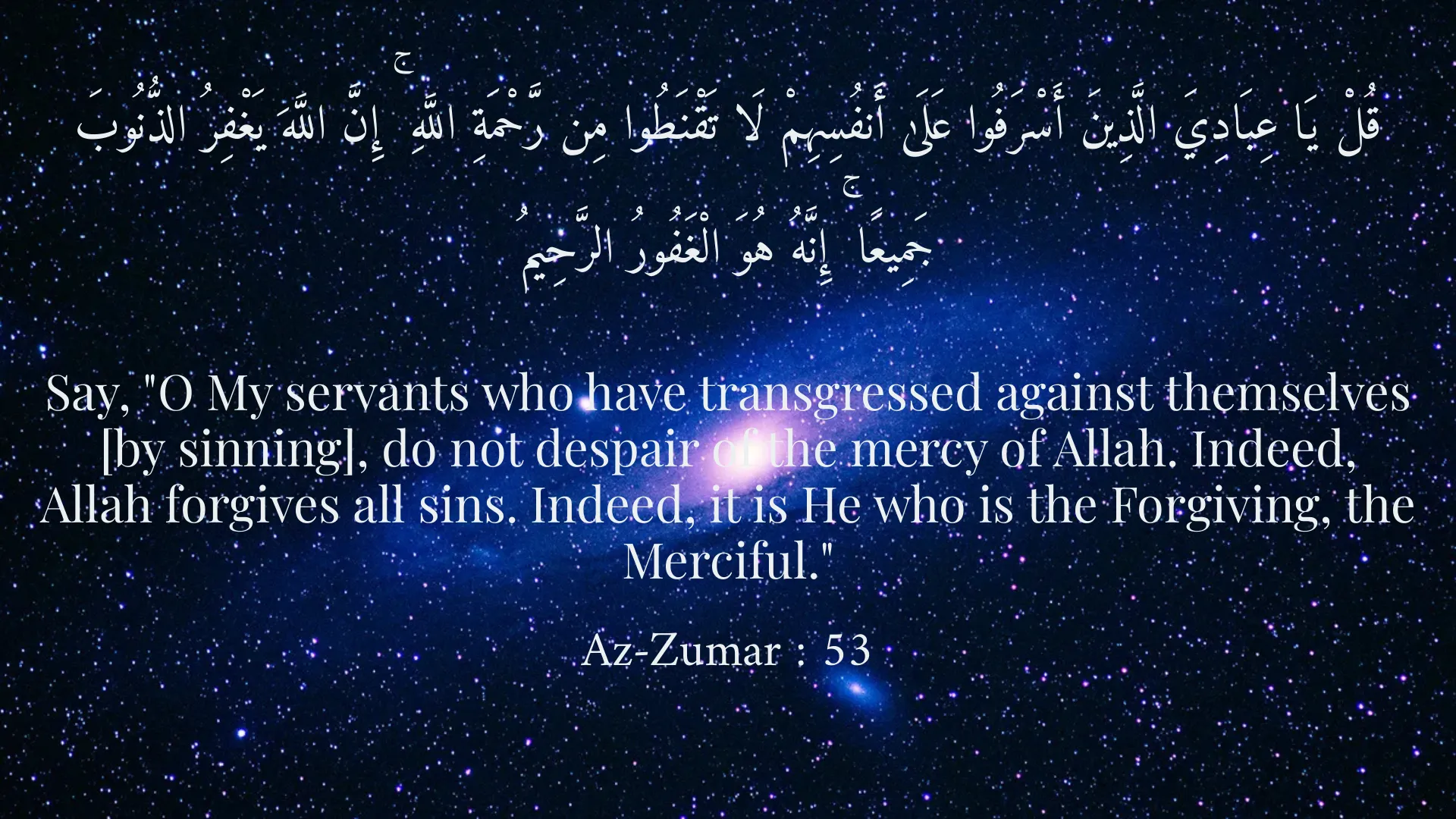
قُلْ يَا عِبَادِيَ الَّذِينَ أَسْرَفُوا عَلَىٰ أَنفُسِهِمْ لَا تَقْنَطُوا مِن رَّحْمَةِ اللَّهِ ۚ إِنَّ اللَّهَ يَغْفِرُ الذُّنُوبَ جَمِيعًا ۚ إِنَّهُ هُوَ الْغَفُورُ الرَّحِيمُ
Say, "O My servants who have transgressed against themselves [by sinning], do not despair of the mercy of Allah. Indeed, Allah forgives all sins. Indeed, it is He who is the Forgiving, the Merciful."
Az-Zumar : 53
إِنَّمَا التَّوْبَةُ عَلَى اللَّهِ لِلَّذِينَ يَعْمَلُونَ السُّوءَ بِجَهَالَةٍ ثُمَّ يَتُوبُونَ مِن قَرِيبٍ فَأُولَٰئِكَ يَتُوبُ اللَّهُ عَلَيْهِمْ ۗ وَكَانَ اللَّهُ عَلِيمًا حَكِيمًا
The repentance accepted by Allah is only for those who do wrong in ignorance [or carelessness] and then repent soon after. It is those to whom Allah will turn in forgiveness, and Allah is ever Knowing and Wise.
An-Nisa : 17
وَاسْتَغْفِرُوا رَبَّكُمْ ثُمَّ تُوبُوا إِلَيْهِ ۚ إِنَّ رَبِّي رَحِيمٌ وَدُودٌ
And ask forgiveness of your Lord and then repent to Him. Indeed, my Lord is Merciful and Loving.
Hud : 90
Short Story
In ancient times, there was a king who, due to his misdeeds and numerous oppressions, had alienated his people. He would sleep with a disturbed conscience at night and suffer from loneliness and fear during the day. One night, he dreamt of a sea of fire engulfing him. He awoke in terror and sought out a wise sage renowned for his piety and closeness to God. With tearful eyes, the king confessed his countless sins and mistakes to the sage, deeply fearing divine retribution. The sage gently took his hand and said, "O King! Despair itself is a greater sin. God is too magnificent for His servant's sin to make him despair of His mercy. The door of repentance is always open, and His ocean of forgiveness is boundless." The king found a ray of hope in the sage's words and, with a broken heart and firm resolve, turned to the Divine. From that day forward, he abandoned injustice, treated his people with kindness, and dedicated all his efforts to rectifying his past mistakes. The people were astonished by this transformation, and he lived out his remaining days in justice and benevolence. Thus, even the darkest past was illuminated by the light of repentance and divine mercy.