Quranic Answer
The Holy Quran is a timeless guide for humanity, advocating for hope, light, and resilience in the face of adversity. It serves as a reminder that despair and hopelessness are not options for those who believe in the mercy and power of Allah. This profound message is encapsulated in various verses, each emphasizing the importance of maintaining hope and striving for goodness in all circumstances. In Surah Az-Zumar, verse 53, Allah commands believers to address their fears and anxieties by recognizing His mercy: 'Say, O My servants who have believed, fear your Lord. For those who do good in this world is good, and the earth of Allah is spacious. Indeed, the patient will be given their reward without account.' This verse is a powerful invitation for believers to never seek refuge in despair because the realm of Allah’s mercy is expansive, allowing room for every individual to turn back and seek His forgiveness. The message clearly articulates that the path of righteousness will not go unnoticed; the faithful are assured of their rewards, thus creating a cycle of hope that encourages individuals to strive continuously for goodness. Despairing in the mercy of Allah is considered a grave error, as it reflects a lack of trust in His boundless ability to forgive and uplift His creation. In the Quran, believers are repeatedly urged not to lose hope, as doing so channels negativity and demotivation. Instead, the Quran fosters a mindset grounded in optimism, suggesting that every trial offers a lesson and that Allah’s mercy transcends our finite understanding. Surah Al-Baqarah, verse 286, further reinforces this idea by stating: 'Allah does not burden a soul beyond that it can bear.' This verse is a powerful message that acknowledges individual struggles and reinforces the belief that each person has the strength to overcome life’s challenges. It encourages believers to view their trials through the lens of faith, fostering patience and resilience. No one is subjected to hardship without the capacity to endure; this prescribed strength serves as a foundation upon which one can cultivate hope, believing that every challenge is a stepping stone rather than an insurmountable wall. Furthermore, the Quran emphasizes the exclusivity of worship directed towards Allah, as detailed in Surah Al-Mu’minun, verse 74: 'And your Lord has decreed that you not worship except Him.' This directive not only establishes the stream of divine consciousness but also serves to ground believers in the realization that all hope must come from Allah alone. Turning to Him in moments of distress and uncertainty is emphasized, invoking reliance on His mercy and guidance. Reassurance is paramount in the face of despair, and Allah’s words are a balm for troubled hearts. It is crafted in His divine wisdom that believers are called to remind themselves frequently of His presence and mercy, fortifying their resolve to maintain hope. Constant remembrance of Allah and seeking His aid cultivates a spiritual milieu that empowers individuals. Allah is depicted as a source of comfort and alleviation from burdens, and thus the direction is clear: do not look away from Him. Moreover, in Surah Al-Imran, verse 12, Allah reiterates the call to His servants to ‘Fear your Lord.’ This is not merely a warning but a compassionate reminder that faith is interconnected with trust. Those who believe in Allah's mercy should never lose sight of it. In moments where despair might loom large, those who are grounded in faith understand that maintaining hope is an act of worship in itself. They recognize that each moment steeped in despair is a moment away from the light Allah offers, and thus they strive to turn back to that light with fervor. The Quran as a whole emphasizes that the concept of hope is not merely a feeling but an action that requires the involvement of both heart and mind. Believers are called to engage in good deeds and constant reflection and remembrance of Allah's generosity. This duality of action and hope creates a framework within the faith which allows positive energy to flourish and despair to dissipate. In conclusion, the teachings of the Holy Quran are incredibly relevant and necessary in today's world, as despair and hopelessness plague many souls. The messages found in the verses serve as enduring reminders to always be vigilant in maintaining hope and striving towards goodness. They remind us that life’s trials are not indications of despair but opportunities for growth and reflection. The promise that Allah’s mercy is always within reach sustains believers through their darkest moments and inspires them to arise, equipped with strength and resilience. In every challenge faced in life, those who have faith in Allah’s mercy can find solace and empowerment in hope, transforming despair into an opportunity for spiritual elevation. Consequently, the faithful stand united against despair, illuminated by prayer, good deeds, and the indelible promise of Allah’s mercy.
Related Verses
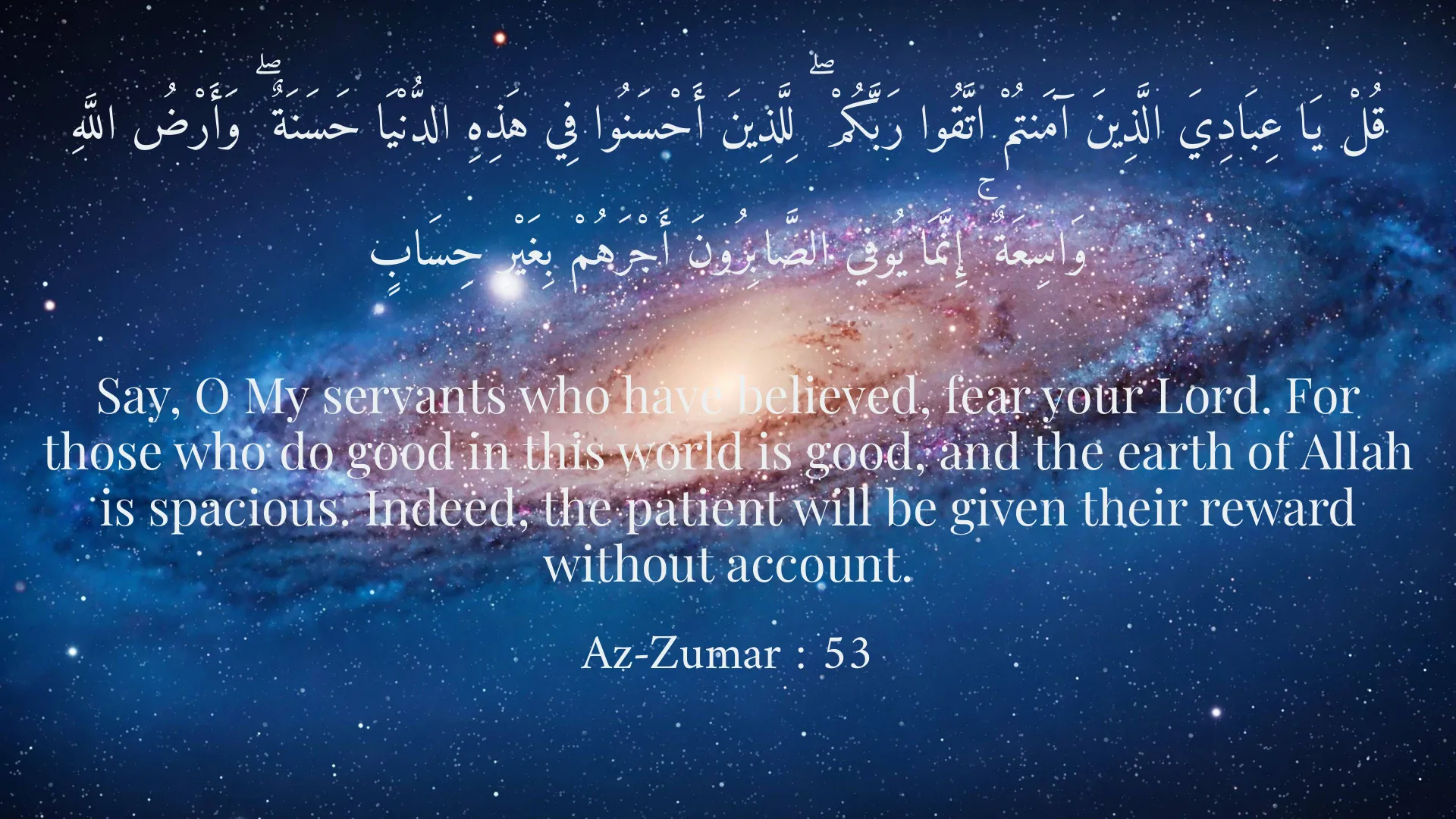
قُلْ يَا عِبَادِيَ الَّذِينَ آمَنتُمْ اتَّقُوا رَبَّكُمْ ۖ لِلَّذِينَ أَحْسَنُوا فِي هَذِهِ الدُّنْيَا حَسَنَةٌ ۖ وَأَرْضُ اللَّهِ وَاسِعَةٌ ۚ إِنَّمَا يُوفي الصَّابِرُونَ أَجْرَهُمْ بِغَيْرِ حِسَابٍ
Say, O My servants who have believed, fear your Lord. For those who do good in this world is good, and the earth of Allah is spacious. Indeed, the patient will be given their reward without account.
Az-Zumar : 53
لَا يُكَلِّفُ اللَّهُ نَفْسًا إِلَّا وُسْعَهَا ۚ لَهَا مَا كَسَبَتْ وَعَلَيْهَا مَا اكْتَسَبَتْ ۗ رَبَّنَا لَا تُؤَاخِذْنَا إِن نَّسِينَا أَوْ أَخْطَأْنَا ۚ رَبَّنَا وَلَا تَحْمِلْ عَلَيْنَا إِصْرًۭا كَمَا حَمَلْتَهُ عَلَى الَّذِينَ مِن قَبْلِنَا ۚ رَبَّنَا وَلَا تُحَمِّلْنَا مَا لَا طَاقَةَ لَنَا بِهِۦ ۖ وَاعْفُ عَنَّا وَاغْفِرْ لَنَا وَارْحَمْنَا ۚ أَنتَ مَوْلَانَا فَانصُرْنَا عَلَى الْقَوْمِ الْكَافِرِينَ
Allah does not burden a soul beyond that it can bear. For it is what [good] it has gained, and against it is what [evil] it has earned. Our Lord, do not impose blame upon us if we have forgotten or made a mistake. Our Lord, lay not upon us a burden like that which You laid upon those before us. Our Lord, and burden us not with that which we have no ability to bear. And pardon us; and forgive us; and have mercy upon us. You are our protector, so give us victory over the disbelieving people.
Al-Baqarah : 286
قُلْ يَا عِبَادِيَ الَّذِينَ آمَنُوا اتَّقُوا رَبَّكُمْ ۖ لِلَّذِينَ أَحْسَنُوا فِي هَذِهِ الدُّنْيَا حَسَنَةٌ وَأَرْضُ اللَّهِ وَاسِعَةٌ ۚ إِنَّمَا يُوفي الصَّابِرُونَ أَجْرَهُمْ بِغَيْرِ حِسَابٍ
Say, O My servants who have believed! Fear your Lord.
Al-Imran : 12
Short Story
One day, Jesus was a preacher in a town where people had become hopeless due to their failures. He always told them, 'Despair is your worst enemy.' One day he met a young man named Hasan who spoke of his repeated failures. Jesus comforted him with a smile and recited verses from the Quran. Listening to the verses, Hasan realized that he should never despair of God's mercy. After that, he began to restart his life with renewed hope.