Quranic Answer
The Holy Quran serves as a fundamental source of guidance for Muslims around the world, providing not only spiritual teachings but also practical directives for leading a righteous life. Among the multitude of topics addressed within its verses, the subject of lawful sustenance holds a prominent position. The Quran underscores the significance of lawful provisions for believers, delineating ethical boundaries and guidelines that one must observe in their quest for sustenance. In essence, the type of sustenance one relies on is seen as directly connected to their spiritual wellbeing and standing in the eyes of Allah. One of the pivotal passages on this topic is found in Surah Al-Ma'idah, verse 88, where Allah instructs the believers categorical to consume only pure and lawful provisions. This directive is not just about dietary restrictions; it also encompasses all aspects of one’s earning and sustenance. By doing so, believers are promised mercy and blessings, reinforcing the idea that a person's livelihood should be obtained through ethical means. The Quran makes it abundantly clear that striving for lawful earnings is not just a commendable act, it is an obligation that bears significant consequences for one’s faith and relationship with the divine. Moreover, the rejection of unlawful sustenance is deemed a necessary action for every believer. This insistence on lawful sustenance not only serves to safeguard individual piety, but it also fosters a broader ethical posture within society. In Surah Al-Baqarah, verse 173, Allah reminds believers that even in times of necessity, they must steer clear of what is unlawful. This reminder is essential for adhering to Islamic ethical principles, highlighting the commitment Muslims have to integrity and morality, even in difficult circumstances. It signals that the pursuit of lawful sustenance is not merely a matter of choice but a fundamental responsibility that reflects one’s faith. The importance of ethical earning is further emphasized in Surah Al-An'am, verse 151, where Allah clearly states that nothing is lawful except what has been prescribed by Him. This clause serves to underline the strict demarcation between lawful (halal) and unlawful (haram) means of earning. Such instructions encapsulate the broader ethical framework that governs a Muslim's life, illustrating the interconnectedness of faith and everyday actions. Every aspect of one’s livelihood and business dealings must adhere to these divine directives to ensure spiritual integrity and community harmony. Earning lawful sustenance involves specific characteristics that operate within the Islamic parameter. For instance, honesty and transparency in business practices are not merely recommended but mandated. The Quran calls upon believers to uphold justice and fairness in all transactions, prohibiting any form of deception or exploitation. This dedication to ethical conduct strengthens communal trust and fosters an environment where individuals can thrive without infringing upon the rights of others. Additionally, seeking wealth through halal means is intrinsically linked to the principle of sharing and caring for the less fortunate. A central tenet of Islam is the importance of charity and helping those in need. The act of earning lawful sustenance should therefore not only focus on individual gain but also encompass broader social responsibility. The Quran calls upon believers to give zakat (obligatory charity) and engage in acts of kindness, ensuring that their earnings contribute positively to their communities. In doing so, believers enhance their social standing as active participants in uplifting society, thereby reinforcing the weightiness of their lawful sustenance. The ramifications of disregarding the laws of lawful sustenance are severe. Indulging in haram earnings not only tarnishes one’s faith but also distorts societal structures. The Quran elucidates that unethical practices can lead to widespread corruption, injustice, and social strife, undermining the very fabric of an Islamic community. Therefore, the emphasis on lawful sustenance serves as a safeguard against societal decay, promoting a harmonious coexistence that benefits everyone involved. In conclusion, the Quran's focus on lawful sustenance transcends mere consumption guidelines; it establishes a framework for living that is deeply intertwined with ethical conduct, community responsibility, and spiritual integrity. The repeated calls to seek only from pure sources serve as a reminder to believers that their actions, both in what they consume and in how they earn, are reflections of their faith and reliance on divine mercy. Muslims are, therefore, not only encouraged but compelled to pursue a life that is rich in wholesome and lawful provisions, ensuring that their spiritual and ethical foundations remain intact. In a world where ethical boundaries are often blurred, the Quran's guidance on lawful sustenance offers a clear path toward righteousness and social harmony, ultimately leading to a more just and equitable society for all.
Related Verses
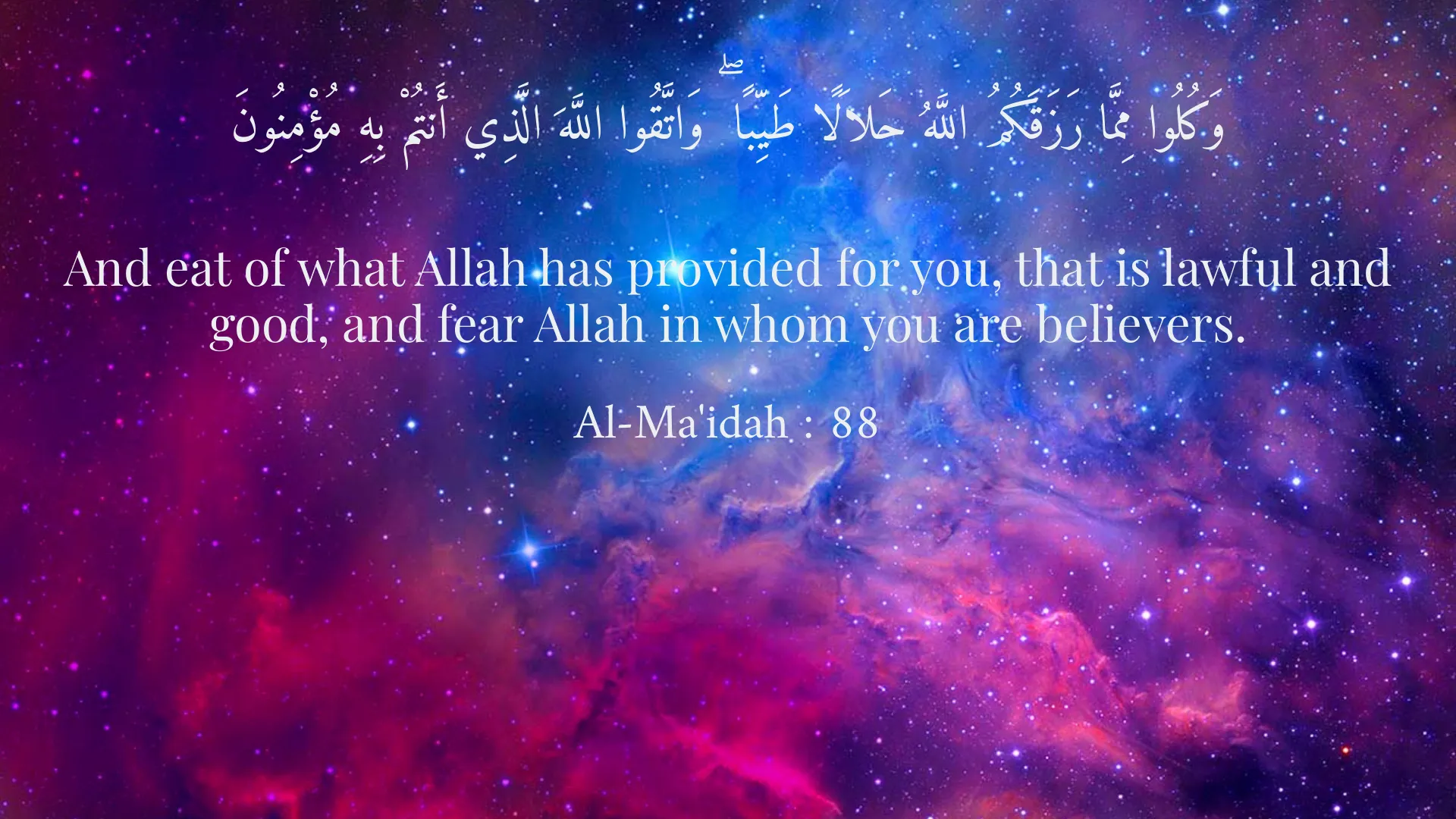
وَكُلُوا مِمَّا رَزَقَكُمُ اللَّهُ حَلاَلًا طَيِّبًا ۖ وَاتَّقُوا اللَّهَ الَّذِي أَنتُمْ بِهِ مُؤْمِنُونَ
And eat of what Allah has provided for you, that is lawful and good, and fear Allah in whom you are believers.
Al-Ma'idah : 88
إِنَّمَا حَرَّمَ عَلَيْكُمُ الْمَيْتَةُ وَالْدَّمُ وَلَحْمُ الْخِنزِيرِ وَمَا أُهِلَّ بِهِ لِغَيْرِ اللَّهِ ۖ فَمَنِ اضْطُرَّ غَيْرَ مُتَجَانِفٍ لِإِثْمٍ فَإِنَّ اللَّهَ غَفُورٌ رَّحِيمٌ
Indeed, He has only forbidden to you dead animals, blood, the flesh of swine, and that which has been dedicated to other than Allah. But whoever is forced by necessity, neither desiring [it] nor transgressing [its limit] - there is no sin upon him. Indeed, Allah is Forgiving and Merciful.
Al-Baqarah : 173
قُلْ تَعَالَوْا أَتْلُ عَلَيْكُمْ مَا حَرَّمَ رَبُّكُمْ عَلَيْكُمْ أَلَّا تُشْرِكُوا بِهِ شَيْئًا وَبِالْوَالِدَيْنِ إِحْسَانًا ۚ وَلَا تَقْتُلُوا أَبْنَائَكُمْ مِنْ إِمْلاَقٍ ۚ نَحْنُ نَرْزُقُهُمْ وَإِيَّاكُمْ ۚ وَلَا تَقْرَبُوا الْفَوَاحِشَ مَا ظَهَرَ مِنْهَا وَمَا بَطَنَ ۚ وَلَا تَقْتُلُوا النَّفْسَ الَّتِي حَرَّمَ اللَّهُ إِلَّا بِالْحَقِّ ۚ ذَٰلِكُمْ وَصَّاكُمْ بِهِ لَعَلَّكُمْ تَعْقِلُونَ
Say, 'Come, I will recite to you what your Lord has prohibited to you - that you not associate anything with Him, and to parents, good treatment. And do not kill your children out of poverty; We provide for them and for you. And do not approach immoralities, what is apparent of them and what is concealed. And do not kill the soul which Allah has forbidden, except by right. This has been instructed to you that perhaps you will use reason.'
Al-An'am : 151
Short Story
One day, a man went to a spice shop and asked the shopkeeper to provide him with the best spices. The shopkeeper replied, 'These spices are all lawful and pure, but have you checked that everything you did before buying was right and lawful?' The man hesitated for a moment and then responded, 'Yes, I believe it’s lawful!' The shopkeeper smiled and said, 'If you want to enjoy the taste and aroma of these spices, you must ensure they came to you through lawful means!' The man left the shop with a reminder of God and faith in lawful principles.