Quranic Answer
Hope for God's Mercy in the Holy Quran The concept of hope is a beacon that illuminates the path of believers in the quest for spiritual fulfillment and divine grace. Within the pages of the Holy Quran, the theme of hope for God's mercy emerges as a fundamental and recurrent motif, offering solace and inspiration to the hearts of countless individuals. The Quranic verses articulate a profound understanding of the relationship between faith, righteous deeds, and the boundless mercy of Allah, inviting believers to embrace optimism and seek forgiveness. One of the exemplary verses that emphasize this indispensable concept can be found in Surah Az-Zumar, where Allah states: 'Say, 'O My servants who have believed, fear your Lord. For those who do good in this world is good, and the earth of Allah is spacious. Indeed, the patient will be given their reward without account.' (Verse 10). This verse not only highlights the significance of piety and good conduct but also reinforces the idea that Allah's mercy knows no bounds. The reassurance that 'the patient will be given their reward without account' serves as a reminder to believers that perseverance in faith and righteous action is met with divine generosity. The message encapsulated within this verse challenges the common tendency to succumb to despair during life's trials and tribulations. Instead, it invites believers to cultivate hope and trust in Allah's mercy, emphasizing that no individual should ever feel excluded from the grace of the Almighty. The notion that the 'earth of Allah is spacious' signifies that there is always room for repentance and return to Him, irrespective of one’s past misdeeds. In essence, this verse manifests the infinite possibilities offered through God's mercy—a theme that resonates deeply within the human experience. Furthermore, in Surah Al-Baqarah, verse 218, Allah reiterates the close association between belief, action, and mercy: 'Indeed, those who have believed and those who have emigrated and fought in the cause of Allah will be given great hope for forgiveness from their Lord, and Allah is Forgiving and Merciful.' This verse highlights a crucial aspect of spiritual development—the intertwining of faith, sacrifice, and the hope for divine forgiveness. The endeavor to uphold righteousness and to strive in the path of Allah opens the doors to His mercy, as illustrated by the great promise of forgiveness offered to those who fight for His cause. The emphasis on collective action—such as emigration and struggle for the sake of Allah—underscores the notion that hope for mercy is built not only on individual belief but also on communal effort. The wave of solidarity and support that characterizes believers encourages compassion among individuals, further enhancing the appeal of God's mercy. It portrays a community bound by shared beliefs and actions, each member lifted by the hope of divine grace. Additionally, Surah Al-An’am, verse 107, enriches the narrative around divine mercy by portraying the Prophet Muhammad (peace be upon him) as a manifestation of this grace: 'And We have not sent you, [O Muhammad], except as a mercy to the worlds.' Through this verse, believers are reminded of the essential role played by the Prophet in conveying the message of Allah's mercy. His life and teachings serve not just as guidance but as an embodiment of mercy that encourages followers to live by compassion and understanding. The acknowledgment of the Prophet as a 'mercy to the worlds' establishes a personal connection between humanity and divine providence. By following the example of the Prophet, believers are invited to cultivate mercy in their own lives, reflecting the nature of Allah's compassion. This relationship is foundational in reinforcing the hope that whenever one strays, the path to mercy and forgiveness remains accessible through repentance and adherence to the teachings of the Prophet Muhammad. The recurrent references within the Quran to the themes of mercy and hope form a cohesive understanding that underscores the necessity of relying on Allah’s grace, particularly in times of adversity. During moments of hardship, it is this very hope that strengthens faith and provides comfort to the soul. The acknowledgment of one’s imperfections coupled with a genuine intention to seek forgiveness allows for a reinvigoration of faith, promising a renewed relationship with the Creator. In a world often filled with despair and anxiety, the Quranic message serves as a much-needed refuge. The call to seek mercy and forgiveness from Allah allows individuals to release the weight of guilt and shame that may burden their hearts. This liberation not only cultivates inner peace but also fosters an optimistic outlook towards life, encouraging believers to engage with their communities and positively impact those around them. Moreover, the Quran provides multiple avenues for believers to engage with the divine daily, whether through prayers, charitable acts, or seeking knowledge. Each of these actions embodies a step toward drawing near to Allah, thereby nurturing the hopeful spirit that permeates the divine message. The emphasis on dynamic engagement with both faith and community sustains a resilient outlook on life, where hope for God’s mercy acts as an unwavering compass. In conclusion, the Holy Quran intricately weaves together the threads of hope, faith, and God's unwavering mercy, encouraging believers to always aspire toward a genuine relationship with their Creator. Whether through deeds, communal support, or following the noble example of the Prophet Muhammad, individuals are continually reminded that divine mercy awaits all who earnestly seek it. The Quran’s repeated affirmations of hope and mercy provide a powerful source of motivation, steering believers toward compassion, resilience, and a steadfast belief in the boundless grace of Allah. As we navigate the challenges of life, let us hold steadfastly to this message, finding solace and strength in the promise of forgiveness and the endless mercy of our Lord.
Related Verses
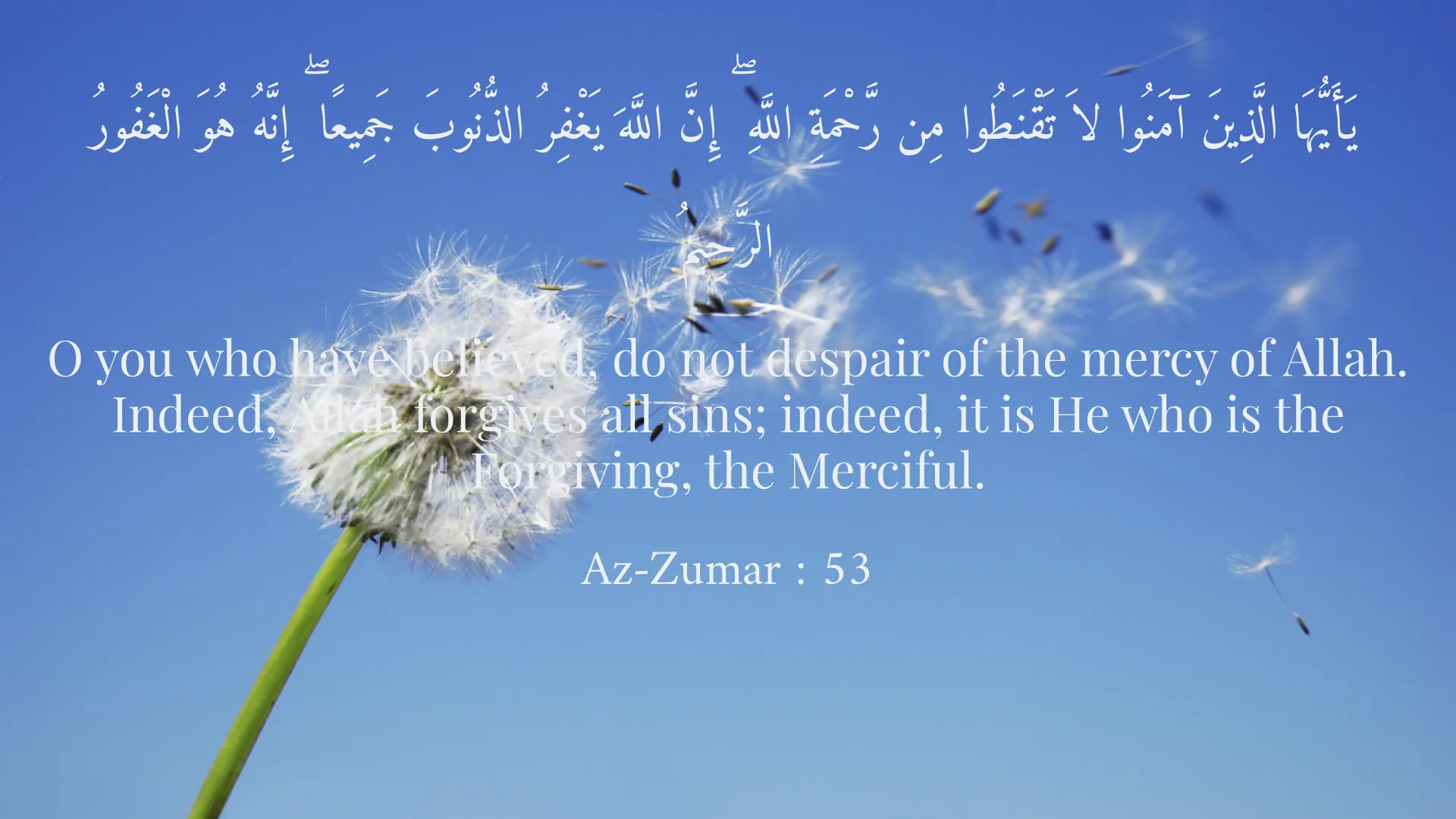
يَأَيُّهَا الَّذِينَ آمَنُوا لاَ تَقْنَطُوا مِن رَّحْمَةِ اللَّهِ ۖ إِنَّ اللَّهَ يَغْفِرُ الذُّنُوبَ جَمِيعًا ۖ إِنَّهُ هُوَ الْغَفُورُ الرَّحِيمُ
O you who have believed, do not despair of the mercy of Allah. Indeed, Allah forgives all sins; indeed, it is He who is the Forgiving, the Merciful.
Az-Zumar : 53
إنَّ الَّذِينَ آمَنُوا وَالَّذِينَ هَاجَرُوا وَجَاهَدُوا فِي سَبِيلِ اللَّهِ أُو۟لَـٰئِكَ يَرْجُونَ رَحْمَةَ اللَّهِ ۖ وَاللَّهُ غَفُورٌ رَّحِيمٌ
Indeed, those who have believed and those who have emigrated and fought in the cause of Allah will be granted hope for mercy from their Lord. And Allah is Forgiving and Merciful.
Al-Baqarah : 218
وما أرسلناك إلا رحمة للعالمين
And We have not sent you, [O Muhammad], except as a mercy to the worlds.
Al-An'am : 107
Short Story
One day, a man named Ali, walking through the city's streets with a heavy heart filled with worries, constantly thought about his sins and lost hope in God's mercy. Suddenly, he remembered the Quranic verses that say, 'Whenever My servants ask about Me, I am indeed near.' From that day on, Ali decided to live with hope in God's mercy and to tread the path of goodness. Over time, peace and hope blossomed in his heart, and the sins that burdened him began to fade away.