Quranic Answer
The question of free will and divine destiny is one of the most profound and complex theological and philosophical discussions throughout Islamic history, engaging the minds of scholars and laypeople alike since the early days of Islam. The Holy Quran, as a book of guidance, clearly addresses both human free will (ikhtiyar) and God's infinite knowledge and power (qadar or divine destiny), not as contradictory concepts, but as complementary truths whose proper understanding is essential for attaining a truly Quranic worldview. The Quranic discourse on this matter simultaneously emphasizes human responsibility and affirms God's absolute sovereignty over all creation. Let us first delve into the aspect of human "free will." The Quran emphatically stresses that human beings are endowed with free will, and their actions emanate from their own volition and choice. This free will forms the very foundation of accountability, responsibility, and the system of reward and punishment in the afterlife. If humans were compelled in their actions, then the sending of prophets, the revelation of divine scriptures, the injunctions of enjoining good and forbidding evil, and concepts such as reward and punishment would be utterly meaningless. The Holy Quran, through numerous verses, underscores the reality that humans discern the path of good and evil and freely choose one over the other. For instance, in Surah Al-Kahf, verse 29, Allah states: "And say, 'The truth is from your Lord, so whoever wills - let him believe; and whoever wills - let him disbelieve.' Indeed, We have prepared for the wrongdoers a fire whose walls will encompass them." This verse explicitly declares that the choice of belief or disbelief rests with the individual. Similarly, in Surah Al-Insan, verse 3, we read: "Indeed, We guided him to the way, be he grateful or ungrateful." This verse clearly indicates that God has shown humanity the path of guidance, and humans, by their own will, choose the path of gratitude or ingratitude. These verses, and many others, highlight humanity's direct responsibility for its actions. Humans are the agents of their deeds, and their intentions and will play a crucial role in shaping their life's direction. This free will bestows dignity upon humans, making them distinct from other creations, possessing the power of discernment, thought, and choice. This characteristic is a trust that God has placed upon humanity, holding them accountable for it. If humans were not free, the concepts of repentance, seeking forgiveness, striving against one's lower self (jihad al-nafs), and working for societal reform would lose all meaning. Humans, relying on their will, can resist temptations, move towards good, and alter their destiny through righteous deeds. This will is a divine gift, and it is precisely this gift that makes Heaven and Hell the result of one's own choices. On the other hand, the Quran equally emphasizes "divine destiny" and the absolute sovereignty of Allah over all existence. The concept of destiny (qadar) signifies that nothing in the universe comes into being except under God's eternal knowledge and His all-encompassing will. God is not only aware of everything but is also the Creator of all things and the Ordainer of all matters. This includes His knowledge of the past, present, and future, as well as His knowledge of the choices humans will make. For example, in Surah Al-An'am, verse 59, we read: "And with Him are the keys of the unseen; none knows them except Him. And He knows what is on the land and in the sea. Not a leaf falls but that He knows it. And no grain is there within the darknesses of the earth or wet or dry but that it is in a clear register." This verse indicates God's comprehensive and pervasive knowledge of every detail in existence, including human actions. Furthermore, in verses like Surah At-Takwir, verse 29, and Surah Al-Insan, verse 30, it is stated: "And you do not will except that Allah wills, the Lord of the worlds." These verses suggest that human will is not independent of God's will but operates within the framework of His divine will and decree (Mashiyyah). God is the Creator of human will and their power of choice. In other words, God has granted humans the power of choice and knows what path they will choose with this power. This eternal knowledge of God does not mean taking away human free will but rather signifies God's complete encompassment of all matters. Belief in divine destiny brings tranquility to the human heart, preventing despair and hopelessness in the face of difficulties, because one knows that everything that happens is ultimately under God's wise orchestration. Moreover, this belief safeguards against arrogance and self-admiration, as every success is attributed to divine grace and assistance. The correct Quranic perspective is one that views these two concepts in balance and harmony. God's knowledge does not equate to compulsion. God knows what a human will choose, but He does not force that choice upon them. This is akin to a teacher who knows which student will study and which will not, and consequently, what grade they will receive; this knowledge of the teacher does not cause the student's success or failure; rather, the student chooses to study or not. God has provided humans with intellect, innate disposition (fitra), and prophets to recognize the straight path. He has given humans the power of will and choice to decide their course in life. At the same time, all these processes occur within the framework of God's overarching knowledge and will. Humans are agents with free will, but their free will operates within the sphere of God's power and decree. We are agents by our will, but our will itself is created by God. This balance preserves individual responsibility while affirming the infinite grandeur and power of Allah. Therefore, the Holy Quran calls upon humans to strive, be responsible, and use their free will to choose good, all while having faith in God's eternal power and knowledge, knowing that nothing occurs outside His will and planning. This perspective encourages humans towards effort and piety, safeguarding them from absolute determinism as well as from self-conceit and arrogance.
Related Verses
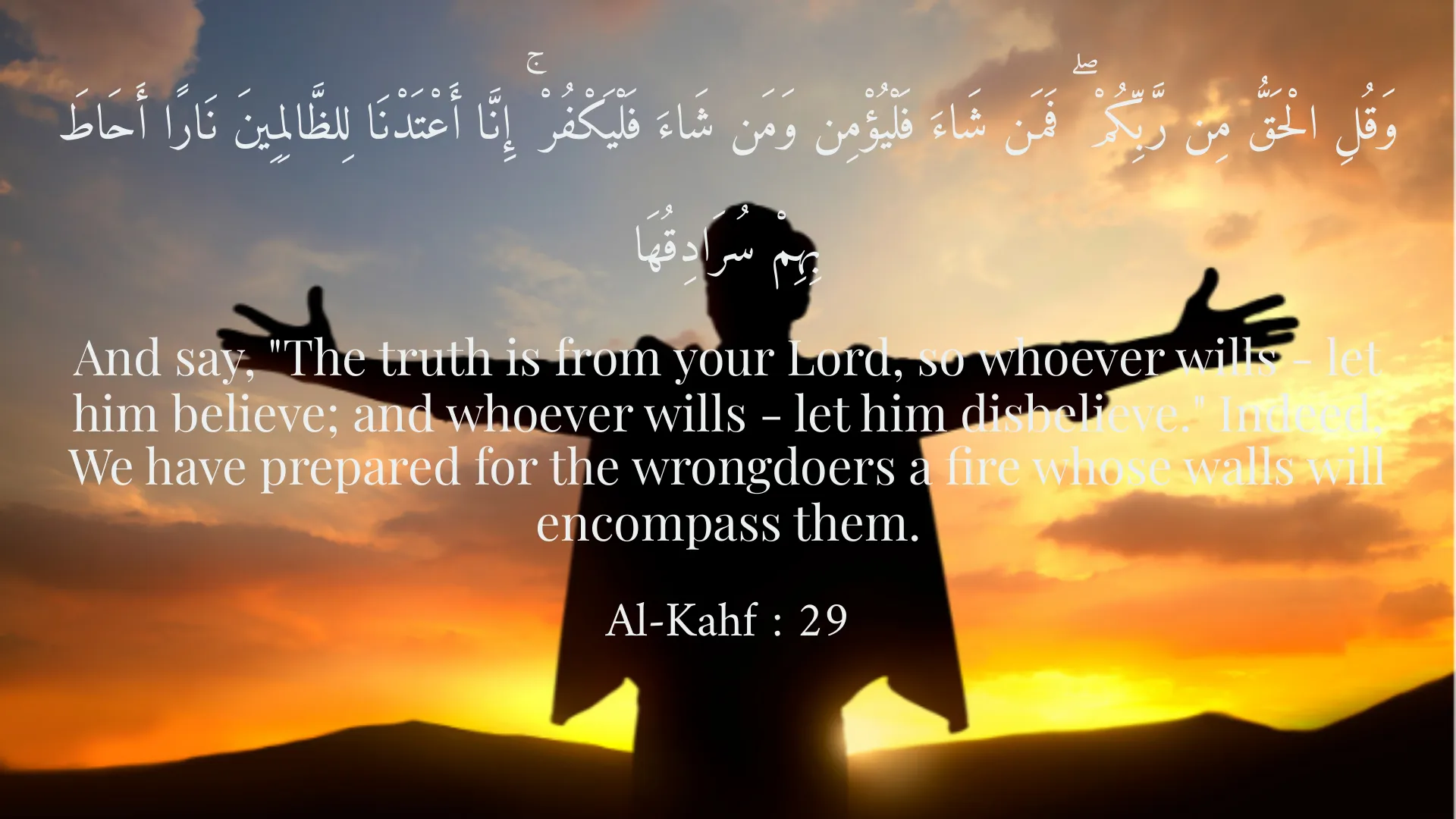
وَقُلِ الْحَقُّ مِن رَّبِّكُمْ ۖ فَمَن شَاءَ فَلْيُؤْمِن وَمَن شَاءَ فَلْيَكْفُرْ ۚ إِنَّا أَعْتَدْنَا لِلظَّالِمِينَ نَارًا أَحَاطَ بِهِمْ سُرَادِقُهَا
And say, "The truth is from your Lord, so whoever wills - let him believe; and whoever wills - let him disbelieve." Indeed, We have prepared for the wrongdoers a fire whose walls will encompass them.
Al-Kahf : 29
إِنَّا هَدَيْنَاهُ السَّبِيلَ إِمَّا شَاكِرًا وَإِمَّا كَفُورًا
Indeed, We guided him to the way, be he grateful or ungrateful.
Al-Insan : 3
وَمَا تَشَاءُونَ إِلَّا أَن يَشَاءَ اللَّهُ رَبُّ الْعَالَمِينَ
And you do not will except that Allah wills, Lord of the worlds.
At-Takwir : 29
Short Story
It is narrated that in ancient times, a man named Murad lay exhausted and thirsty in a scorching desert. He looked up at the sky and said to himself, "If it is divine destiny that I shall perish, what use is there in striving?" But at that very moment, a voice within his heart whispered, "O Murad, God has not created you with empty hands and a bound will. Destiny outlines the path, but taking steps upon it is by your will." Hearing this, Murad found new strength, painstakingly rose, and set off towards a distant spring he perceived. After much suffering, he reached the water and was saved from certain death. He understood that divine destiny never prevents human will and effort; rather, effort and will themselves are part of destiny. From that day forward, Murad never ceased striving in any endeavor and was always grateful to God, who created him with free will and also paved the way for him to achieve good destiny.