Quranic Answer
The Holy Quran serves as a timeless guide for Muslims around the world, providing profound insights into various aspects of life, including the importance of collective work. Though the Quran does not explicitly articulate the significance of working together as a community in a direct manner, its verses reflect a clear emphasis on social interaction, mutual assistance, and the cooperation of believers. This article seeks to explore the implications of collaboration as highlighted in the Quran, and how these teachings serve as a foundational pillar for fostering a sense of community among Muslims. One of the key verses that allude to the importance of collective action is found in Surah Al-Ma'idah, verse 2. Here, Allah instructs the believers saying, 'And cooperate in righteousness and piety.' This phrase underscores the idea that positive actions and good deeds cannot be achieved in isolation. While individual merit and personal efforts are acknowledged, the verse advocates for collaboration and support among community members. It implies that to foster righteousness—something that is fundamental to a faith-driven life—individuals must come together and unite their strengths for a greater cause. This notion is echoed throughout Islamic teachings, emphasizing that unity amplifies the potential for effective change. The significance of collective work is further reinforced in Surah Al-Imran, verse 104, where Allah warns, 'And do not be like those who divided and became divided among themselves.' This verse addresses the detrimental effects of division and conflict within the Muslim community. It serves as a reminder that discord can lead to disarray and hinder progress towards collective goals. In the journey of faith, it is imperative for believers to avoid fragmentation and instead, to proactively seek ways to unite their efforts in pursuit of common objectives. The importance of working together in harmony cannot be overstated; it is a crucial aspect of building a cohesive and supportive community. From a broader perspective, the Quran emphasizes solidarity within the Muslim community. Throughout history, various Islamic movements have highlighted collective action in their endeavors to advocate for justice, equity, and social welfare. The concept of 'ummah,' or the global community of Muslims, resonates strongly within the Islamic narrative, depicting a collective identity that transcends geographical and cultural boundaries. This notion of belonging fosters a sense of responsibility towards one another, encouraging Muslims to collaborate for the betterment of society at large. In practical life, the relevance of collective work can be observed in diverse scenarios. Consider the family unit, where collaboration among members is essential in effectively raising and educating children. Parents, guardians, and extended family members must work together, sharing responsibilities and nurturing an environment that fosters growth and development. By doing so, they lay the foundation for producing good and faithful generations who will, in turn, contribute positively to society. These familial collaborations are microcosms of the larger community, encapsulating the essence of unity and shared purpose therein. Additionally, community events and organized activities are clear manifestations of collective work in action. Such gatherings provide opportunities for Muslims to come together for charitable causes, educational workshops, and social celebrations. They necessitate the cooperation of various individuals who each play a role, whether that is through planning, execution, or participation. These events serve as a powerful reminder of what can be achieved through collective effort, as they foster connections, strengthen relationships, and promote a sense of belonging among community members. Moreover, collective work extends beyond community gatherings; it permeates various spheres of life, including humanitarian aid, environmental initiatives, and social activism. The Quran prompts believers to engage in actions that contribute positively to society, underlining the importance of coming together to address pressing issues such as poverty, justice, and climate change. As a pivotal teaching, the essence of cooperation can inspire Muslims to join forces with others—regardless of their background or beliefs—to achieve common goals that positively influence their communities and the world as a whole. The benefits of collective work are manifold, extending not only to those directly involved but also impacting the broader society. When believers unite their strengths and skills to work towards a common purpose, they create a ripple effect that can incite widespread change. From volunteering efforts to advocacy campaigns, cooperation amplifies the voices of individuals and ensures that their contributions are felt far and wide. In conclusion, while the Holy Quran may not overtly discuss the importance of collective work, its teachings undoubtedly highlight the crucial role of cooperation, unity, and social interaction within the Muslim community. Whether it is through family structures, community events, or broader social efforts, collective work remains an essential element of religious teachings. As believers embrace these principles and actively engage with one another, they not only cultivate a supportive environment but also empower their communities to thrive. The Quran's exhortation to 'cooperate in righteousness and piety' serves as an enduring call to action, urging Muslims to recognize that true progress is often a collective endeavor embarked upon together.
Related Verses
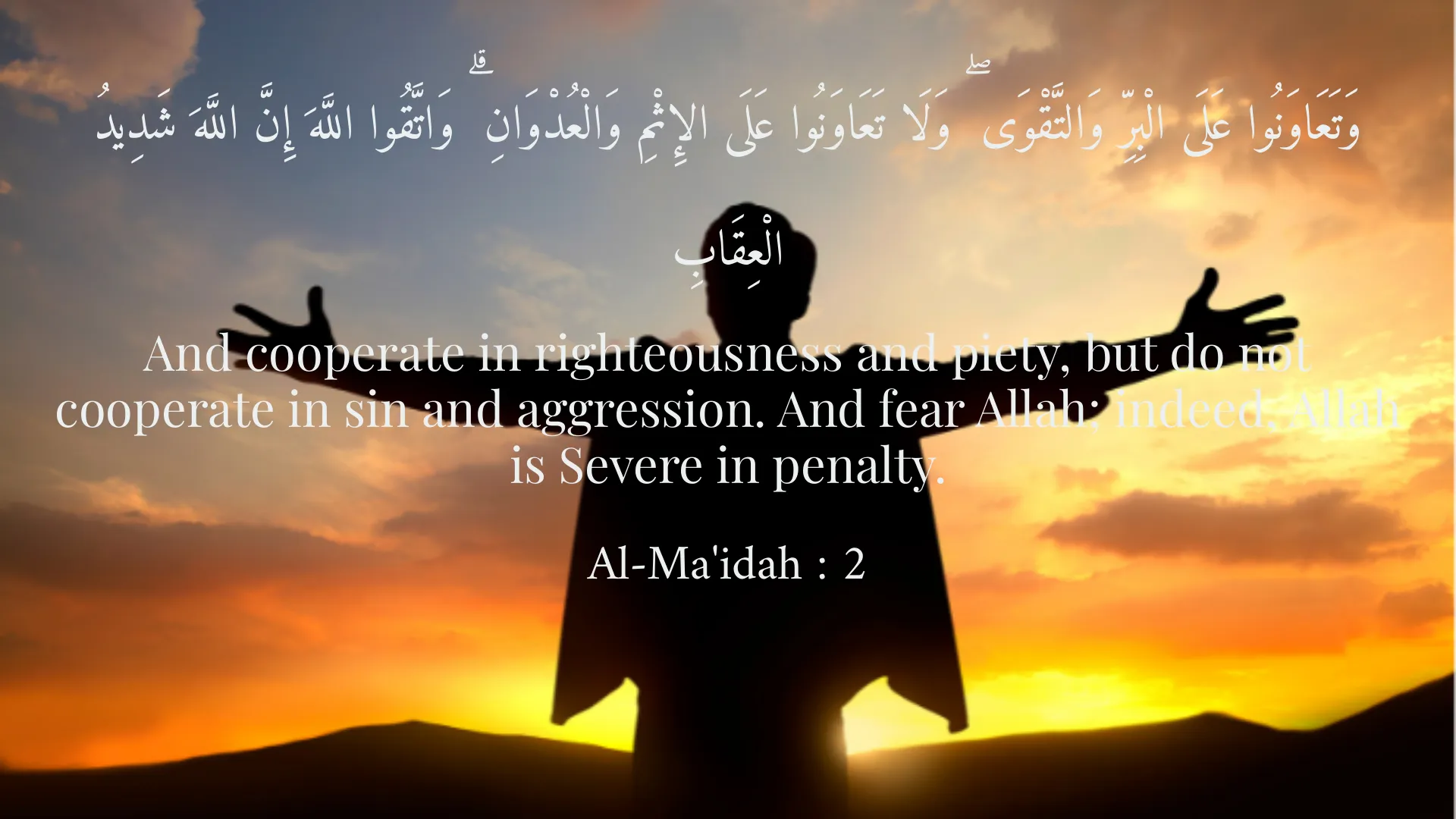
وَتَعَاوَنُوا عَلَى الْبِرِّ وَالتَّقْوَى ۖ وَلَا تَعَاوَنُوا عَلَى الإِثْمِ وَالْعُدْوَانِ ۗ وَاتَّقُوا اللَّهَ إِنَّ اللَّهَ شَدِيدُ الْعِقَابِ
And cooperate in righteousness and piety, but do not cooperate in sin and aggression. And fear Allah; indeed, Allah is Severe in penalty.
Al-Ma'idah : 2
وَلا تَكُونُوا كَالَّذِينَ تَفَرَّقُوا وَاخْتَلَفُوا مِن بَعْدِ مَا جَاءَهُمُ الْبَيِّنَاتُ ۚ وَأُولَـٰئِكَ لَهُمْ عَذَابٌ عَظِيمٌ
And do not be like those who divided and became divided after the clear proofs had come to them. And those have a great punishment.
Al-Imran : 104
Short Story
One day, a group of young people decided to come together to help earthquake victims. Each had a unique skill; one was a medic, another took charge of food supplies, and a third provided emotional support. Through their teamwork and collaboration, they managed to set up a temporary center and assist those in need. This experience fostered a sense of solidarity and joy among them, highlighting the strength of collective work.