Quranic Answer
The Purpose of Creation According to the Holy Quran The Holy Quran, regarded as the eternal word of God in Islam, provides profound insight into the purpose of creation, particularly concerning humanity and the jinn. One of the most pivotal verses that reflect this purpose is found in Surah Adh-Dhariyat, verse 56: 'And I did not create the jinn and mankind except to worship Me.' Through this statement, Allah unequivocally conveys that worship is the fundamental reason for the creation of human beings and jinn. This verse encapsulates the essence of our existence, illustrating that every individual is bestowed with a divine purpose that centers around devotion and connection to their Creator. The concept of purpose is critical in understanding one’s life in the Islamic faith. Worship, in this context, is not merely an act confined to rituals; it encompasses all actions performed in accordance with God's guidance and intentions, leading to the cultivation of a life that is pleasing to Him. Whether through prayer, charity, kindness, or ethical pursuits, every action can be transformed into an act of worship when it is undertaken with the intention of serving Allah. This integrative approach to worship highlights the need for Muslims to immerse themselves in their daily lives with mindfulness and devotion. Furthermore, in Surah Aal-E-Imran, verse 185, Allah emphasizes the principle of accountability: 'And you will be fully compensated for your deeds on the Day of Resurrection.' This verse serves as a reminder that every individual will face the consequences of their actions in this world and the next. The promise of reward and recompense underscores the idea that life is characterized by tests and challenges, each serving as an opportunity for personal growth and for enhancing one's relationship with God. As Muslims navigate the complexities of life, the knowledge of divine accountability acts as both guidance and motivation to adhere to a path that aligns with their purpose. The notion of life as a test is a recurring theme throughout the Quran. Various verses indicate that trials serve as a means to purify the soul and strengthen faith. For instance, in Surah Al-Baqarah, verse 155, Allah states: 'And We will surely test you with something of fear and hunger and a loss of wealth and lives and fruits, but give good tidings to the patient.' This perspective transforms challenges from mere hardships into vital components of spiritual development, forcing believers to remain steadfast in their worship and trust in Allah's wisdom. The understanding that trials are part of a divine plan reinforces the importance of a religious mindset amidst adversity, which is directed towards seeking Allah's pleasure through patience and resilience. Additionally, the quest for purpose and the responsibilities associated with it also push individuals to consider their roles within society. The Quran encourages a worldview that emphasizes community, cooperation, and compassion. Surah Al-Ma'idah, verse 32 teaches that the act of saving a single life is akin to saving all of mankind, which highlights the collective responsibility that Muslims have toward one another. This narrative fosters a sense of unity and shared responsibility, further reflecting on how worship extends beyond individual devotion to contributing positively to society. Moreover, the teachings of the Prophet Muhammad (peace be upon him) elaborate on the significance of purpose in daily living. He often emphasized that one's daily actions and interactions serve to foster an environment where worship is lived rather than just performed. In his sayings, we find guidance on how to navigate personal relationships, uphold justice, and exhibit compassion. This holistic approach reinforces the notion that the purpose of life transcends merely adhering to religious obligations; instead, it encompasses fostering a presence of good character and moral integrity in all aspects of life. In conclusion, the verses from the Holy Quran, such as Surah Adh-Dhariyat, verse 56 and Surah Aal-E-Imran, verse 185, remind Muslims of their core purpose—to worship Allah and fulfill their duties as stewards of the earth. These teachings echo the sentiment that life is a test filled with responsibilities, trials, and opportunities to connect with our Creator. In the dynamic interplay of individual faith and collective responsibility, every Muslim is called to remember their purpose and strive to embody it in their everyday existence. Consequently, the commitment to fulfill this divine purpose not only enhances personal spirituality but also contributes to building a just, compassionate, and morally upright community. Hence, it is imperative for every believer to keep their life's objective in focus and continuously seek ways to elevate their worship, ensuring that their actions align with the purpose for which they were created.
Related Verses
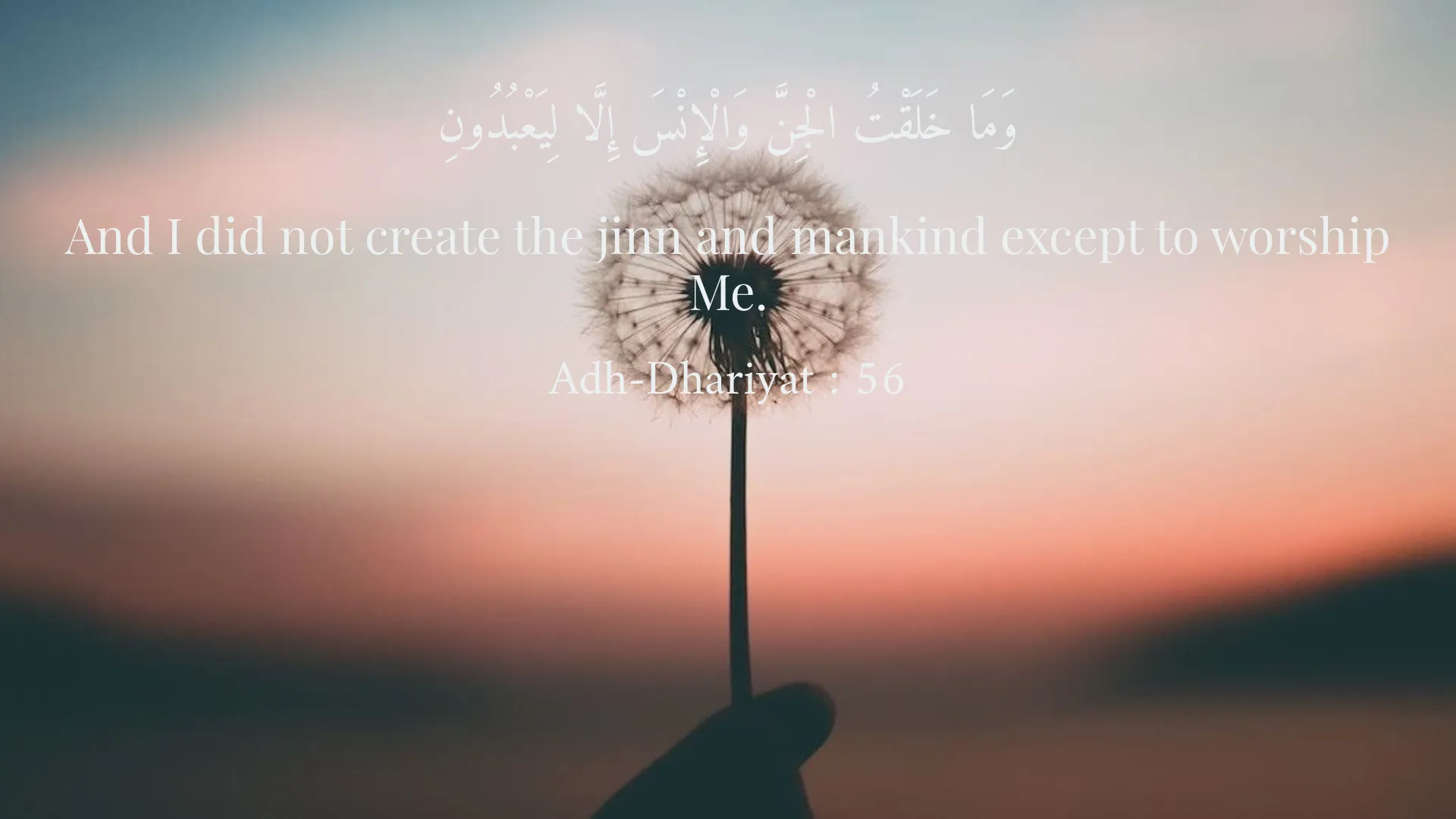
وَمَا خَلَقْتُ الْجِنَّ وَالْإِنْسَ إِلَّا لِيَعْبُدُونِ
And I did not create the jinn and mankind except to worship Me.
Adh-Dhariyat : 56
وَإِنَّمَا تُوفَوْنَ أُجُورَكُمْ يَوْمَ الْقِيَامَةِ
And you will be fully compensated your deeds on the Day of Resurrection.
Aal-E-Imran : 185
Short Story
Once upon a time, a young man named Hasan was searching for the purpose of his life. He was constantly asking himself why he walked on the earth. Seeking peace and meaning, he read the verses of the Quran and realized that Allah had created him for worship and for a relationship with Him. Understanding this truth, Hasan decided to dedicate his life to serving others and fulfilling this purpose, experiencing tremendous growth in his life.