Quranic Answer
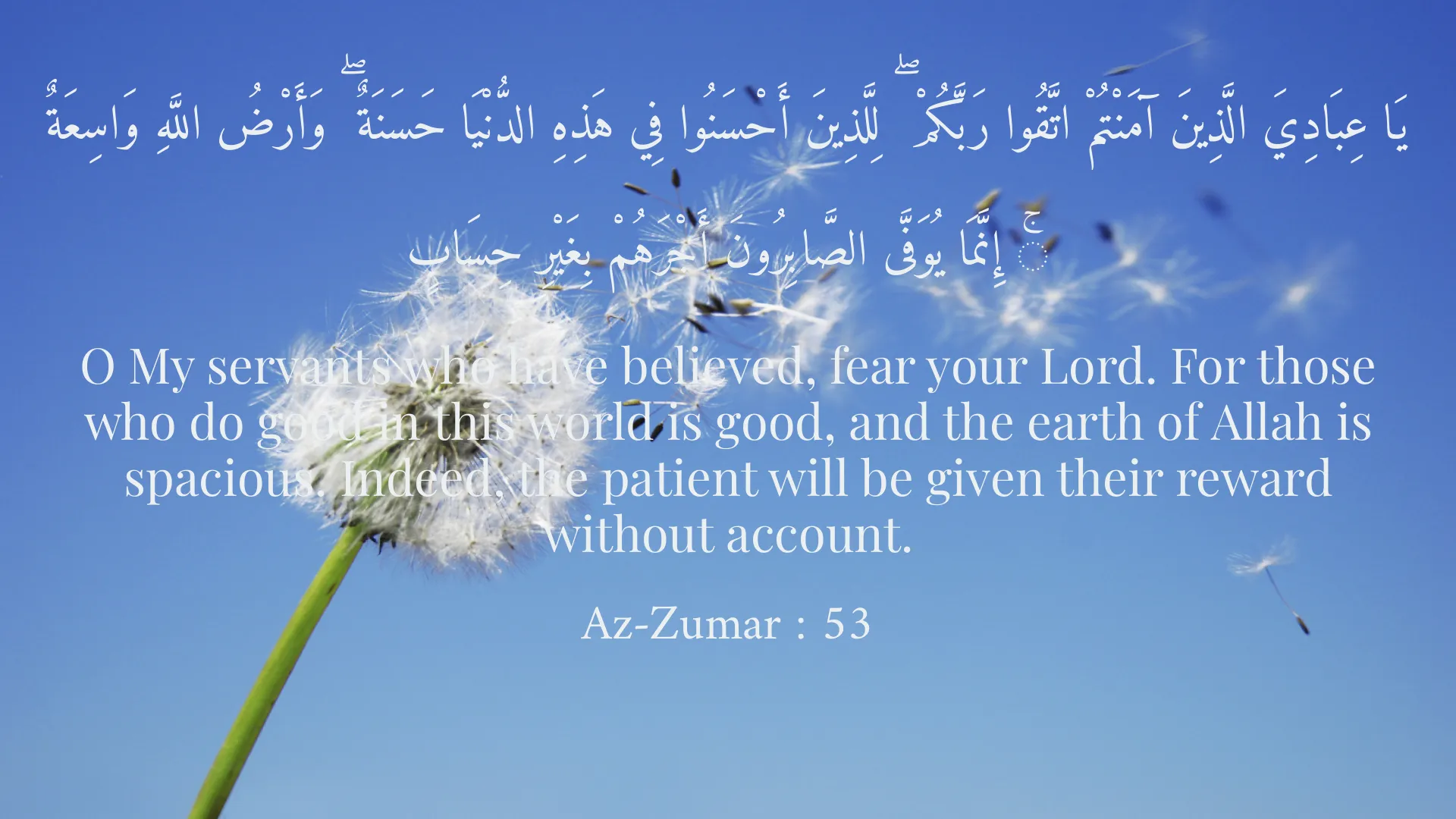
In the Holy Quran, God's mercy and forgiveness are clearly mentioned for all, offering a profound sense of hope and encouragement to humanity. The concept of divine mercy is a central theme in Islamic theology and serves as a guiding principle for believers. The Quran provides numerous verses that emphasize the boundless nature of Allah's forgiveness and the importance of repentance. An essential verse in this context is found in Surah Az-Zumar, verse 53, where Allah states: 'Say, O My servants who have believed, fear your Lord. For those who do good in this world is good, and the earth of Allah is spacious. Indeed, the patient will be given their reward without account.' This passage is rich in meaning, embedding the idea that God's mercy is not limited to a select few but extended to all believers who sincerely turn to Him. The phrase 'O My servants who have believed' signifies a direct address from Allah to those who exhibit faith and trust in Him. Herein lies a profound invitation; it expresses that despite human imperfections and errors, believers should not lose hope in Allah's mercy. The verse implicitly acknowledges that everyone has the capacity for wrongdoing, yet encourages them to seek righteousness through faith and good deeds. Notably, the phrase 'the earth of Allah is spacious' reminds us that the opportunities for repentance and the pursuit of goodness are infinite. There is always room for improvement and seeking goodness in one's life regardless of past transgressions. Patience, as alluded to in the verse, is another key factor that is essential in the journey of faith. Allah promises that the patient will be rewarded abundantly without measure, indicating that enduring difficulties and remaining steadfast on the path of righteousness is highly valued in Islam. This reward speaks not only to the spiritual elevation of the individual but also to the communal benefit of such steadfastness, inspiring others to adopt patience and perseverance in their own lives. Moreover, in Surah At-Tawbah, verse 102, Allah advises believers to strive in their repentance and seek His forgiveness. The verse states: 'And (there are others) who have confessed their sins; they have mixed a good deed with another that was bad. Perhaps Allah will turn to them in mercy. Indeed, Allah is Forgiving and Merciful.' This recommendation underscores the necessity of actively seeking God's forgiveness, implying that it is not enough to simply expect forgiveness; rather, one must strive for it. Here we observe that Allah recognizes human flaws and offers a way to reconcile one's mistakes through genuine repentance. Repentance in Islam, known as 'Tawbah,' is not merely a verbal reaffirmation or acknowledgment of one’s sins; it entails a conscious decision to abandon wrongdoing and redirect oneself towards righteous living. The act of repentance requires sincerity and a commitment to amend past behaviors. This process is accessible to every individual, emphasizing that no one is beyond the reach of God's mercy. One may find solace in the fact that returning to Allah is always possible; the doors to repentance remain open until the moment of one's death. The Quran also reassures believers of the significance of repentance. In Surah Al-Furqan, verse 70, Allah mentions, 'And those who do not invoke with Allah another deity or kill the soul which Allah has made unlawful and do not commit unlawful sexual intercourse. And whoever should do that will meet a penalty.' However, the subsequent verse emphasizes: 'Except for those who repent, believe and do righteous work. For them Allah will replace their evil deeds with good. And ever is Allah Forgiving and Merciful.' This transfiguration of sins into good deeds demonstrates the transformative power of sincere repentance, showcasing Allah's vast capacity for forgiveness. The recurring emphasis on mercy and forgiveness in the Quran serves not only as a reassurance for believers but also as a reminder of the necessity of humility and accountability. When an individual acknowledges their mistakes and seeks forgiveness, they embark on a journey towards self-improvement and spiritual growth. This divine promise encourages believers to continuously reflect on their actions and strive for a life of goodness and righteousness. In light of these themes, believers are constantly reminded that they should never despair of Allah's mercy. In Islam, despair is considered a grave error, as it negates Allah's attributes of forgiveness and compassion. Therefore, the Quran emphasizes that no matter how great the sins may be, one should always turn back to Allah with a sincere heart, invoking His mercy and grace. The promise of forgiveness is a beacon of hope for all, reinforcing the idea that every soul harbors the potential for redemption. The significance of these teachings is profound, as they instill a sense of hope and motivation for any individual seeking to return to Allah. The clarity with which the Quran addresses mercy and forgiveness provides a framework for believers to navigate their lives. Engaging with these verses encourages a proactive approach to repentance and teaches that God’s love is far greater than any sin. By fostering a humble spirit dedicated to rectifying one's mistakes, believers can discover a path laden with divine compassion and light. In conclusion, the Holy Quran offers unparalleled insights into the nature of God's mercy and the importance of repentance. Through various verses, Allah assures believers that His arms are always open for anyone willing to return to Him, regardless of their past. This invitation fosters a culture of hope and encourages individuals to constantly strive towards betterment, fueled by the understanding that the potential for forgiveness and mercy from Allah is infinite. Thus, it is imperative that believers embrace the opportunities for repentance, submit themselves earnestly to Allah, and seek refuge in His mercy with a pure heart. The Quran remains a guiding light, emphasizing that every mistake can be corrected, and every path, however distant, can always lead back to divine grace.
Related Verses
يَا عِبَادِيَ الَّذِينَ آمَنْتُمْ اتَّقُوا رَبَّكُمْ ۖ لِلَّذِينَ أَحْسَنُوا فِي هَذِهِ الدُّنْيَا حَسَنَةٌ ۖ وَأَرْضُ اللَّهِ وَاسِعَةٌ ۚ إِنَّمَا يُوَفَّى الصَّابِرُونَ أَجْرَهُمْ بِغَيْرِ حِسَابٍ
O My servants who have believed, fear your Lord. For those who do good in this world is good, and the earth of Allah is spacious. Indeed, the patient will be given their reward without account.
Az-Zumar : 53
وَأُولَـٰئِكَ هُمُ الْمُهْتَدُونَ
And they are the rightly guided.
At-Tawbah : 102
Short Story
Once upon a time, a man sat in a corner of the city, pondering how to correct his life. He recalled the verses of the Quran and understood with his heart that it is never too late to repent. He decided to return to Allah, pray, and ask for forgiveness for his mistakes. Gradually, his life improved, and he felt that God's mercy was always near him.