Quranic Answer
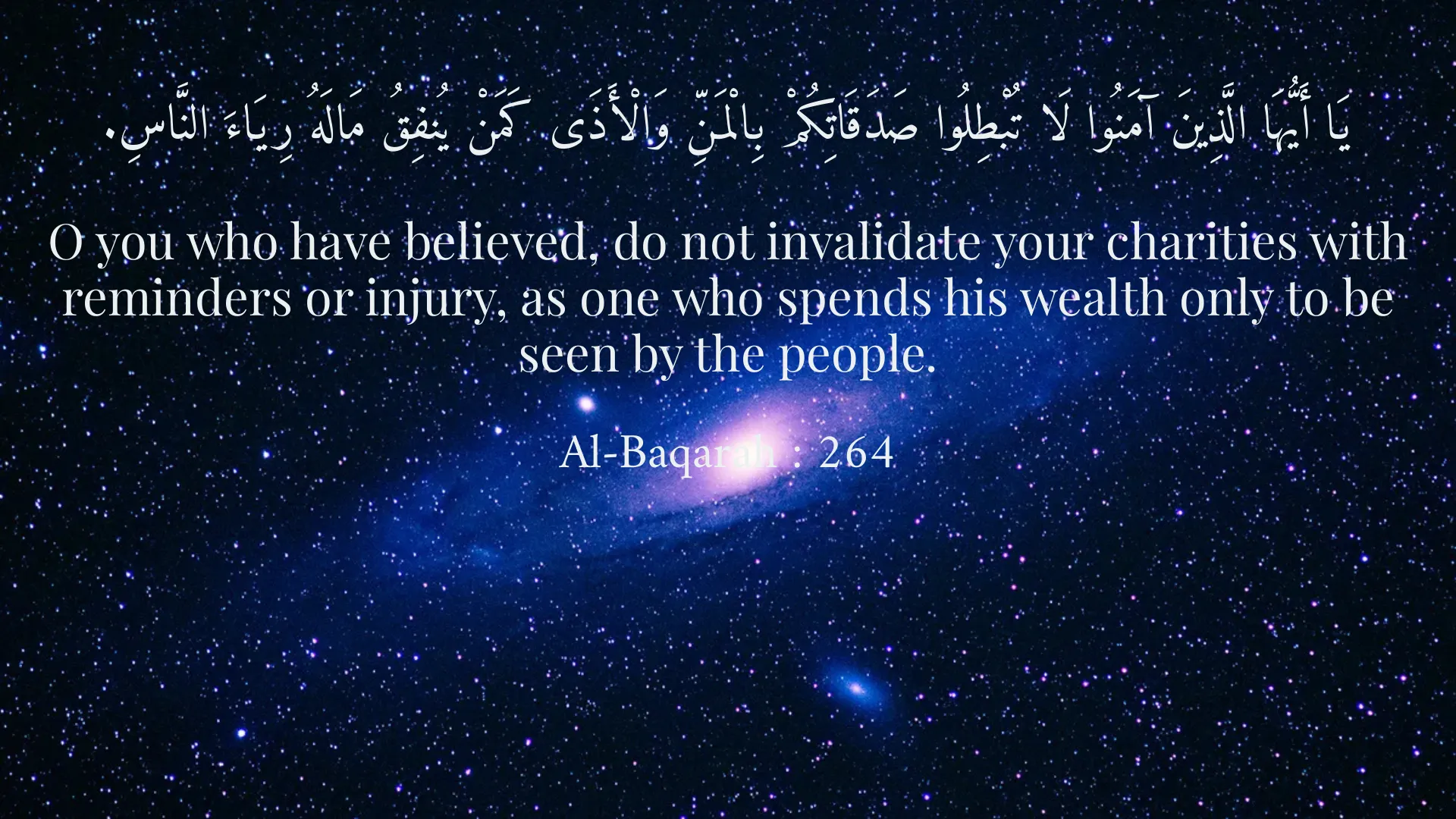
In the Holy Quran, the emphasis on performing good deeds and acts of charity with sincerity, devoid of ostentation, is a fundamental principle that underpins the essence of Islamic moral and ethical teachings. The Quran highlights that the intention behind any charitable act is paramount, and that any actions undertaken for the sake of public recognition or social status can lead to spiritual and moral deterioration. In Surah Al-Baqarah, verse 264, Allah directly addresses the believers, stating: 'O you who have believed, do not invalidate your charities with reminders or injury, as one who spends his wealth only to be seen by the people.' This verse illuminates a critical aspect of true charity: the intention. It shows that charity should not be merely an act of financial giving but rather a sincere expression of one’s faith and commitment to helping others without the desire for acknowledgment or praise. Hypocrisy, or the act of doing good deeds for mere recognition, is condemned. The underlying message is clear—if one performs good deeds with the intention of impressing others, not only does it invalidate the charitable act in the eyes of Allah, but it can also deter the individual from genuinely engaging in philanthropy. The importance of maintaining sincerity in worship and charitable acts is reiterated throughout the Quran. In Surah Al-An'am, verse 162, Allah commands, 'Say, indeed, my prayer, my rites of sacrifice, my living and my dying are for Allah, Lord of the worlds.' This verse encapsulates the concept of complete submission to Allah in all actions, including acts of charity. When one gives selflessly, prioritizing the pleasure of Allah above all, they not only experience serenity but also receive an abundance of blessings and rewards, both in this life and the hereafter. Moreover, the act of performing good deeds requires self-awareness and a conscious effort to purify one’s intentions. This awareness connects to the broader Islamic principle of Taqwa, which encourages mindfulness of God in all aspects of life. By performing good deeds purely for the sake of Allah, individuals can cultivate inner peace and a genuine spirit of generosity. This internal transformation is essential in fostering an environment where compassion and empathy flourish. Additionally, engaging in acts of kindness secretly can be a powerful means of ensuring the purity of one’s intentions. The Quran encourages believers to assist others without seeking acknowledgment. For instance, the Prophet Muhammad (peace be upon him) emphasized the significance of hidden charity in various Hadiths. He mentioned that the noblest form of charity is that which is given in secret so that the left hand does not know what the right hand does. This notion of anonymity in charitable actions reinforces the idea of serving humanity without the entanglements of pride or showmanship. Beyond the individual aspect of charitable acts, collaboration with others in philanthropy not only amplifies the benefits of good deeds but also fosters community bonds and shared responsibilities. When people come together for a common cause, it creates a collective spirit of empathy and compassion, where individuals are motivated not just by personal interest but by a shared commitment to uplift those in need. This collaborative spirit is essential in today’s society, where the challenges faced by many can only be addressed through collective efforts. By working together, individuals can share resources, knowledge, and skills, thereby enhancing the overall impact of their charitable initiatives. In conclusion, the teachings of the Quran and the exemplification of the Prophet Muhammad (peace be upon him) offer rich guidance on the importance of performing good deeds with sincerity and without hypocrisy. The emphasis on maintaining pure intentions and engaging in acts of charity for Allah's pleasure is fundamental to Islamic belief. By focusing on altruism and community service, individuals can not only enrich their spiritual lives but also contribute meaningfully to society. Thus, as we strive to align our actions with these principles, we cultivate a more compassionate world, reflecting the core values of our faith. Let us make it our mission to perform acts of kindness with sincerity, recognizing that every small gesture has the potential to create immense impact, forging paths of goodness that ripple through our communities and beyond.
Related Verses
يَا أَيُّهَا الَّذِينَ آمَنُوا لَا تُبْطِلُوا صَدَقَاتِكُمْ بِالْمَنِّ وَالْأَذَى كَمَنْ يُنفِقُ مَالَهُ رِيَاءَ النَّاسِ.
O you who have believed, do not invalidate your charities with reminders or injury, as one who spends his wealth only to be seen by the people.
Al-Baqarah : 264
وَقَضَى رَبُّكَ أَلَّا تَعْبُدُوا إِلَّا إِيَّاهُ وَبِالْوَالِدَيْنِ إِحْسَانًا.
And your Lord has decreed that you not worship except Him, and to parents, good treatment.
Al-Isra : 23
قُلْ إِنَّ صَلَاتِي وَنُسُكِي وَمَحَيَايَ وَمَمَاتِي لِلَّهِ رَبِّ الْعَالَمِينَ.
Say, indeed, my prayer, my rites of sacrifice, my living and my dying are for Allah, Lord of the worlds.
Al-An'am : 162
Short Story
Once upon a time, there was a man named Ali who decided to do good deeds for the sake of Allah. Fearing hypocrisy, he performed all his good acts in secret. One day, he learned that a believer in his neighborhood needed financial assistance. With pure intentions, Ali helped him without doing so in front of others. After a while, Ali felt calmer and happier. He realized that when he performed good deeds without hypocrisy, his spirit filled with tranquility, and blessings entered his life.