Quranic Answer
“How can I increase my faith in divine promises?” This is a profound and fundamental question that every believer encounters on their spiritual journey. Faith in divine promises forms the bedrock of a Muslim's belief system, providing serenity, hope, and direction in the face of life's challenges and adversities. Divine promises encompass various aspects, including provision (rizq), victory for those who uphold justice, rewards for the righteous, punishment for evildoers, the establishment of justice, forgiveness of sins, and ultimately, eternal felicity and divine pleasure in the afterlife. Strengthening this faith is a gradual process that demands continuous knowledge, action, and contemplation. One of the primary ways to bolster faith in divine promises is through deep contemplation of the Holy Quran (Tadabbur). The Quran, as the flawless word of God, explicitly articulates divine promises and glad tidings. Merely reciting the verses is insufficient; one must immerse their soul in their meanings and messages through profound reflection. When we read verses where Allah explicitly promises victory (for instance, Surah Al-Hajj, verse 22:40: "...And Allah will surely support those who support Him. Indeed, Allah is Powerful and Exalted in Might."), we must believe these promises wholeheartedly. Understanding Allah's attributes, such as "As-Sadiq al-Wa'd" (the Fulfiller of Promises), "Ar-Razzaq" (the Provider), "Al-'Aleem" (the All-Knowing), and "Al-Hakeem" (the All-Wise) through the Quranic verses, leads us to the conviction that everything originating from Him is truth and will undoubtedly come to pass. The more we connect with the divine word and comprehend its profound meanings, the more our trust in the Speaker of this word, the One and Only God, will grow. This deep engagement and contemplation not only augment our knowledge but also infuse our hearts with certainty that His promises stem not from weakness or forgetfulness, but from absolute knowledge and power. The second crucial step is constant remembrance of Allah (Dhikr Allah). The human heart is a vessel that is dominated by whatever fills it. If this vessel is filled with the remembrance of God, no room remains for doubt or skepticism regarding His promises. The Holy Quran states: "Those who have believed and whose hearts are assured by the remembrance of Allah. Unquestionably, by the remembrance of Allah hearts are assured" (Ar-Ra'd, 13:28). This verse directly links remembrance to inner peace and unwavering faith. The five daily prayers (Salat), supplications (Du'a), and glorifications (Tasbihat) are all instruments for strengthening this bond. When we are constantly in communion with our Creator, remembering His greatness and power, our belief in His ability to fulfill His promises becomes firmer. Dhikr is like water poured upon the seed of faith, allowing it to take root and flourish. This continuity in remembrance ensures that during moments of difficulty and despair, instead of succumbing to negative thoughts, we immediately connect to the infinite source of power and mercy, recalling His promises in our minds. Dhikr is not merely verbal repetition; it is a profound presence of heart that leads to a deeper understanding of divine presence and power. The third significant step is complete reliance upon Allah (Tawakkul). Tawakkul means trusting and entrusting one's affairs to God after exerting the necessary effort and fulfilling one's duties. A true believer understands that while they are responsible for striving and endeavoring, the ultimate outcome rests with God. This perspective reduces psychological pressure and grants inner peace. The Quran declares: "And whoever relies upon Allah - then He is sufficient for him. Indeed, Allah will accomplish His purpose. Allah has already set for everything a [decreed] extent" (At-Talaq, 65:3). Tawakkul stems from comprehending Allah's absolute power and wisdom. When an individual realizes that Allah is Absolute Good and never wills harm for His servant, they gain greater assurance in His promises concerning their well-being and success. Correct Tawakkul does not imply abandoning effort and waiting for a miracle; rather, it means entrusting the outcome to Allah after employing all one's capabilities, with certainty that He will ordain the best for us. Patience and perseverance in the face of trials and tribulations (Sabr) constitute the fourth factor in strengthening faith. This worldly life is full of challenges and hardships. It is in these moments that true faith is tested. Allah explicitly promises in the Quran: "For indeed, with hardship [will come] ease. Indeed, with hardship [will come] ease" (Ash-Sharh, 94:5-6). This promise is repeated twice to emphasize its certainty. When a person endures difficulties with patience and steadfastness, firmly believing in this divine promise, they not only emerge successfully from the divine test but also deepen their faith in the truth of God's promises. Personal experience of overcoming hardships with divine assistance and grace serves as the strongest proof of His promises' fulfillment. Patience is not merely passive endurance; it is an active stance on the right path, hopeful of divine relief. This patience is a spiritual act that keeps one away from despair and provides energy to await the fulfillment of divine promises. Fifth, contemplating the signs of Allah in the cosmos (Afaq) and within oneself (Anfus). When we observe the astonishing order of the universe, the movement of stars, the cycle of life, the intricate creation of the human body, and the diversity of creatures, we grasp Allah's infinite power and boundless knowledge. A Creator with such grandeur and precision cannot possibly forget His promises or fail to bring them to fruition. Surah Al-Baqarah, verse 2:164 states: "Indeed, in the creation of the heavens and earth, and the alternation of the night and the day, and the [great] ships which sail through the sea with that which benefits people, and what Allah has sent down from the heavens of rain, giving life thereby to the earth after its lifelessness and dispersing therein every [kind of] moving creature, and [in] the dispersal of winds and clouds controlled between the heaven and the earth - are signs for a people who use reason." This contemplation deepens the roots of faith and instills certainty that the God who meticulously manages this vast system will also perfectly fulfill His promises. Sixth, adherence to righteous deeds (Amal Salih) and upholding piety (Taqwa). Faith is not solely of the heart; it must also manifest through action. Performing obligatory acts, abstaining from forbidden ones, serving humanity, and striving for goodness are all indicators of living faith. Allah promises those who believe and perform righteous deeds a pure life in this world and the best reward in the Hereafter (An-Nahl, 16:97: "Whoever does righteousness, whether male or female, while he is a believer - We will surely cause him to live a good life, and We will surely give them their reward [in the Hereafter] according to the best of what they used to do."). When a person demonstrates the sincerity of their faith through their actions, Allah, in turn, fulfills His promises to them, which itself increases their faith and assurance in God and His promises. The relationship between faith and action is reciprocal and reinforcing. The more sincere our actions are and in accordance with divine pleasure, the greater our faith in the truth of His promises becomes, as we have placed ourselves on the correct path for the fulfillment of those promises. Finally, studying the stories of prophets and righteous predecessors can be immensely inspiring. Prophets and the righteous were prime examples of unwavering reliance and firm faith in divine promises. Consider Prophet Ibrahim (AS), his faith in the promise of a child in old age and then his salvation from the fire of Nimrod. How Prophet Musa (AS) trusted in the promise of deliverance from Pharaoh and the parting of the sea. How Prophet Yusuf (AS), after years of suffering and separation, had unwavering faith in the fulfillment of his dream. And how Prophet Muhammad (PBUH) had complete certainty in the promise of Islam's victory even during the most severe hardships and encirclement by enemies. Studying these narratives not only offers lessons but also demonstrates that divine promises are fulfilled for sincere servants in every time and place. These role models help us to remain steadfast on our path of faith and to know that if we fulfill our duties, Allah will likewise fulfill His promises. Strengthening faith in divine promises is an inner journey that gradually solidifies through a deeper understanding of God and His word, constant remembrance, true reliance, patience in adversity, contemplation of creation, and righteous actions. Every step on this path guides the heart towards light and certainty, bringing a lasting peace that no worldly thing can disturb. This faith gives meaning and purpose to human life, equipping individuals to face every phenomenon in this world and the Hereafter.
Related Verses
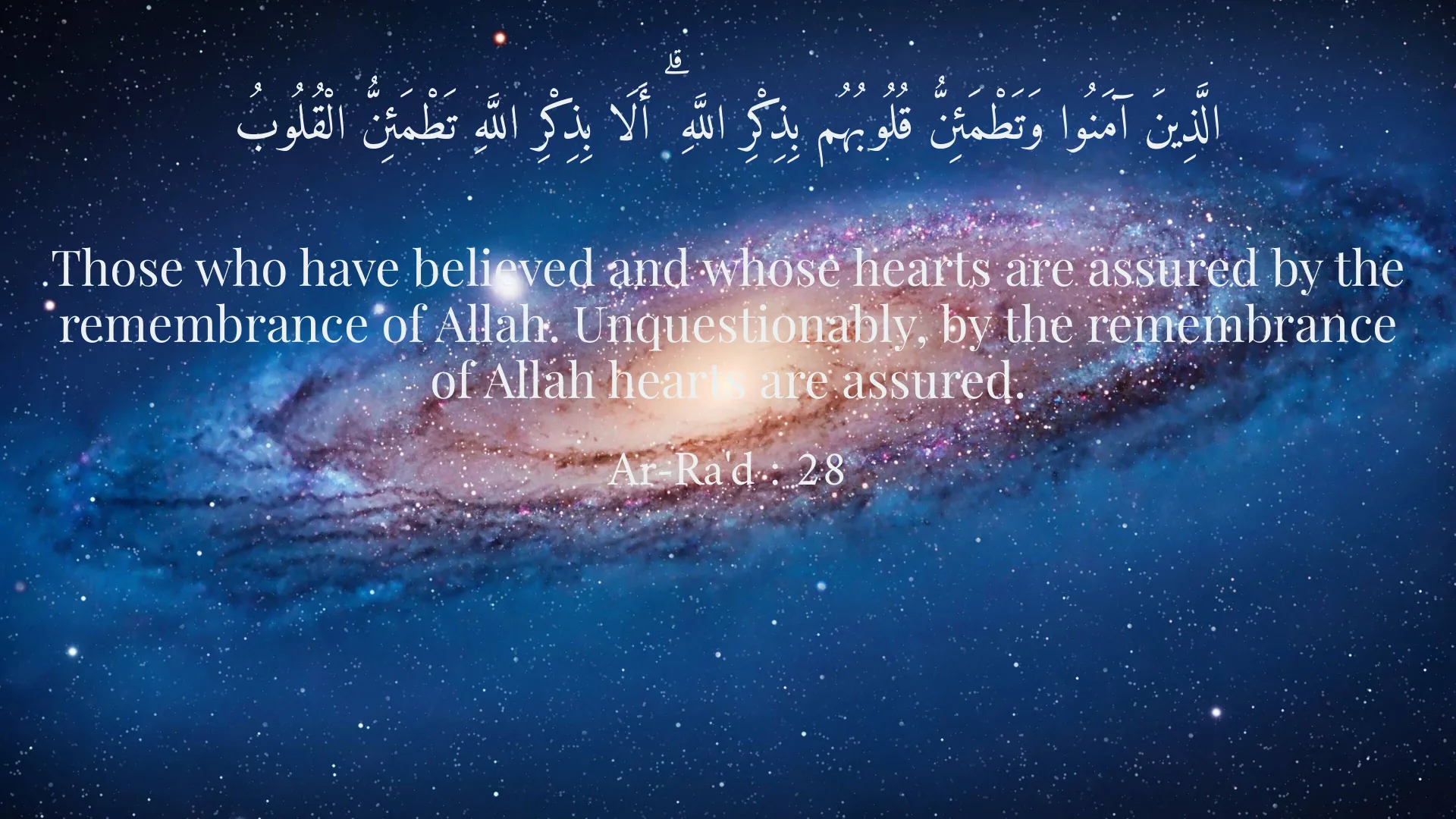
الَّذِينَ آمَنُوا وَتَطْمَئِنُّ قُلُوبُهُم بِذِكْرِ اللَّهِ ۗ أَلَا بِذِكْرِ اللَّهِ تَطْمَئِنُّ الْقُلُوبُ
Those who have believed and whose hearts are assured by the remembrance of Allah. Unquestionably, by the remembrance of Allah hearts are assured.
Ar-Ra'd : 28
وَمَن يَتَوَكَّلْ عَلَى اللَّهِ فَهُوَ حَسْبُهُ ۚ إِنَّ اللَّهَ بَالِغُ أَمْرِهِ ۚ قَدْ جَعَلَ اللَّهُ لِكُلِّ شَيْءٍ قَدْرًا
And whoever relies upon Allah - then He is sufficient for him. Indeed, Allah will accomplish His purpose. Allah has already set for everything a [decreed] extent.
At-Talaq : 3
فَإِنَّ مَعَ الْعُسْرِ يُسْرًا ﴿٥﴾ إِنَّ مَعَ الْعُسْرِ يُسْرًا ﴿٦﴾
For indeed, with hardship [will come] ease. Indeed, with hardship [will come] ease.
Ash-Sharh : 5
Short Story
In ancient times, there lived an ascetic man named Sheikh Abdullah, renowned for his trust in God and contentment. One day, as he journeyed through a desert, his provisions ran out. His companions grew anxious and distressed, but the Sheikh remained calm. He turned towards the heavens and said, "O Lord, You have promised to provide for every living creature. How then can Your servant, who has sought refuge at Your door, be an exception to this rule?" Not an hour passed before a sudden wind arose, and from a distance, a caravan of camels appeared, laden with delicious foods and water. The caravanners, who had lost their way, sought the Sheikh's help upon seeing him. In return, they generously fed and watered him and his companions. Sheikh Abdullah smiled and said, "See how God fulfills His promise. It is only necessary for us to trust in Him with pure intention and be patient." And thus, the faith of his companions in divine promises increased.