Quranic Answer
Repentance in Islam: A Pathway to Forgiveness and Mercy Repentance, or "Tawbah" in Arabic, holds a significant place in the Islamic faith. It represents a profound turning back to Allah, seeking forgiveness for sins and wrongdoings committed throughout one’s life. The concept of repentance is deeply rooted in the teachings of the Holy Quran and the practices of the Prophet Muhammad, which collectively guide Muslims on how to earn Allah's mercy and forgiveness. The Meaning of Repentance At its core, repentance is an acknowledgment of one's faults and a sincere commitment to amend those behaviors. It is not merely a verbal expression but a heartfelt resolution to change one’s ways. The Quran emphasizes that true repentance must emanate from a deep sense of remorse and regret. It is about more than just fear of punishment; it involves understanding the impact of one’s actions and striving to rectify mistakes. The Quran provides numerous verses illustrating the conditions and virtues of repentance. For instance, in Surah Al-Furqan, verse 70, it is stated: "Except for those who repent, believe and do righteous work. For them Allah will replace their evil deeds with good. And ever is Allah Forgiving and Merciful." This verse encapsulates the essence of true repentance: it requires faith and a commitment to righteousness. To be truly forgiven, one must not only express remorse but also take actionable steps toward self-improvement and righteousness. Conditions for Accepting Repentance Islam delineates specific conditions necessary for the acceptance of repentance. The first and foremost condition is sincerity. Repentance must be genuine, stemming from the depths of the heart. It is essential for the individual to feel sincere regret for their transgressions, understanding that every sin is a departure from the mercy of Allah. This sincerity paves the way for a profound transformation in one’s life. Secondly, there must be a resolute intention to abstain from the sins that have been committed. In Surah At-Tahreem, verse 8, Allah commands, "O you who have believed, repent to Allah with sincere repentance." This command implies that true repentance requires effort and commitment, prompting individuals to reflect and monitor their behavior actively. They must resolve to turn away from sinful actions and towards virtuous deeds. Life's Trials: Pathways to Remember Allah Life is fraught with challenges and trials that can serve as reminders for individuals to reflect on their actions and return to Allah. Often, it is during times of hardship that one may find a deeper connection to their spiritual self. Difficulties can prompt sincere repentance, leading believers to seek Allah’s forgiveness passionately. These trials, while burdensome, can thus transform into opportunities for growth and spiritual renewal. It is within these moments that individuals can manifest their commitment to spiritual resilience by turning back to Allah. Therefore, it is essential to view life challenges not merely as obstacles but as pivotal moments for spiritual reflection and redirection. The Importance of Timing in Repentance In Islam, there exists a crucial understanding concerning the timing of repentance. Surah Al-Imran, verse 135, states: "And there is no sin upon them if they repent before Allah." This highlights the profound truth that there remains a window of opportunity for every individual to repent and seek forgiveness, provided they do so sincerely and promptly. Failing to exercise this opportunity can lead to remorse later on, which may not be met with the same sincerity or urgency. Ultimately, timely repentance acts as a safeguard against the accumulation of sins. The Prophet Muhammad emphasized the importance of seeking forgiveness before death approaches, teaching that the gates of repentance remain open to those who sincerely turn back to Allah. Maintaining Hope in Allah's Mercy A significant aspect of repentance in Islam is the unwavering belief in Allah’s mercy. Muslims are encouraged to maintain hope, regardless of the magnitude of their wrongdoings. In various sayings of the Prophet Muhammad, the profound nature of Allah's mercy is emphasized, assuring believers that no sin is too great for forgiveness, provided one approaches it earnestly. This hope is vital not only in encouraging individuals to repent but also in fostering a compassionate community, where individuals support each other in seeking Allah's mercy. By sharing their journeys of repentance, believers can create a culture of accountability and encouragement. Conclusion In conclusion, repentance (Tawbah) in Islam is an essential aspect of the faith that embodies turning back to Allah and seeking forgiveness for sins. It requires sincerity, a heartfelt resolution to change, recognition of life's challenges as opportunities for spiritual growth, and a deep understanding of the importance of timing in seeking forgiveness. Truly, Allah's mercy is vast and all-encompassing, offering a path to redemption for those who strive sincerely to repent. Through adhering to these sublime principles, a believer can foster a deep, meaningful connection with Allah, transforming their lives into one that drips with mercy, forgiveness, and righteousness. In this quest for redemption, one not only seeks personal growth but contributes positively to the community at large, aligning with the very essence of Islamic teachings.
Related Verses
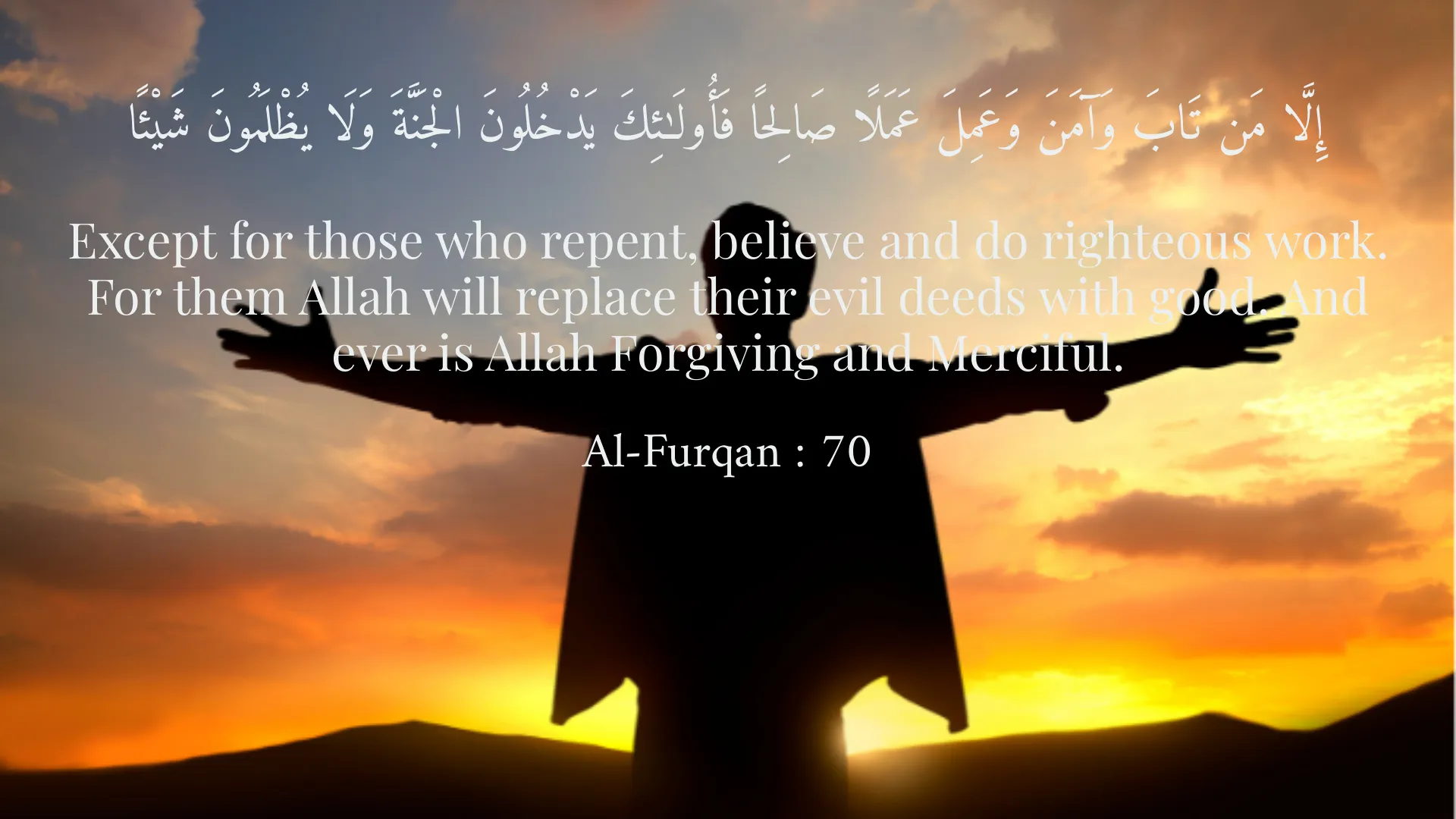
إِلَّا مَن تَابَ وَآمَنَ وَعَمِلَ عَمَلًا صَالِحًا فَأُولَـٰئِكَ يَدْخُلُونَ الْجَنَّةَ وَلَا يُظْلَمُونَ شَيْئًا
Except for those who repent, believe and do righteous work. For them Allah will replace their evil deeds with good. And ever is Allah Forgiving and Merciful.
Al-Furqan : 70
يَـٰٓأَيُّهَا الَّذِينَ آمَنُوا تُوبُوا إِلَى اللَّهِ تَوْبَةً نَّصُوحًا
O you who have believed, repent to Allah with sincere repentance.
At-Tahreem : 8
وَإَن كَانَتْ كَبِيرَةً إِلَّا أَلَّا تَفَارَقُوا حَتَّى تَتُوبُوا
And there is no sin upon them if they repent before Allah.
Al-Imran : 135
Short Story
One day, a pious man went to a temple with a heavy heart seeking forgiveness from Allah. There, he saw an old man praying and said to him, 'Repentance requires sincerity from the heart.' Inspired by the old man's words, the pious man decided to heed his heart and change his life through better actions.