Quranic Answer
Faith and Hypocrisy in the Holy Quran Faith and hypocrisy are two concepts that resonate deeply with the teachings of the Holy Quran, offering a profound understanding of the human condition and the spiritual journey towards a life of righteousness. While faith signifies a sincere belief in Allah and His messengers, hypocrisy represents a facade, a pretense of faith without genuine conviction. This article explores these two contrasting concepts as depicted in the Holy Quran, emphasizing the importance of authenticity in one's beliefs and actions. The Essence of Faith At its core, faith, or 'iman' in Arabic, is described as a state of the heart—a deep-seated belief and trust in Allah's existence, His attributes, and the teachings of the prophets. This belief is not merely theoretical; it is an all-encompassing conviction that translates into actions and behaviors in accordance with Islamic teachings. Faith is nurtured through knowledge, worship, and the development of a deep relationship with Allah. One of the pivotal verses in the Quran that addresses the essence of faith is found in Surah Al-Baqarah. Verse 22 states, 'And when it is said to them, 'Believe as the people have believed,' they say, 'Shall we believe as the foolish have believed?' Unquestionably, it is they who are the foolish, but they do not know.' This verse highlights how some individuals mock the concept of faith, viewing it as inferior or trivial. However, from an Islamic perspective, true faith is characterized by humility, recognition of one's shortcomings, and a deep understanding of the oneness of Allah. Distinguishing Hypocrisy Hypocrisy ('nifaq') contrasts sharply with faith. It refers to the act of displaying outward appearances of faith while internally harboring disbelief or insincerity. The Quran offers various warnings regarding hypocrisy and its severe consequences in the afterlife. The hypocrites are often depicted as individuals who seek to deceive others into believing in their faith while they remain unfaithful in their hearts. A clear illustration of hypocrisy can be seen in the way some respond to the call for faith. They may scoff at those who fervently believe, labeling them as 'foolish' or 'naive.' Such attitudes not only undermine the significance of faith but also reflect a deeper psychological struggle against their own conscience. They fail to recognize that genuine faith leads to enlightenment, while hypocrisy breeds confusion and spiritual torment. Authenticity in Worship To genuinely separate faith from hypocrisy, one must cultivate a sincere and honest inner self. The Quran emphasizes the importance of intention ('niyyah') in worship. In Surah Al-Mu'minun, verse 2 states, 'And those who are conscious of their prayer,' indicating the importance of approaching prayer with humility and sincerity. Prayer is a fundamental act of worship that serves as a direct line of communication between the believer and Allah. It is through this practice that one can reaffirm their faith and strive for closeness to the Creator. Furthermore, the Quran advises believers to be fully aware of the obligations imposed upon them. In Surah Al-Baqarah, verses 1-2, the significance of engaging with the divine guidance contained within the Quran is emphasized. Believers are reminded to reflect upon the Book, understanding its teachings, and applying them in their lives. This deep engagement not only strengthens one's faith but also prevents the slip into hypocrisy by ensuring that actions align with beliefs. The Role of Genuine Intentions Genuine intentions play a crucial role in distinguishing true faith from hypocrisy. The Islamic perspective teaches that outward actions are meaningless if not accompanied by sincere intentions. It is not enough to perform rituals; one must strive to embody the essence of those rituals in their daily lives. For instance, charity ('sadaqah') should be given with the aim of helping others, not for the sake of gaining recognition or status among peers. Similarly, acts of worship should stem from an internal desire to connect with Allah and seek His pleasure, rather than conforming to societal expectations. Moreover, one of the key characteristics of a true believer is the self-awareness of their faith. Believers are encouraged to continuously assess their intentions and actions, ensuring that they are congruent with the teachings of Islam. This self-reflection helps combat the risk of hypocrisy and reinforces the commitment to true faith. Consequences of Hypocrisy The Quran makes it abundantly clear that hypocrisy carries dire consequences. Hypocrites are warned about their fate in the Hereafter, where they will be misled and punished for their insincerity. In various verses across the Quran, Allah states that hypocrites will find themselves in the lowest pits of Hell, reflecting the gravity of their deception. This serves as a moral reminder for believers to be vigilant about their faith, to avoid the pitfalls of hypocrisy, and to strive for integrity in their worship and dealings with others. Conclusion In conclusion, faith and hypocrisy are two fundamentally different concepts outlined in the Holy Quran. Faith is a sincere and profound belief in Allah and His messengers, while hypocrisy is a pretense, an outward display devoid of inner conviction. To cultivate authentic faith, individuals must engage in sincere worship, maintain genuine intentions, and align their actions with their beliefs. The teachings of the Quran guide believers towards a life of sincerity, urging them to reject the superficiality of hypocrisy. Ultimately, the journey toward faith is a personal and introspective one, rooted in the heart and expressed through a commitment to living righteously under the guidance of the Divine.
Related Verses
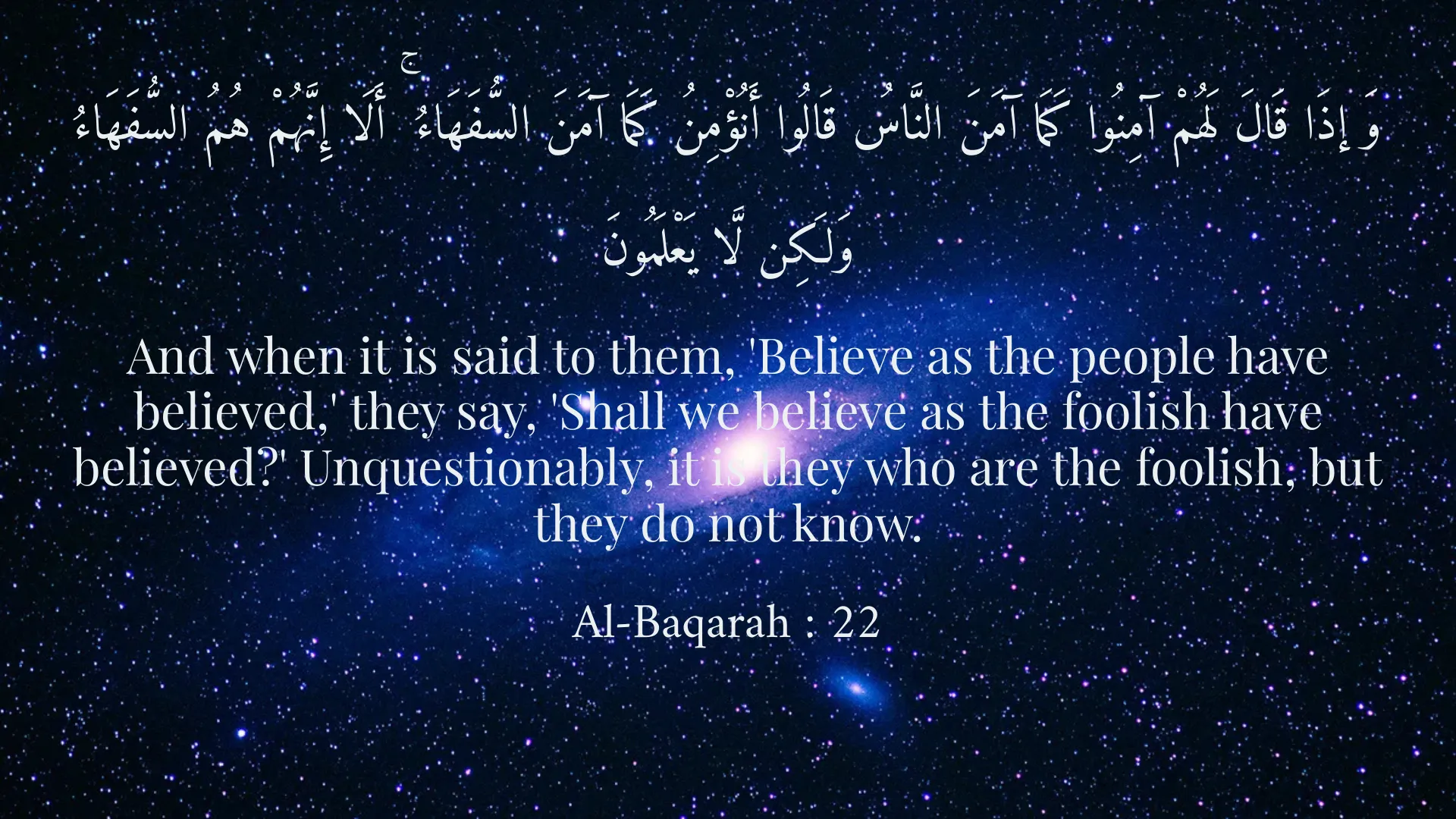
وَ إذَا قَالَ لَهُمْ آمِنُوا كَمَا آمَنَ النَّاسُ قَالُوا أَنُؤْمِنُ كَمَا آمَنَ السُّفَهَاءُ ۚ أَلَا إِنَّهُمْ هُمُ السُّفَهَاءُ وَلَكِن لَّا يَعْلَمُونَ
And when it is said to them, 'Believe as the people have believed,' they say, 'Shall we believe as the foolish have believed?' Unquestionably, it is they who are the foolish, but they do not know.
Al-Baqarah : 22
وَالَّذِينَ هُمْ فِي صَلَاتِهِمْ خَاشِعُونَ
And those who are conscious of their prayer.
Al-Mu'minun : 2
Short Story
Once upon a time, there was a man named Hasan who was troubled by a question in his mind: how could he avoid hypocrisy? He recalled the verses of the Quran and realized he should always have a pure intention for worship. Hasan became humble in his prayers and tried to align his life's aspects with true faith. After some time, he found peace and tranquility in his heart, and he no longer worried about hypocrisy.