Quranic Answer
In the Holy Quran, Allah frequently praises His good servants, underscoring a distinct module of qualities inherent in those who adhere to righteousness. These attributes are not only pivotal in shaping an individual’s character but also serve as a guiding light in navigating social relationships and responsibilities towards others. Through various verses, Allah elaborates on the characteristics of the righteous, illustrating their esteemed status among His creations and reinforcing their role as exemplary figures in society. One of the most remarkable illustrations of righteousness is found in Surah Al-Baqarah, verse 177, where Allah provides a comprehensive definition of what it means to be righteous. The verse states: 'Righteousness is not that you turn your faces toward the east or the west, but [true] righteousness is in one who believes in Allah, the Last Day, the Angels, the Book, and the Prophets and gives his wealth, in spite of love for it, to relatives, orphans, the needy, the traveler, those who ask [for help], and for freeing slaves; and [who] establishes prayer and gives zakah.' This elucidation highlights that righteousness is not merely defined by personal piety or devotion to Allah, but rather signifies a holistic approach encompassing moral integrity and compassion towards others. The mention of 'good deeds towards others' clearly emphasizes that spirituality transcends individual worship; it requires active participation in the well-being of others. Charity, known as Sadaqah or zakah, is an essential component. It is imperative to note that the phrase ‘in spite of love for it’ underscores the importance of selflessness. True righteousness is demonstrated through sacrificial giving, displaying altruistic behavior that prioritizes the needs of others over personal desires. The call to aid relatives, orphans, the needy, and travelers also draws attention to the communal aspect of faith, underscoring the intertwined nature of personal devotion, familial duty, and social responsibility. Moving beyond the individual context, righteousness according to the Quran is foundational in establishing a harmonious society. Righteous individuals play a vital role in engaging with and uplifting their communities, creating a strong web of support that fundamentally enhances societal welfare. This interconnectedness is crucial as it propagates a culture of care, empathy, and compassion, critical for building social cohesion. Moreover, in Surah Al-Imran, verse 133, Allah assures His righteous servants of paradise, stating, 'And hasten to forgiveness from your Lord and a garden as wide as the heavens and the earth, prepared for the righteous.' This promise is profound, as it highlights not only the material benefits of leading a righteous life but also the spiritual rewards that await in the hereafter. The reference to a 'garden as wide as the heavens and the earth' underscores the enormity of Allah's rewards, signifying that those who embody righteousness through obedience to Allah's commands and perseverance in piety shall experience unparalleled happiness and fulfillment after death. The notion of hastening to forgiveness emphasizes the need for individuals to continuously strive for improvement, seek repentance, and work towards rectifying their shortcomings, thus instilling a sense of urgency rather than complacency in their spiritual journey. Additionally, in Surah Al-Mu’minun, verse 11, Allah proclaims, 'And those who will be the inheritors of Paradise will remain therein eternally.' This declaration is significant as it assures believers of a permanent abode in Paradise as a reward for their righteousness. It establishes the essence of faith that not only is there a promise for divine rewards, but also a reiteration of the eternal nature of such rewards, providing comfort and motivation for believers in their lives. The phrase 'will remain therein eternally’ denotes that the righteous will experience enduring bliss free from the pains and tribulations of the worldly life. The assurance of divine blessings manifests a profound understanding of perseverance and continuous faith in Allah's benevolence, accentuating the importance of steadfastness in pursuit of righteousness. From these verses, it is undeniable that righteousness is multifaceted, extending beyond personal behavior into societal interactions, family relations, and knowledge pursuits. The Quran elevates the concept of righteousness to a universal standard, encouraging its followers to embrace and promote righteousness not only for their own spiritual elevation but for the collective betterment of humanity. Such teachings serve as a beacon for believers to reflect upon their actions and ensure that their conduct aligns with their beliefs. Furthermore, fostering such values in family and community settings reinforces the educational aspect of faith as it encourages individuals to engage in discussions and practices that reflect divine wisdom. In conclusion, the Quran's teachings on righteousness encompass a comprehensive lifestyle that advocates for both personal piety and social engagement. The integration of good deeds, charitable actions, and continuous efforts in seeking Allah's forgiveness demonstrates that righteousness is a living principle that governs all aspects of life. As believers strive to imitate the characteristics of the righteous, they not only aim to attain heavenly rewards but also contribute to the greater good of society, thereby establishing a legacy of compassion and moral integrity. The Quran, in directing its followers toward this path, invites them to partake in a journey marked by divine guidance, resulting in a life of purpose, fulfillment, and ultimately, eternal bliss.
Related Verses
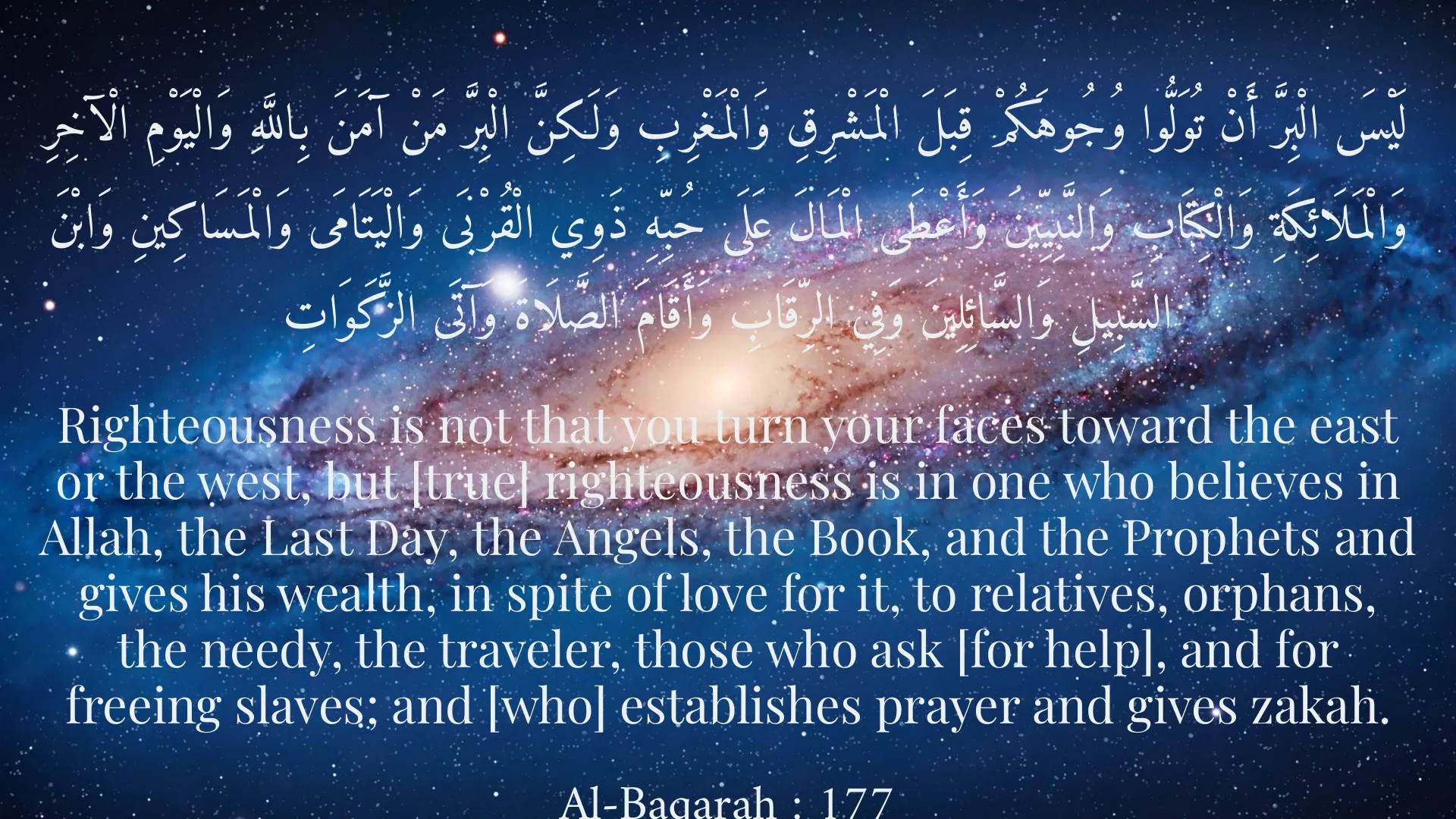
لَيْسَ الْبِرَّ أَنْ تُوَلُّوا وُجُوهَكُمْ قِبَلَ الْمَشْرِقِ وَالْمَغْرِبِ وَلَـكِنَّ الْبِرَّ مَنْ آمَنَ بِاللَّهِ وَالْيَوْمِ الْآخِرِ وَالْمَلَائِكَةِ وَالْكِتَابِ وَالنَّبِيِّينَ وَأَعْطَى الْمَالَ عَلَى حُبِّهِ ذَوِي الْقُرْبَى وَالْيَتَامَى وَالْمَسَاكِينِ وَابْنَ السَّبِيلِ وَالسَّائِلِينَ وَفِي الرِّقَابِ وَأَقَامَ الصَّلَاةَ وَآتَى الزَّكَوَاتِ
Righteousness is not that you turn your faces toward the east or the west, but [true] righteousness is in one who believes in Allah, the Last Day, the Angels, the Book, and the Prophets and gives his wealth, in spite of love for it, to relatives, orphans, the needy, the traveler, those who ask [for help], and for freeing slaves; and [who] establishes prayer and gives zakah.
Al-Baqarah : 177
وَسَارِعُوا إِلَى مَغْفِرَةٍ مِّن رَّبِّكُمْ وَجَنَّةٍ عَرْضُهَا كَعَرْضِ السَّمَاءِ وَالْأَرْضِ أُعِدَّتْ لِلْمُتَّقِينَ
And hasten to forgiveness from your Lord and a garden as wide as the heavens and the earth, prepared for the righteous.
Al-Imran : 133
أُو۟لَـٰئِكَ هُمُ الْوَارِثُونَ
And those who will be the inheritors of Paradise.
Al-Mu'minun : 11
Short Story
One day, a young man named Ali was inspired by the concept of righteousness. He helped people every day and strived to be proactive in his good behavior towards others. He decided to dedicate a portion of his earnings to those in need every week. Ali noticed that with each act of kindness he performed, his heart felt more at peace and he experienced joy. By embodying the teachings of the Quran, he discovered the true essence of goodness and directed his life towards improvement.