Quranic Answer
In today's world, where financial and economic concerns consume a significant portion of our daily lives, maintaining faith and inner peace can seem incredibly challenging. However, the Holy Quran, as the divine word and a comprehensive guide for life, offers profound and practical teachings to navigate these challenges. These teachings not only help us cope with financial difficulties but also serve as a means to strengthen faith and achieve true tranquility. The first and perhaps most crucial principle that the Quran teaches us in facing financial worries is the concept of 'Tawakkul' or complete reliance on Allah. Tawakkul means absolute and sincere trust in the Lord, who is the ultimate Provider, and there is no creature on earth whose provision is not with Allah. This concept is clearly articulated in Surah Hud, verse 6: 'And there is no creature on earth but that upon Allah is its provision.' This verse reassures us that even in the most difficult financial circumstances, one should not despair of Allah's grace and generosity. True Tawakkul does not mean abandoning effort and waiting for a miracle; rather, it implies that after exhausting all possible and legitimate endeavors, one entrusts the outcome to Allah Almighty. This act of surrendering the outcome to God removes a heavy burden from a person's shoulders, bringing about inner peace. When we arrive at the conviction that Allah is the true Sustainer and never abandons His servants, many of our financial anxieties and worries diminish significantly. The second point, repeatedly emphasized in the Holy Quran, is 'Patience (Sabr) and Prayer (Salat).' In Surah Al-Baqarah, verse 153, it states: 'O you who have believed, seek help through patience and prayer. Indeed, Allah is with the patient.' This verse instructs believers to seek assistance through patience and prayer when facing hardships. Patience here means resilience in the face of problems, enduring difficulties, and avoiding distress or complaint. Prayer, as the pillar of religion and the believer's ascension, is a direct means of communication with Allah and a source of spiritual peace and strength. When a person stands in prayer amidst financial preoccupations, they are freed from all worldly concerns and engage in intimate communion with their Creator. This spiritual connection imbues a person with the strength to confront financial issues from a broader perspective and to not lose hope. Patience teaches us that every hardship has an end, and every rise and fall in life carries a divine wisdom. These two pillars, patience and prayer, are not merely tools for maintaining faith in the face of financial troubles, but are generally considered the mainstays of human spiritual and mental stability against all adversities of life. A third crucial point is 'Gratitude (Shukr) and Contentment (Qana'ah).' Even amidst severe financial difficulties, the Quran calls us to express gratitude for the blessings we possess. In Surah Ibrahim, verse 7, we read: 'If you are grateful, I will surely increase you [in favor]; but if you deny, indeed, My punishment is severe.' This verse promises an increase in blessings for the grateful. Gratitude, even for small things, shifts a person's perspective from what they lack to what they have, fostering a sense of satisfaction and peace. Contentment, on the other hand, means being satisfied with what Allah has bestowed and avoiding excessive greed and covetousness. Contentment does not imply that one should stop striving to improve their financial situation, but rather that one should not attach their heart to worldly possessions and be pleased with what they have. This attitude frees a person from endless worries about acquiring more and comparing themselves to others, allowing them to enjoy their life even with minimal resources and achieve inner tranquility. When we are appreciative of the small and large blessings we have, even in difficult circumstances, a sense of abundance and blessing flows into our lives, and this itself helps strengthen faith. The fourth principle is 'Charity (Infaq) and Helping the Needy.' It might seem counterintuitive that during times of financial strain, the Quran encourages us to give and help others. However, the Holy Quran regards charity not merely as an expense but as a spiritual investment that brings blessings and increases provision. In Surah Al-Baqarah, verse 261, it states: 'The example of those who spend their wealth in the way of Allah is like a seed [of grain] which grows seven spikes; in each spike is a hundred grains. And Allah multiplies [His reward] for whom He wills. And Allah is all-Encompassing and Knowing.' This verse likens spending in the way of Allah to a seed that produces seven ears, with a hundred grains in each ear. This divine promise assures the believer that giving charity does not diminish their wealth but rather increases it and blesses it. Beyond worldly blessings, charity strengthens empathy and social responsibility in a person, freeing them from focusing solely on personal problems and guiding them towards a broader view of society. This act eliminates selfishness and demonstrates to a person that what they possess is a trust from God that should be used in the right way. Finally, recalling the 'philosophy of divine trials' in life and the 'transient nature of the world' can help us maintain faith. In Surah Al-Baqarah, verse 155, the Quran states: 'And We will surely test you with something of fear and hunger and a loss of wealth and lives and fruits, but give good tidings to the patient.' This verse explicitly states that Allah tests His servants with fear, hunger, loss of wealth, lives, and crops. Financial difficulties can also be part of this divine test, the purpose of which is to gauge the extent of a servant's faith, patience, and reliance on God. By understanding this philosophy, instead of despairing, one seeks to successfully pass this trial. Furthermore, awareness of the transient nature of this world and that all worldly possessions are temporary can alleviate the intensity of financial worries. The Quran repeatedly points out that the life of this world is a fleeting and brief enjoyment, and the true reward is in the Hereafter. This perspective helps a person put financial concerns in their proper place and not allow them to overshadow their entire life and faith. In summary, through reliance on Allah, patience, prayer, gratitude, contentment, charity, and a correct understanding of the philosophy of divine trials and the transient nature of this world, one can maintain faith amidst the most severe financial worries and attain true inner peace.
Related Verses
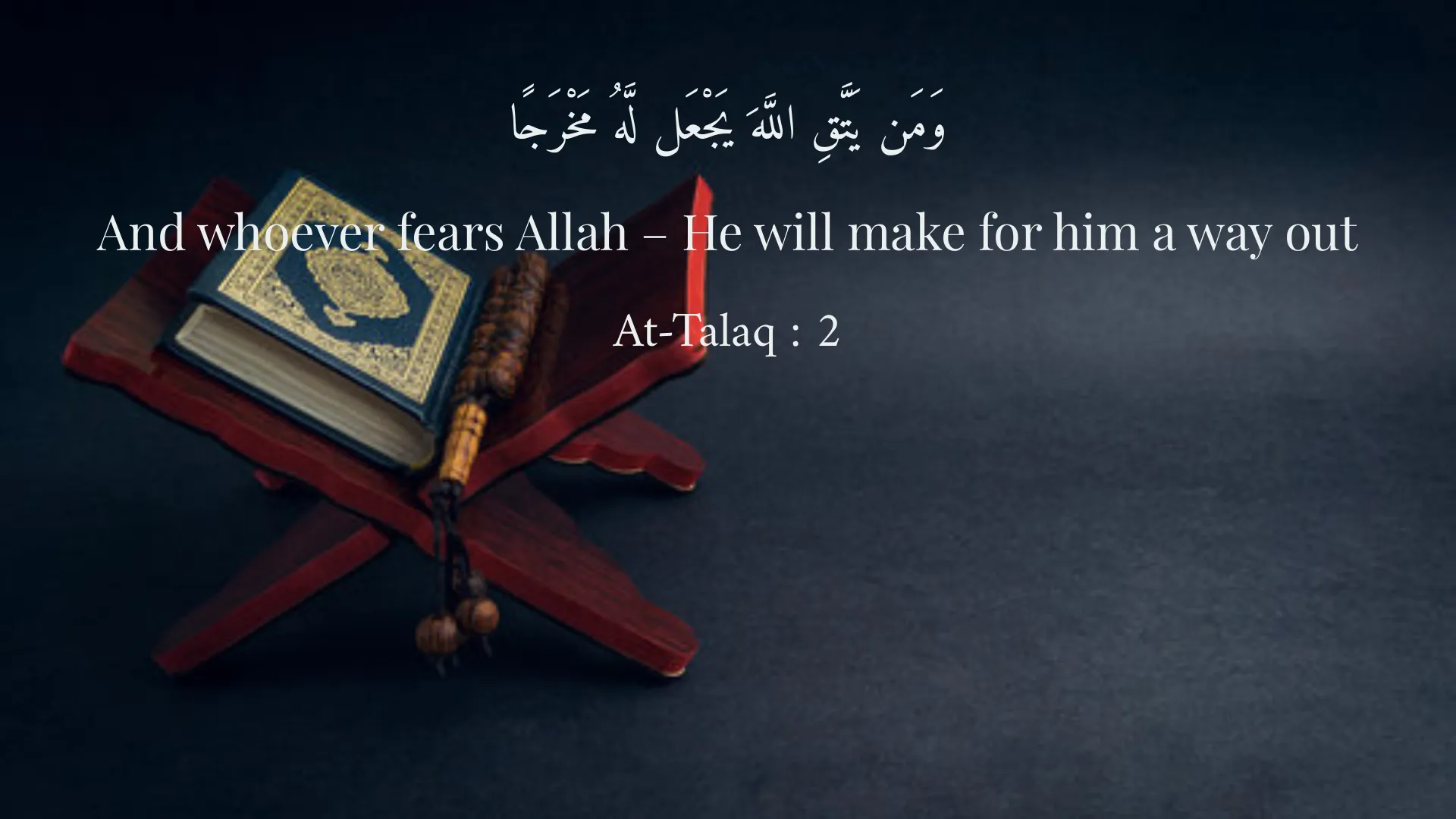
وَمَن يَتَّقِ اللَّهَ يَجْعَل لَّهُ مَخْرَجًا
And whoever fears Allah – He will make for him a way out
At-Talaq : 2
وَيَرْزُقْهُ مِنْ حَيْثُ لَا يَحْتَسِبُ ۚ وَمَن يَتَوَكَّلْ عَلَى اللَّهِ فَهُوَ حَسْبُهُ ۚ إِنَّ اللَّهَ بَالِغُ أَمْرِهِ ۚ قَدْ جَعَلَ اللَّهُ لِكُلِّ شَيْءٍ قَدْرًا
And will provide for him from where he does not expect. And whoever relies upon Allah – then He is sufficient for him. Indeed, Allah will accomplish His purpose. Allah has already set for everything a [decreed] extent.
At-Talaq : 3
يَاأَيُّهَا الَّذِينَ آمَنُوا اسْتَعِينُوا بِالصَّبْرِ وَالصَّلَاةِ ۚ إِنَّ اللَّهَ مَعَ الصَّابِرِينَ
O you who have believed, seek help through patience and prayer. Indeed, Allah is with the patient.
Al-Baqarah : 153
وَمَا مِن دَابَّةٍ فِي الْأَرْضِ إِلَّا عَلَى اللَّهِ رِزْقُهَا وَيَعْلَمُ مُسْتَقَرَّهَا وَمُسْتَوْدَعَهَا ۚ كُلٌّ فِي كِتَابٍ مُّبِينٍ
And there is no creature on earth but that upon Allah is its provision; and He knows its dwelling place and its depository. All is in a clear register.
Hud : 6
Short Story
It is narrated in Saadi's Golestan that a wealthy, anxious man, constantly striving to increase his fortune and thus never at peace, once encountered a dervish sitting peacefully by a flowing stream, content with only a crust of bread and some herbs. The wealthy man, astonished, asked: "O Dervish, how can you be so carefree and at peace amidst such poverty?" The dervish smiled and replied: "My friend, you constantly bear the burden of preserving and increasing your wealth, living day and night in fear and hope. But I have entrusted my provision to a generous Provider who has promised sustenance for all creatures. My heart is light, for I know that what comes from Him is sufficient, and what goes was not truly mine to begin with. Therefore, my sorrow is less than yours." This tale teaches us that peace and faith reside more in reliance and contentment than in treasures and riches.