Quranic Answer
In the Holy Quran, the themes of difficulties and adversities in life are extensively discussed. The Quran serves as a source of wisdom, emphasizing that trials and tests are inherent parts of the human experience. It teaches us that enduring hardships does not necessarily equate to punishment for sins, rather, it is a means through which individuals can grow closer to God. This article aims to explore these themes by delving deeply into Quranic verses and their implications for the human spirit. From the very outset, we see in Surah Al-Baqarah, verse 155, where Allah (SWT) states: ‘And We will surely test you with something of fear and hunger and a loss of wealth and lives and fruits, and give good tidings to the patient.’ This verse encapsulates the essence of the human condition, highlighting that tests may come in various forms—fear, hunger, loss, and ultimately, death. It serves as a reminder that life is not merely a continuum of joy but is also accompanied by episodes of trial and tribulation that test our resilience, patience, and faith. The verse eloquently suggests that such trials are not negative outcomes, but rather opportunities designated by Allah to measure one’s patience (Sabr) and faith (Iman). It establishes a foundational understanding that hardships can be gateways to personal and spiritual growth. The trials encountered can encourage individuals to dig deep into their own resilience, confront fears, and nurture a connection with the divine. This analysis finds further substantiation in Surah Al-Imran, verse 186, where Allah (SWT) reassures, ‘Indeed, Allah is with the patient.’ This divine assurance signifies that during moments of adversity, believers are not alone. There is an implicit promise that the believers will receive support and guidance from God in their times of need. In fact, this verse could be interpreted as a divine endorsement of patience, encouraging individuals to endure challenges without succumbing to despair or frustration. The Quran thus highlights that trials can provide profound opportunities for change and growth. For instance, during times of personal loss or adversity, one might find themselves drawn closer to God, either through prayer, reflection, or by seeking forgiveness and mercy. Such instances often illuminate the understanding of what is truly essential in our lives and direct our focus toward reverence and worship of Allah. In this way, hardships can serve as a pivotal turning point, a chance for renewal and spiritual introspection. Furthermore, it is essential to recognize that not all adversities are direct punishments for wrongdoing. Often, life’s struggles can manifest as a cumulative result of our own decisions or the circumstances we find ourselves in. Decisions made in moments of weakness or haste can lead to challenges that compel us to reflect on our actions. However, this observation does not imply that every hardship is a punishment for sin. Instead, it highlights the complexity of life, where challenges serve as lessons to learn from, ultimately nudging us toward a path of righteousness and growth. A profound understanding arises when we consider that some adversities can be entirely independent of one’s moral standing. They may be global tragedies such as natural disasters or pandemics that strike indiscriminately, affecting all people regardless of their faith or actions. In these contexts, the Quranic perspective encourages believers to maintain faith and navigate through the trials with patience, knowing that their response to adversity can also be a form of worship. Moreover, the need for community support becomes crucial during challenging times. The Quran encourages social solidarity and emphasizes the importance of helping one another through difficult times. As articulated in Surah Al-Ma’idah, verse 32, Allah mentions that saving a single life holds immense value. This reinforces the idea that enduring hardships can be a collective experience, and in turn, our humanity is showcased in how we support one another. Adversity can also serve as a catalyst for empathy. Experiencing hardship imbues individuals with a deeper understanding of the struggles faced by others. Individuals who have navigated their own difficulties may be more inclined to lend a hand to those who are suffering. This can foster a compassionate community where shared experiences help bolster mutual support. In conclusion, the Quran teaches us that hardship is an intrinsic part of life’s journey. It functions as a mechanism by which we can cultivate patience, deepen our faith, and reconnect with the essence of our existence—our relationship with Allah. While some adversities may stem from our choices, others can arise from circumstances beyond our control. Regardless of their origin, it remains imperative to approach challenges with resilience and maintain the conviction that God is with the patient. Ultimately, life’s tribulations remind us of the ephemeral nature of worldly existence and compel us to seek connections with what is eternal. In the end, through the lens of the Quran, we are encouraged to face life’s tests with grace, understanding, and unwavering faith, fostering a transformative journey that leads us closer to our Creator.
Related Verses
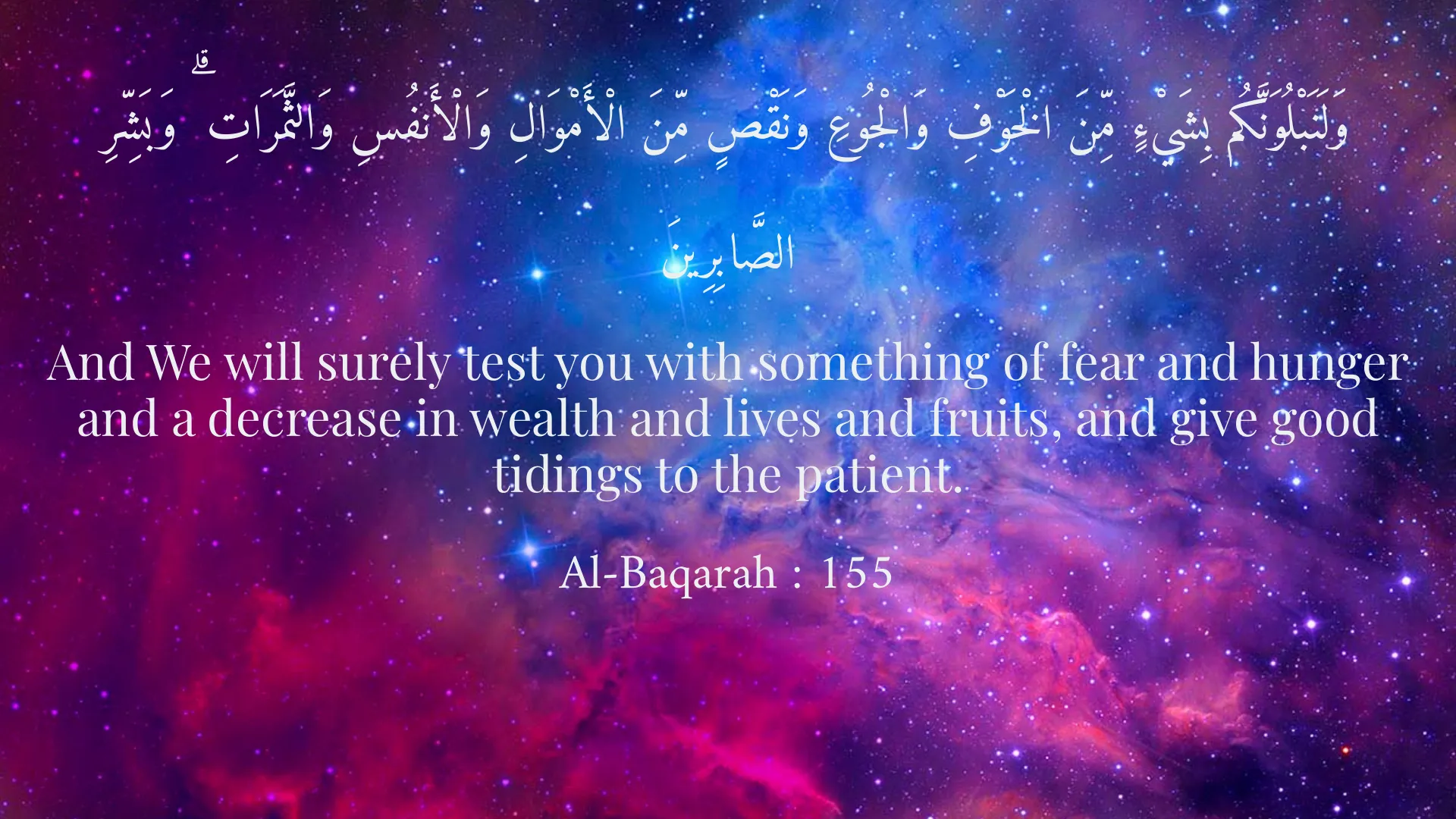
وَلَنَبْلُوَنَّكُم بِشَيْءٍ مِّنَ الْخَوْفِ وَالْجُوعِ وَنَقْصٍ مِّنَ الْأَمْوَالِ وَالْأَنفُسِ وَالثَّمَرَاتِ ۗ وَبَشِّرِ الصَّابِرِينَ
And We will surely test you with something of fear and hunger and a decrease in wealth and lives and fruits, and give good tidings to the patient.
Al-Baqarah : 155
إِنَّ اللَّهَ مَعَ الصَّابِرِينَ
Indeed, Allah is with the patient.
Al-Imran : 186
Short Story
One day, a young man named Sajjad became upset and despaired due to the problems in his life. He thought that perhaps these hardships were a punishment for his sins. However, a wise figure passed by and said, 'O Sajjad, know that hardships are not always a result of sin; they can be a test from God.' After hearing this, Sajjad decided to be patient and draw closer to God instead of feeling hopeless. Over time, he found a greater sense of peace and realized that his struggles had led to his growth in faith.