Quranic Answer
The question of whether worldly failures signify a person's distance from Almighty God delves into a profound aspect of human experience and divine wisdom, as understood through the Holy Quran. At first glance, based on superficial interpretations, some might assume that if someone experiences failure, they must have incurred God's displeasure or deviated from His path. However, a careful contemplation and precise examination of the luminous verses of the Holy Quran reveal a far more nuanced and often incorrect understanding of divine wisdom and His practices in this world. The Quran explicitly shows that worldly life is full of trials and tests, and success and failure, hardship and ease, are all inseparable components of this grand stage of divine probation. Allah states clearly in the Holy Quran that humans are constantly subjected to trials. In Surah Al-Baqarah, verse 155, we read: “And We will surely test you with something of fear and hunger and a loss of wealth and lives and fruits, but give good tidings to the patient.” This verse clearly indicates that afflictions, hardships, and deficiencies in life – which in a general sense can be considered as 'failures' – are part of Allah's tradition to test the faith and patience of His servants. Similarly, in Surah Al-Anbiya, verse 35, it states: “Every soul will taste death. And We test you with evil and with good as trial; and to Us you will be returned.” This verse emphasizes that we are tested with both 'evil' (hardships and failures) and 'good' (successes and blessings). Therefore, experiencing failure is not a sign of distance, but rather a sign of being placed in the crucible of divine testing. Looking at the lives of the Prophets (peace be upon them all) also testifies to this truth. The Prophets of Allah, who were among the closest and most beloved servants of God, faced the most severe trials and the greatest apparent 'failures' during their lives. Prophet Noah (peace be upon him) preached monotheism to his people for centuries, yet only a few believed in him; was this a sign of his distance from God? Absolutely not. Prophet Yusuf (Joseph) was thrown into a well by his brothers and spent years unjustly imprisoned; these events were significant worldly setbacks, but never meant he was far from God, rather they led to the elevation of his status and character. Prophet Ayub (Job) was tested with severe illness and the loss of his wealth and children, but his unparalleled patience showed the pinnacle of his closeness to his Lord. Even the Prophet Muhammad (peace be upon him), the most beloved of Allah's creation, faced persecution, economic boycotts, and military setbacks like the Battle of Uhud during his prophethood. These Quranic and historical evidences clearly show that trials and hardships, even if they appear as great worldly failures, can be a means of drawing closer to Allah and elevating one's ranks, not of moving away. The key to understanding this issue lies in the quality of a person's reaction to failure. The Holy Quran advises believers to resort to patience (sabr) and prayer (salat) when facing difficulties and setbacks. In Surah Al-Baqarah, verse 153, Allah says: “O you who have believed, seek help through patience and prayer. Indeed, Allah is with the patient.” This verse teaches us that in difficult moments, instead of despairing or feeling abandoned, we should return to God with a calm and trusting heart. Failure can be an opportunity for self-improvement, re-evaluation of actions, and strengthening one's reliance on Allah (tawakkul) (Al-Imran, verse 159: “…So when you have decided, then rely upon Allah. Indeed, Allah loves those who rely [upon Him].”). When a person surrenders wholeheartedly to divine wisdom and will, even the most apparent failures can become stepping stones for spiritual and moral growth. Divine wisdom is hidden behind many events, even those that seem adverse at first glance. The story of Prophet Moses (peace be upon him) and Al-Khidr (peace be upon him) in Surah Al-Kahf (verses 60 to 82) is a prime example of this truth. Al-Khidr’s actions seemed strange and even unjust from Moses’ perspective (like damaging a boat or killing a boy), but eventually, it was revealed that each of these actions had a divine wisdom and a great good behind it, hidden from ordinary human perception. This story shows that sometimes what we call 'failure' or 'bad luck' is in fact a divine measure to protect us from a greater calamity or to guide us to a better path, known only to Him. Therefore, failure in worldly affairs is never a definitive sign of being far from God. True distance from God occurs when a person, in the face of difficulties, despairs, disbelieves, loses patience, or turns away from His servitude. Worldly failures can be a means of expiating sins, experiencing humility, gaining a deeper understanding of human weaknesses and the need for the Creator, and ultimately strengthening faith. Both success and failure are tools in the hands of Allah to guide humanity towards perfection and divine proximity. The main importance lies in how we respond to these tests and whether, under all circumstances, our hearts remain connected to the remembrance and love of Allah. The ultimate goal of a believer is to achieve eternal salvation, as stated in Surah Al-Imran, verse 185: “Every soul will taste death, and you will only be given your [full] compensation on the Day of Resurrection. So he who is drawn away from the Fire and admitted to Paradise has succeeded. And what is the life of this world except the enjoyment of delusion.” This verse emphasizes that true success is attaining Paradise and being saved from Hellfire, not merely succeeding in worldly life. Apparent failure in this world can pave the way for this great salvation, if it is accompanied by faith and patience. In conclusion, failures should not be seen as a sign of divine wrath. Instead, they should be considered opportunities for repentance, learning, and a deeper reliance on Allah’s infinite power. Allah is always near, and His doors of mercy are open; it is we who sometimes, through despair and sin, distance ourselves from His compassionate embrace.
Related Verses
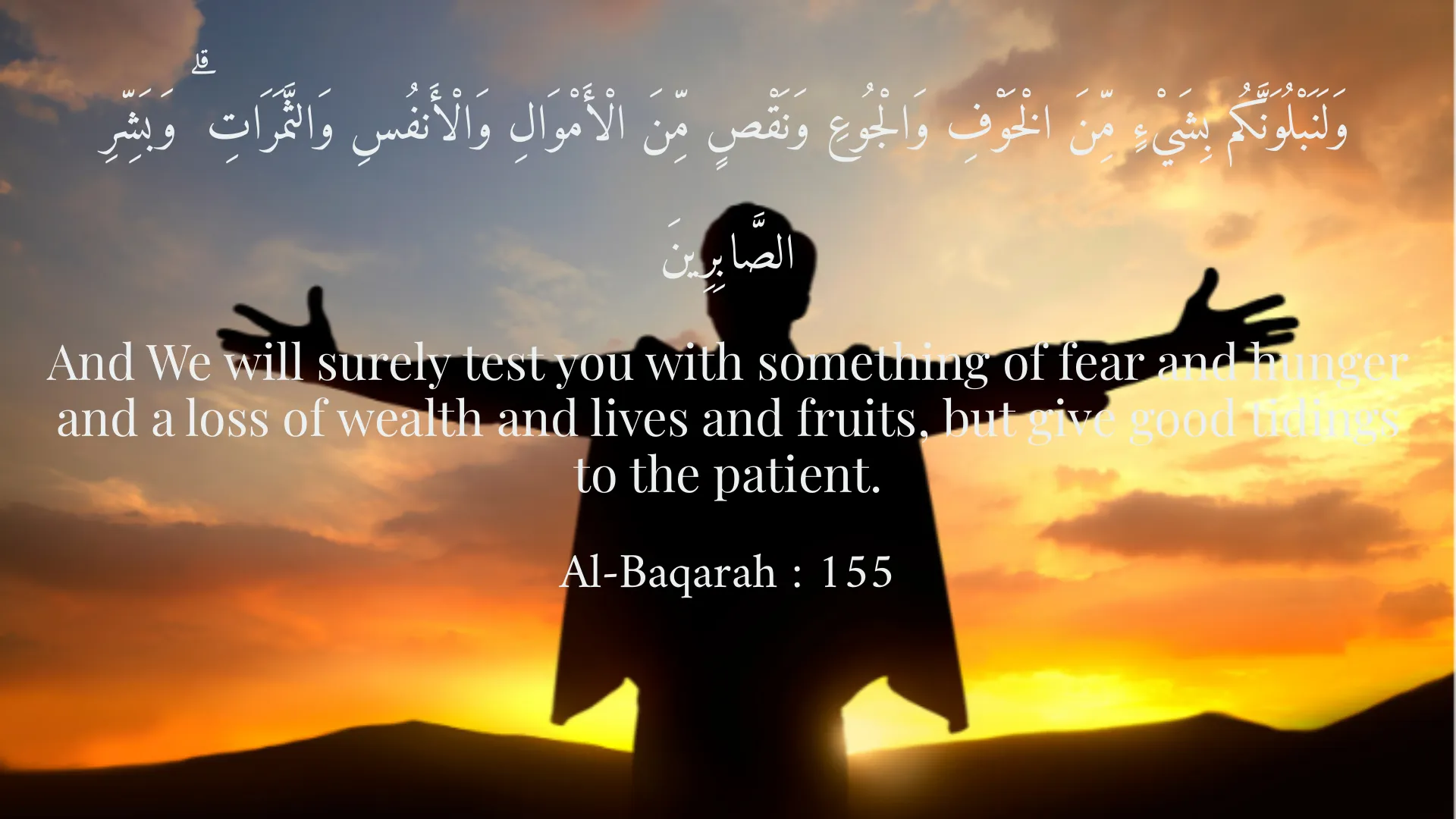
وَلَنَبْلُوَنَّكُم بِشَيْءٍ مِّنَ الْخَوْفِ وَالْجُوعِ وَنَقْصٍ مِّنَ الْأَمْوَالِ وَالْأَنفُسِ وَالثَّمَرَاتِ ۗ وَبَشِّرِ الصَّابِرِينَ
And We will surely test you with something of fear and hunger and a loss of wealth and lives and fruits, but give good tidings to the patient.
Al-Baqarah : 155
كُلُّ نَفْسٍ ذَائِقَةُ الْمَوْتِ ۗ وَنَبْلُوكُم بِالشَّرِّ وَالْخَيْرِ فِتْنَةً ۖ وَإِلَيْنَا تُرْجَعُونَ
Every soul will taste death. And We test you with evil and with good as trial; and to Us you will be returned.
Al-Anbiya : 35
يَاأَيُّهَا الَّذِينَ آمَنُوا اسْتَعِينُوا بِالصَّبْرِ وَالصَّلَاةِ ۚ إِنَّ اللَّهَ مَعَ الصَّابِرِينَ
O you who have believed, seek help through patience and prayer. Indeed, Allah is with the patient.
Al-Baqarah : 153
Short Story
It is narrated in Saadi's Bustan that a pious merchant, after years of diligent work in trade, suffered a great loss and lost all his wealth. He, who had previously been grateful for his prosperity, now sat in a corner, head bowed, thinking he had been deprived of divine grace. One of his friends, a wise and mystic man, consoled him, saying: "My brother, what has happened to you that you sit so sorrowfully? Do you not know that this world is a place of change and transformation? Neither successes are permanent, nor are failures eternal. God sometimes tests His servants with abundance and sometimes with scarcity, to see to whom they have entrusted their hearts in every state. Did you not see Prophet Ayub (peace be upon him), despite all those great afflictions, his faith did not diminish even an iota, and he remained patient? He was the closest to God even in the peak of hardships. Never think that failure in business is a sign of being distant from God. Rather, perhaps this trial is for the purification of your soul, so that you may be freed from worldly attachments and entrust your heart more to your Creator. If in this state too you remain grateful and rely upon Him, this hardship will become a bridge to draw closer to Him, not to move away. He who remembers God even in failure will find Him as a companion and guide." The merchant's spirit was renewed by these wise words, and he understood that true peace lies in submission and reliance on divine will, not in the ups and downs of life. With a fresh heart, he once again exerted himself, this time not for wealth, but for the pleasure of the Almighty, and in this path, he found a peace greater than any fortune.