Quranic Answer
In the Holy Quran, the relationship between faith and good deeds emerges as a pivotal theme that resonates through various verses, presenting them as two intertwined elements essential for a believer's spiritual journey. The Quran elucidates that faith (Iman) and righteous actions (Amal Saleh) are not independently sufficient but are intrinsically connected, each enhancing the quality and acceptance of the other. As a book of guidance, the Quran provides numerous verses that express this profound connection, culminating in a comprehensive understanding of what it means to lead a life in accordance with Islamic principles. To explore the breadth of this relationship, we can begin by delving into Surah Al-Baqarah, verse 277, where Allah proclaims, 'Indeed, those who have believed and done righteous deeds will have gardens in Paradise, wherein they abide eternally, and they will not be unjustly treated.' This verse unequivocally delineates that the promise of Paradise is reserved for those who not only possess faith but complement it with good deeds\. The gardens of Paradise symbolize the ultimate reward and the eternal rest that awaits the believers. Here, one can see that faith serves as the foundation, while good deeds represent the structure built upon that foundation. Moreover, Surah Al-Imran, verse 92, elaborates further on the importance of intention behind good deeds: 'Never will you attain good until you spend from that which you love.' This verse stresses that mere acts of charity or righteousness, devoid of sincere intention or faith in God, do not equate to true goodness. It points out that what one gives or does should stem from genuine affection and sincerity, as authentic faith manifests in human actions. Thus, it illustrates that while good deeds are necessary, they must be accompanied by faith and intention to be duly recognized and rewarded. The relationship between faith and good deeds can also be analyzed through the lens of spiritual humility, which is exemplified in Surah Al-Mu'minun, verses 1-2: 'Certainly will the believers have succeeded: They who are during their prayer humbly submissive.' Here, humility in prayer is indicative of a deeper state of belief and submission to God, suggesting that true faith fosters a humble heart which in turn influences one’s actions. A believer's avoidance of futile matters, in lieu of focusing on prayer and worship, serves as a hallmark of their commitment, linking their inner faith to their outward expressions of righteousness. By synthesizing these verses, one can draw a compelling conclusion that in Islam, the amalgamation of faith and deeds is not merely a theoretical concept but a practical and lived reality. Belief in God and the Day of Judgment serves as the ethical compass for actions in the here and now, embodying the essence of a life lived in accordance with divine guidance. The Quran urges believers to strengthen their faith to inspire righteous conduct, as one's actions are a reflection of their belief system. The teachings of the Quran emphasize that faith without action is often insufficient, while action devoid of genuine faith may lack spiritual merit. This interconnectedness calls for believers to strive to enhance both - their internal belief and their external actions. The holistic approach of fostering both aspects leads to a fulfilling spiritual life and, ultimately, to the promised reward of Paradise. Furthermore, this interdependence between faith and good deeds serves practical purposes in the lives of Muslims. It cultivates a moral framework where individuals are motivated to perform righteous acts not just out of obligation but as an intrinsic part of their faith journey. The synergy created by believing and acting fosters a community of care, compassion, and ethical behavior, essential for societal harmony and personal growth. The Quran’s approach to the integration of faith and deeds reflects a comprehensive ethos that extends beyond theological understanding into practical application. It calls on individuals to reflect upon their actions and intentions continually, aligning them with the values as prescribed by divine commandments. This is a recurring motif throughout Islamic teachings, where self-assessment and personal growth are prioritized to ensure both the acceptance of individual deeds and the ultimate attainment of a fruitful afterlife. Consequently, believers are encouraged to engage actively in good deeds that cater to the welfare of others while simultaneously nurturing their belief. The collective benefits of this principle resonate through numerous dimensions, including emotional satisfaction, social responsibility, and personal development, ultimately driving a believer closer towards a genuine manifestation of faith in their everyday lives. In conclusion, the Quran eloquently imparts that faith and good deeds are essential pillars of a Muslim's life. The relationship between these two elements is geared towards ensuring that neither stands alone; both must coexist and complement one another. A life devoted to faith, characterized by righteous actions, can bring forth both spiritual fulfillment and societal progress. The clear directives and encouragements found within the Quran guide believers toward a path that intertwines their faith with purposeful actions, forging a connection that is not only paramount for individual salvation but also essential for the collective betterment of humanity.
Related Verses
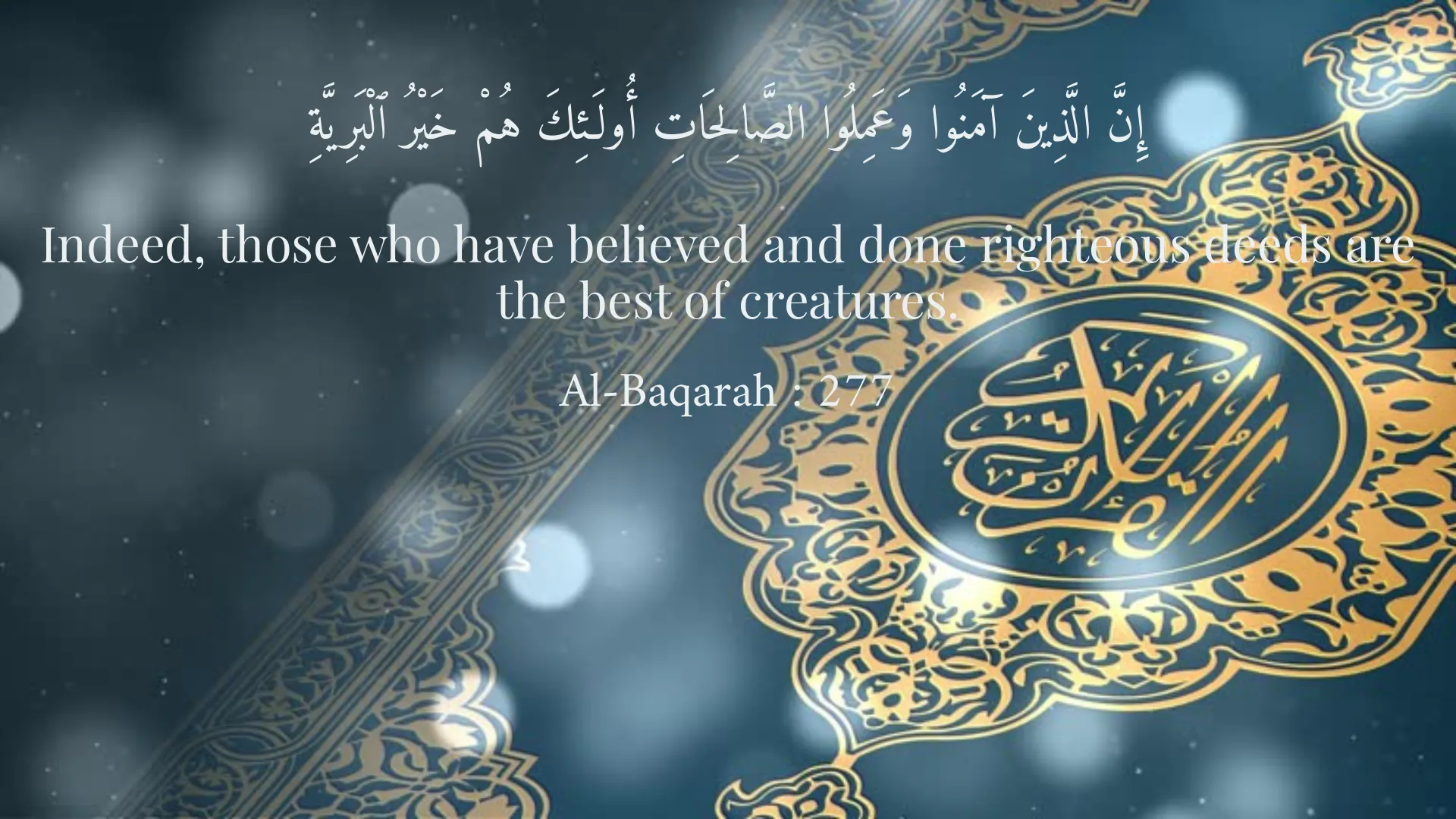
إِنَّ الَّذِينَ آمَنُوا وَعَمِلُوا الصَّالِحَاتِ أُولَـئِكَ هُمْ خَيْرُ ٱلْبَرِيَّةِ
Indeed, those who have believed and done righteous deeds are the best of creatures.
Al-Baqarah : 277
لَن تَنَالُوا ٱلْبِرَّ حَتَّى تُنفِقُوا مِمَّا تُحِبُّونَ ۗ وَمَا تُنفِقُوا مِن شَيْءٍ فَإِنَّ ٱللَّهَ بِهِۦ عَلِيمٌ
Never will you attain good until you spend from that which you love. And whatever you spend, indeed, Allah is Knowing of it.
Al-Imran : 92
قَدْ أَفْلَحَ ٱلْمُؤْمِنُونَ
Certainly will the believers have succeeded.
Al-Mu'minun : 1
Short Story
One day, Adel decided to engage in good deeds, yet he had doubts in his heart about whether these acts were valuable without faith in God. He recalled a verse from the Quran that said, 'Indeed, righteous deeds are not accepted without faith.' He then decided to strengthen his faith first, and only then would he engage in good deeds. After this decision, not only did he feel happier, but his deeds bore more fruit and blessings with pure intentions.