Quranic Answer
In the Holy Quran, piety, known as 'taqwa,' is presented as one of the most pivotal religious concepts that guide the lives of Muslims. It serves as a compass to navigate the complexities of human existence, urging individuals to remain steadfast in their faith and commitment to God. Taqwa encompasses more than just a state of spiritual awareness; it is a profound methodology for living a life that aligns with divine expectations. At its core, taqwa means to avoid disobedience to God and to fulfill His commands, yet its implications pervade various aspects of human behavior and social interaction. To comprehend the multifaceted nature of piety in Islam, one must delve deeper into the teachings of the Quran. It is essential to note that piety is not limited to the acts of worship such as prayer (salah), fasting (sawm), and pilgrimage (hajj), which are undoubtedly integral to Islam. However, the question arises: Is worship the entirety of piety? The answer to this question is a resounding 'no.' Taqwa fundamentally transcends the confines of ritualistic practices and extends into the realms of daily interactions and ethical conduct. In Surah Al-Imran, verse 102, Allah articulates a call to piety: 'O you who have believed, fear Allah and be with those who are true.' This verse elucidates that piety is inextricably linked to sincerity and truthfulness. It is an ethical guideline that encourages believers to associate with the righteous and the honest, thereby illustrating that the practice of taqwa necessitates a commitment to a community rooted in justice and integrity. Here, piety manifests as a communal expectation, not merely an individual endeavor. Furthermore, in Surah Al-Baqarah, verse 177, Allah delineates the concept of righteousness in a more expansive framework. The verse states: 'Righteousness is not that you turn your faces toward the east or the west, but [true] righteousness is in one who believes in Allah, the Last Day, the Angels, the Book, and the Prophets and gives his wealth, in spite of love for it, to relatives, orphans, the needy, the traveler, those who ask [for help], and for freeing slaves; and [who] establishes prayer and gives zakah; and [who] fulfills their promise when they promise; and [who] are patient in poverty and hardship and during battle.' This divine instruction is pivotal because it emphasizes that piety and righteousness are intricately tied to charitable actions and ethical behavior. It underscores that righteous living is not solely about adherence to external rituals but is also about one’s internal disposition and commitment to social justice. Taqwa encourages believers to support those who are vulnerable, including orphans and the needy, and therefore highlights the significance of empathy, compassion, and generosity as pillars of a pious life. Moreover, the Surah’s enumeration of various acts of charity and social responsibility illustrates that piety encompasses comprehensive ethical conduct. The verse further establishes that establishing prayer and giving zakah — obligatory forms of worship — is also part of righteousness, indicating the integral connection between worship and social ethics. Therefore, the Quran depicts piety as an intertwined relationship between individual faith and collective responsibility, urging believers to contribute positively to the welfare of society. Piety, thus, expands beyond mere ritualistic acts and compels individuals to observe moral integrity in all their dealings. For instance, when a person shows utmost care and honesty in their workplace, ensuring fair treatment and respect for their colleagues, or when they prioritize the needs of their families and communities, it must be regarded as an expression of taqwa. These everyday actions are manifestations of a righteous character and provide an avenue for believers to demonstrate their faith in tangible ways. Taqwa implicitly reinforces the idea that morality is not confined to religious observances; it occupies every facet of one’s life, including the professional, social, and personal spheres. According to the Quran, it can be said that piety is viewed as a comprehensive principle in Islamic life that covers all dimensions. The teachings of Allah inspire Muslims to approach life with a sense of accountability and integrity, ensuring that their conduct reflects their spiritual aspirations. This holistic perspective presents a nuanced understanding of how piety shapes not only one’s personal obligations to God but also the ethical responsibilities towards fellow human beings. Furthermore, the embodiment of taqwa can lead to personal and communal transformation. Individuals who engage in pious living often foster environments of trust, cooperation, and support, which can significantly contribute to societal harmony. Such transformations are crucial, especially in times of turmoil and uncertainty, as they cultivate resilience and unity among communities. Those who practice taqwa act as beacons of light, motivating others to embrace values of kindness, honesty, and justice. Ultimately, the concept of taqwa invites believers to pursue a balanced life where spiritual commitments resonate with ethical considerations. It encourages an authentic lifestyle where one's devotion to God corresponds with compassionate actions that enrich the lives of others. Thus, in Islam, piety is integral not only to individual souls but is also a catalyst for comprehensive social well-being, urging believers to live righteously in both public and private life. This profound understanding of taqwa underscores the relevance of piety in addressing contemporary ethical dilemmas, guiding Muslims to live with purpose and commitment to the greater good of humanity.
Related Verses
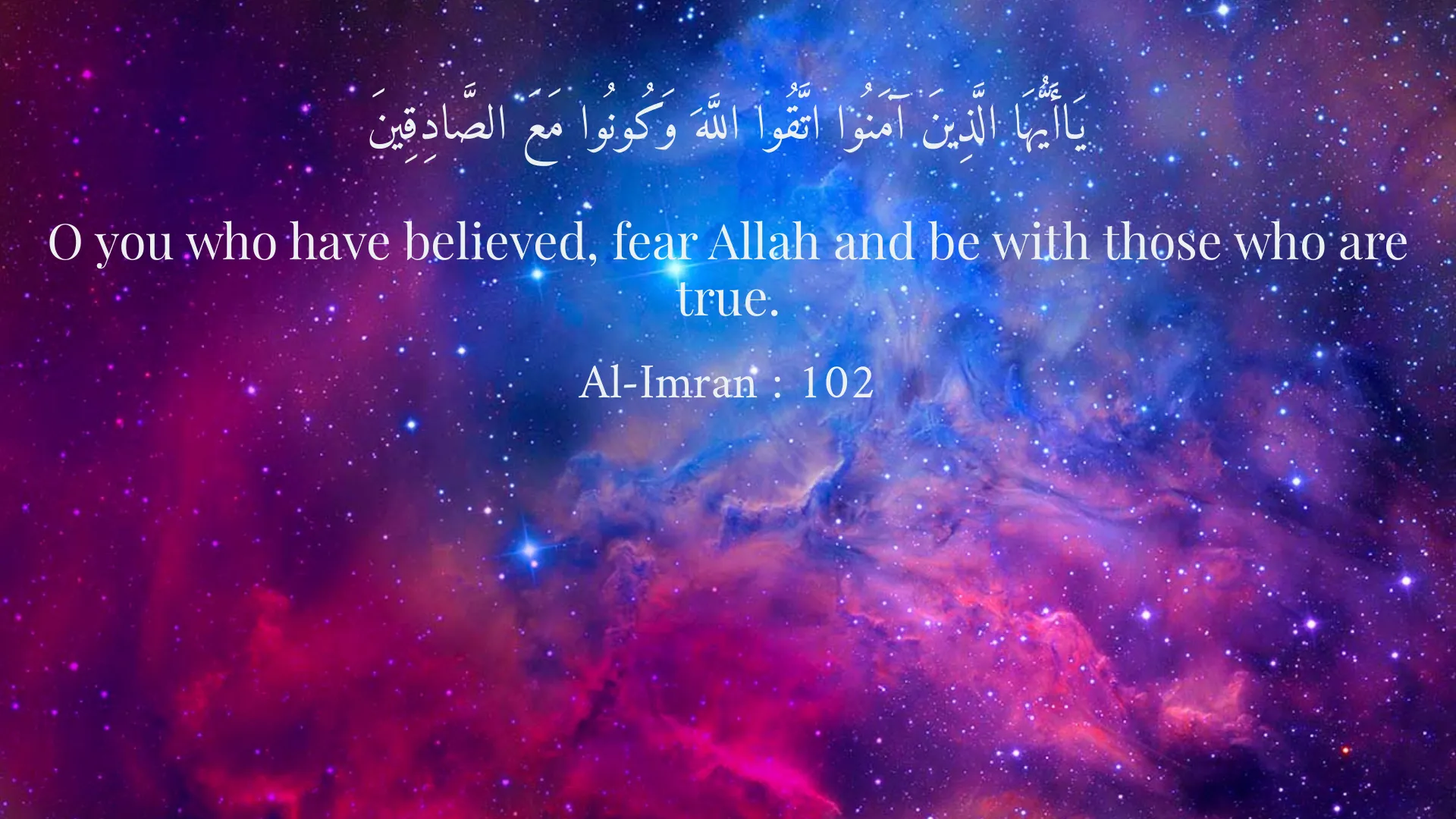
يَاأَيُّهَا الَّذِينَ آمَنُوا اتَّقُوا اللَّهَ وَكُونُوا مَعَ الصَّادِقِينَ
O you who have believed, fear Allah and be with those who are true.
Al-Imran : 102
لَيْسَ الْبِرَّ أَن تُولُّوا وَجُوهَكُمْ قِبَلَ الْمَشْرِقِ وَالْمَغْرِبِ وَلَكِنَّ الْبِرَّ مَنْ آمَنَ بِاللَّهِ وَالْيَوْمِ الْآخِرِ وَالْمَلَائِكَةِ وَالْكِتَابِ وَالنَّبِيِّينَ
Righteousness is not that you turn your faces toward the east or the west, but [true] righteousness is in one who believes in Allah, the Last Day, the Angels, the Book, and the Prophets.
Al-Baqarah : 177
Short Story
One day, Adel was sitting with his friends, discussing life and the true meaning of piety. He said, 'Friends, piety is not just about praying and fasting. Rather, good behavior and honesty are also signs of true piety. I have always tried to be honest in my dealings and respect others.' His friends nodded in agreement, realizing he had come closer to the truth.