Quranic Answer
### The Importance of Repentance in Islam Repentance, known as 'Tawbah' in Arabic, is an essential principle in Islam that emphasizes the importance of returning to Allah with a sincere heart after committing sins. The concept of repentance is deeply rooted in the teachings of the Holy Quran and the traditions of Prophet Muhammad (peace be upon him). The Quran illustrates the vastness of Allah's mercy and forgiveness, encouraging believers to seek repentance as a means of spiritual cleansing and growth. ### Allah's Readiness to Accept Repentance According to the Holy Quran, Allah is perpetually prepared to accept the repentance of His servants. The verse from Surah Al-Furqan, verse 70, definitively states that the sins committed by those who repent and sincerely believe are forgiven. This verse highlights that the acceptance of repentance is contingent upon specific prerequisites that believers must satisfy. These include having a genuine intention and feeling remorseful for their past actions. The clarity of this concept serves as a reminder that repentance is not merely a verbal declaration but rather an emotional and heartfelt return to a state of righteousness. ### Conditions for Accepted Repentance The conditions for accepted repentance are explicitly mentioned in the Quran. Surah An-Nisa, verse 17 articulates that forgiveness is extended only to those who sincerely repent with knowledge and understanding. This reinforces the idea that repentance is a conscious choice, requiring individuals to seek knowledge about their actions, recognize their errors, and humbly approach Allah seeking mercy. Thus, for a repentance to be genuinely accepted, one must wholeheartedly regret their wrongful actions and pledge to turn back to Allah with pure intentions. ### Allah's Infinite Mercy Adding to the profound nature of forgiveness, Surah Az-Zumar, verse 53 assures believers that Allah's mercy is boundless. The verse calls to action, addressing believers with the phrase: "O My servants who have believed, do not be discouraged by My mercy; indeed, Allah forgives all sins." This powerful declaration serves as an encouragement for individuals who may feel overwhelmed by their past transgressions; it emphasizes that repentance is an avenue through which they can redirect their lives towards righteousness. This verse embodies the essence of hope in the act of repentance, suggesting that no matter the gravity of one’s sins, the door to forgiveness remains ajar as long as one seeks it earnestly. ### The Process of Repentance Repentance involves a multifaceted process that requires an individual to engage in deep self-reflection. It begins with recognizing one's sins, followed by a sincere feeling of remorse and guilt. This acknowledgment is crucial; it acts as a catalyst prompting the believer to turn toward Allah in supplication. Next, an essential component of Tawbah is the intention to never revert to those sinful behaviors again. Furthermore, true repentance may also involve correcting any wrongs done to others, seeking forgiveness from them, and making amends if possible. This reflects the Islamic teaching that one's relationship with Allah is closely linked to one's relationship with fellow human beings. ### The Role of Sincerity Sincerity is the bedrock of accepted repentance. Individuals must return to Allah with an honest heart dedicated to changing their behavior. It is imperative that the repentance stems from a place of genuine regret and not merely as a response to fear of punishment. True repentance signifies a commitment to self-improvement and devotion to upholding the tenants of faith. This involves engaging in good deeds and strengthening one's relationship with Allah through prayer, reading the Quran, and participating in charitable acts. ### Overcoming Despair In a world filled with challenges and moral dilemmas, many individuals may find themselves feeling hopeless due to their past actions. This despair can be contrasted with the notion of divine mercy, which is exemplified in the teachings of Islam. The assurance provided in the Quran regarding Allah's readiness to forgive serves as a beacon of hope for those who seek repentance. Believers are encouraged to lean on their faith during moments of weakness, reminding themselves that they are never too far from the grace of Allah as long as they turn back towards Him. ### The Consequences of Sincere Repentance Repenting sincerely has profound spiritual repercussions. It not only brings about forgiveness from Allah but also instills a sense of peace and tranquility within the individual. The act of repentance acts as a purification, allowing believers to renew their faith and draw nearer to Allah. This transformation often leads to a positive ripple effect, affecting one's relationships and interactions with others, and inspiring a life filled with compassion and righteousness. ### Conclusion In conclusion, the significance of repentance in Islam cannot be overstated. The teachings of the Holy Quran on repentance highlight its crucial role in the spiritual journey of every believer. By understanding the conditions for accepted repentance, embracing the concept of Allah's limitless mercy, and committing to genuine self-reflection, individuals can rediscover paths of righteousness. Ultimately, sincere repentance symbolizes not just an act of seeking forgiveness, but a profound transformation that can reshape one’s life and reaffirm their relationship with their Creator. Thus, believers are continually reminded to seek repentance, for every sincere effort will be met with divine mercy and acceptance by Allah.
Related Verses
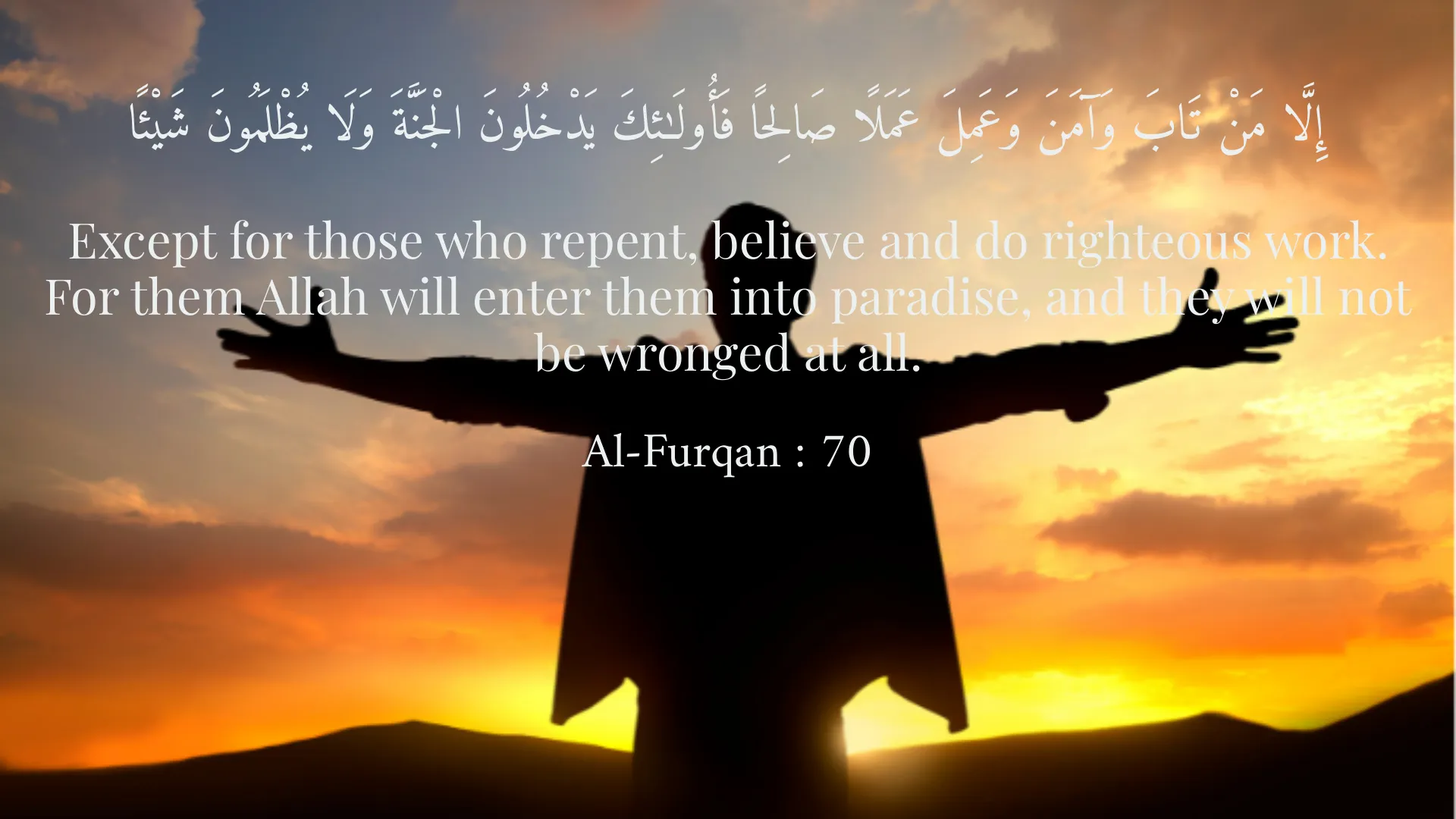
إِلَّا مَنْ تَابَ وَآمَنَ وَعَمِلَ عَمَلًا صَالِحًا فَأُولَـٰئِكَ يَدْخُلُونَ الْجَنَّةَ وَلَا يُظْلَمُونَ شَيْئًا
Except for those who repent, believe and do righteous work. For them Allah will enter them into paradise, and they will not be wronged at all.
Al-Furqan : 70
إِنَّمَا التَّوْبَةُ عَلَى اللَّـهِ لِلَّذِينَ يَعْمَلُونَ السُّوءَ بِجَهَالَةٍ ثُمَّ يتوبُونَ مِن قَرِيبٍ ۚ فَأُولَــٰئِكَ تَتُوبُ عَلَيْهِمْ ۗ وَكَانَ اللَّـهُ عَلِيمًا حَكِيمًا
Repentance is not for those who continue to do evil until death approaches one of them; then he says, 'Indeed, I have repented now.' Nor for those who die while they are disbelievers. For them We have prepared a painful punishment.
An-Nisa : 17
قُلْ يَا عِبَادِيَ الَّذِينَ آمَنُوا اتَّقُوا رَبَّكُمْ لِلَّذِينَ أَحْسَنُوا فِي هَذِهِ الدُّنْيَا حَسَنَةٌ ۖ وَأَرْضُ اللَّـهِ وَاسِعَةٌ ۖ إِنَّمَا يُوَفَّى الصَّابِرُونَ أَجْرَهُمْ بِغَيْرِ حِسَابٍ
Say, 'O My servants who have believed, fear your Lord. For those who do good in this world is good, and the earth of Allah is expansive. Indeed, the patient will be given their reward without account.'
Az-Zumar : 53
Short Story
Ali, in his youth, committed many mistakes and was always worried about the consequences of his actions. One day, seeking peace, he approached a scholar. The scholar told him that Allah's mercy is vast, and whenever he sincerely repents, all his sins will be forgiven. Ali returned home with a heart full of hope and tears, repenting to Allah. After that, his life changed, and he felt a deep sense of contentment.