Quranic Answer
In the Holy Quran, the profound existential question of 'why do we exist?' is answered with unparalleled clarity and depth. The Quran not only provides an answer to this query but also imbues human life with lofty meaning and direction. The primary and ultimate reason for the existence of humans and jinn, as stated in Surah Adh-Dhariyat, verse 56, is 'worship' of the Lord: 'And I did not create the jinn and mankind except to worship Me.' (Wama khalaqtu aljinna waal-insa illa liya’budoon). However, the meaning of 'worship' in this verse extends far beyond mere ritualistic practices like prayer and fasting. In the Quranic view, worship is a comprehensive and holistic way of life that encompasses all aspects of human existence, signifying pure knowledge, obedience, submission, and sincere servitude to the Almighty God. This servitude includes intellectual, practical, ethical, and social dimensions. This means that every thought, every action, every word, and every decision made in pursuit of divine pleasure and based on His teachings is considered an act of worship. This perspective saves human life from emptiness and meaninglessness, granting it a sublime purpose and helping individuals find deep meaning and a stable connection with the Creator of the universe in every moment of their lives. This knowledge and servitude are essential not only for the afterlife but also for human peace and happiness in this world, as by connecting to the infinite source of wisdom and power, humans are freed from any confusion and aimlessness and move towards perfection. Furthermore, the Quran states another purpose for human existence: 'testing' and 'trial.' In Surah Al-Mulk, verse 2, we read: 'He who created death and life to test you [as to] which of you is best in deed...' (Allathee khalaqa almawta waalhayata liyabluwakum ayyukum ahsanu ‘amala). This worldly life is a stage for evaluating human actions, intentions, and patience. This test is an opportunity for growth, transcendence, and the flourishing of inner potentials. God created humans with free will, granting them the power to choose between good and evil and to opt for the right path. The purpose of this test is not for God to discover what He does not know, but for humans themselves to uncover their existential truths and for their deeds to manifest in the universe. These trials, whether in the form of blessings or calamities, are all tools for purifying the soul and elevating human status, helping individuals to confront challenges, learn from them, and move towards perfection. These examinations are an opportunity for humans to demonstrate, through their choices, the extent of their faith, resilience, and submission to the divine will, and this path is a way for them to return to the true object of worship and attain eternal satisfaction. Moreover, humanity is introduced as the 'Khalifa' or vicegerent of God on Earth. In Surah Al-Baqarah, verse 30, it is stated: 'And [mention, O Muhammad], when your Lord said to the angels, 'Indeed, I will make upon the earth a successive authority.'' (Wa-ith qala rabbuka lilmala-ikati innee ja’ilun fee al-ardi khaleefa). This vicegerency places a heavy responsibility on humanity. Humans are tasked with cultivating the Earth, establishing justice, promoting peace and harmony, and utilizing its resources in a way that benefits both present and future generations. As divine trustees, humans must feel responsible towards nature and other creatures and prevent corruption and decay on Earth. This role of vicegerency highlights the social and environmental dimensions of the purpose of creation, indicating that our existence is not only for individual growth but also for playing a constructive role in society and preserving divine creation. This grave responsibility gives meaning to collective human life and guides them towards cooperation and peaceful coexistence to build a better world, a world that reflects divine attributes such as justice, mercy, and beauty. Ultimately, all these objectives are interconnected, offering a comprehensive picture of the reason for existence. Humanity is created to know and worship God (worship), to undergo trials in this path (testing) to reveal their capabilities and perform their best deeds, and at the same time, to fulfill their responsibility as God's vicegerent and cultivator of the Earth (stewardship). Understanding these existential reasons gives human life a deep, rich, and divine meaning. This understanding not only tells us why we are here but also demonstrates how we should live: with purpose, responsibility, love for God and His creation, and with a vision towards eternity. This perspective empowers individuals to be resilient in the face of life's difficulties and to move forward with hope and motivation towards a bright future, knowing that every moment of their life holds divine meaning and value, and are steps taken on the path to achieving the sublime purpose of creation, and in every breath, there is an opportunity to draw closer to God and achieve eternal happiness. This path is full of peace, contentment, and hope, ultimately leading to divine pleasure.
Related Verses
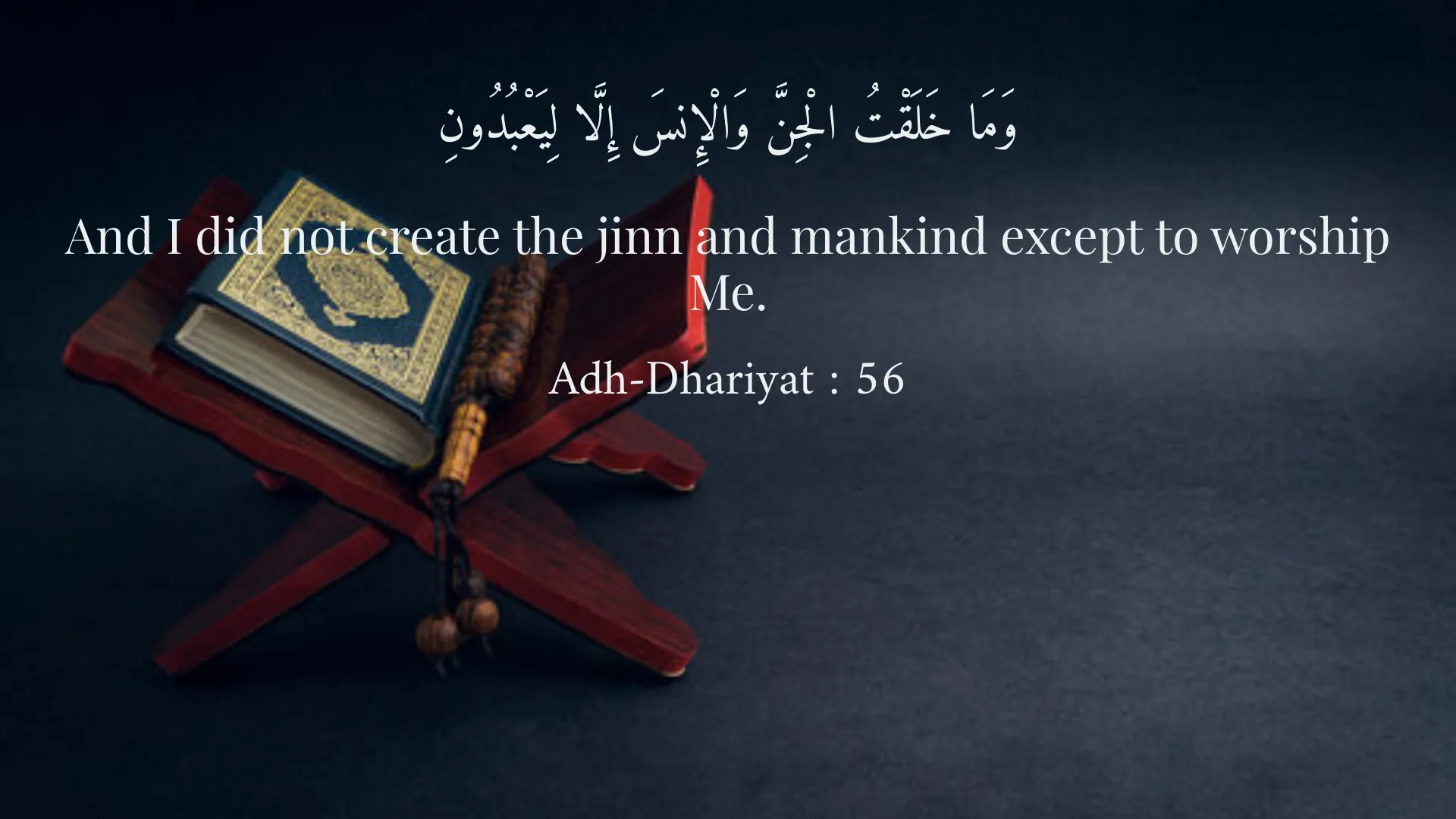
وَمَا خَلَقْتُ الْجِنَّ وَالْإِنسَ إِلَّا لِيَعْبُدُونِ
And I did not create the jinn and mankind except to worship Me.
Adh-Dhariyat : 56
الَّذِي خَلَقَ الْمَوْتَ وَالْحَيَاةَ لِيَبْلُوَكُمْ أَيُّكُمْ أَحْسَنُ عَمَلًا ۚ وَهُوَ الْعَزِيزُ الْغَفُورُ
He who created death and life to test you [as to] which of you is best in deed - and He is the Exalted in Might, the Forgiving.
Al-Mulk : 2
وَإِذْ قَالَ رَبُّكَ لِلْمَلَائِكَةِ إِنِّي جَاعِلٌ فِي الْأَرْضِ خَلِيفَةً ۖ قَالُوا أَتَجْعَلُ فِيهَا مَن يُفْسِدُ فِيهَا وَيَسْفِكُ الدِّمَاءَ وَنَحْنُ نُسَبِّحُ بِحَمْدِكَ وَنُقَدِّسُ لَكَ ۖ قَالَ إِنِّي أَعْلَمُ مَا لَا تَعْلَمُونَ
And [mention, O Muhammad], when your Lord said to the angels, 'Indeed, I will make upon the earth a successive authority.' They said, 'Will You place upon it one who causes corruption therein and sheds blood, while we declare Your praise and sanctify You?' Allah said, 'Indeed, I know that which you do not know.'
Al-Baqarah : 30
Short Story
It is narrated that a wealthy king was constantly striving to expand his dominion and add to his treasury, never ceasing his efforts and acquisitions. Despite all his blessings and power, he carried a feeling of emptiness and restlessness in his heart, whose origin he knew not. One day, disguised as a dervish, he went among the people and arrived at a village where a wise and pious man lived. The king shared the tale of his restless heart with him and asked: 'O wise elder! With all this wealth and power, why does my heart find no peace, and why do I feel something is missing?' The dervish smiled and said: 'O King! You are seeking 'to have' instead of 'to be.' God did not create you merely to accumulate; rather, He created you to behold Him, to know Him, and to walk in the path of His pleasure. Your existence is not for adding to your possessions, but for adding to your knowledge and good deeds.' The king was profoundly changed by the dervish's words. From then on, he not only sought to cultivate his land and establish justice but also spent more of his time reflecting on divine majesty and serving the people. He truly found the meaning of 'being' within himself and attained inner peace.