Quranic Answer
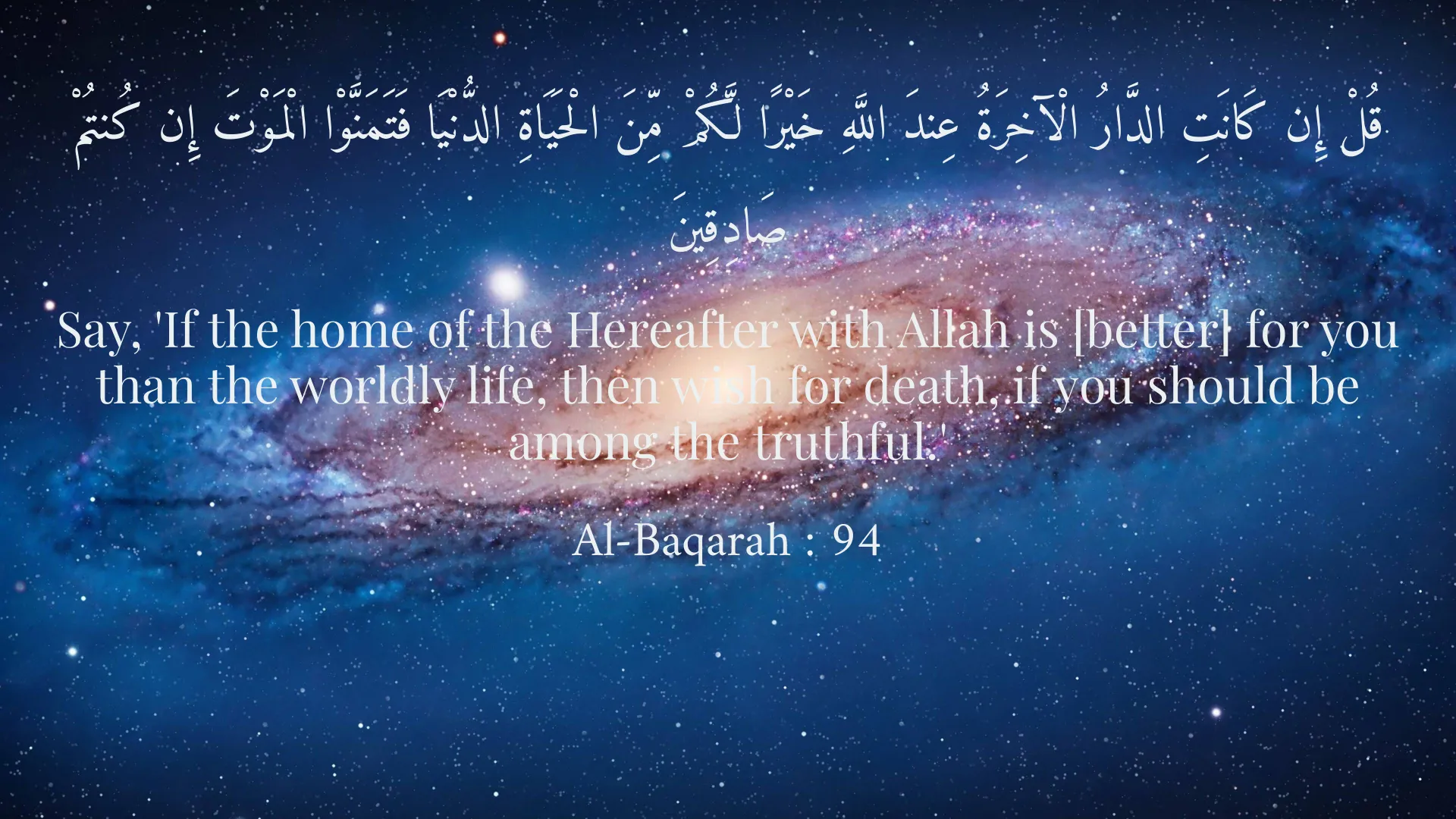
In the Holy Quran, wishing for death is considered a negative feeling and a sign of spiritual weakness. This perspective is profoundly illustrated in Surah Al-Baqarah, verse 94, where Allah instructs: 'Say, if the home of the Hereafter with Allah is [better] for you than the worldly life, then why do you not wish for death?' This verse serves multiple purposes, inviting believers to introspect and consider their true motivations for living. It emphasizes that while the worldly life may be filled with trials and tribulations, the promise of the Hereafter holds immeasurable rewards for those who remain steadfast in their faith. This notion of duality between the present life and the afterlife is crucial in Islamic teachings, suggesting that life itself is a test, and the true rewards await believers in the eternal realm. This verse highlights that true believers should have unwavering faith in both this life and the Hereafter. Wishing for death may often indicate despair, a feeling that leads individuals to overlook the mercy and compassion of Allah. In times of hardship, it is essential for every believer to turn towards Allah, remembering His infinite mercy and the strength He provides to endure life's challenges. Instead of succumbing to the darkness that may lead one to wish for death, believers are called upon to engage in fervent prayer, seek help from Allah, and strive to improve their circumstances. Further reinforcing this idea, Surah Al-Imran, verse 139 states: 'So do not weaken and do not grieve, for you will be superior if you are [true] believers.' This verse offers a source of hope, urging believers to maintain their spirits even in the face of adversity. The assurance embedded in this verse serves as a reminder that those who uphold their faith and persevere through trials will ultimately attain a place of honor and superiority in the sight of Allah. Wishing for death, therefore, not only signifies weak faith but also indicates a lack of understanding of Allah's mercy and power. Instead of surrendering to hopelessness, believers are encouraged to cultivate a hopeful outlook on life, rooted in the belief that Allah has a plan for everyone and that challenges are often preludes to blessings. Moreover, the Holy Quran frequently emphasizes the virtues of patience (Sabr) and gratitude (Shukr) as essential tools for navigating the hardships of life. Patience is not merely the act of enduring difficulties but also a demonstration of one's faith in Allah's timing and plan. When believers practice patience, they develop resilience and fortitude, allowing themselves to face adversities with a positive mindset. Similarly, gratitude plays a pivotal role in shaping a believer's perspective. By acknowledging and appreciating the myriad of blessings bestowed upon them, believers can cultivate contentment where despair might otherwise reside. This practice of gratitude helps reinforce a positive mindset, preventing individuals from wishing for death as an escape from life's trials. The longing for death often emerges from a place of dissatisfaction or frustration with one's current life circumstances. In a world filled with unpredictability and fear, many individuals may find it easier to resign themselves to the idea of death rather than engaging in the arduous journey of self-improvement. However, such thoughts can be counterproductive and damaging. In contrast, Islamic teachings advocate for an outlook that finds value in every moment of life. Each day presents an opportunity for growth, reflection, and the chance to implement positive changes. Believers are encouraged to focus on solutions and take proactive steps towards alleviating their struggles instead of wishing for an end to those struggles. Faith in Allah goes hand in hand with taking responsibility for one's actions and choices. When faced with challenges, instead of longing for death, believers should seek avenues for betterment, engage in community support, and maintain a connection with Allah through prayer and acts of charity. The act of helping others can serve as a powerful reminder of the intrinsic worth of life, fostering a sense of purpose and fulfillment that transcends individual suffering. The Quran also offers numerous accounts of prophets and holy figures who faced immense trials and tribulations. Their perseverance and unwavering faith serve as benchmarks for individuals grappling with their personal struggles. For example, the story of Prophet Job (Ayyub) is one of unparalleled patience in the face of suffering. He epitomized resilience, consistently turning to Allah in his moments of despair while maintaining faith in Allah's ultimate mercy. Such narratives are interwoven throughout the Quran to inspire believers to find strength in their faith, reinforcing the idea that wishing for death is contrary to the spirit of survival and divine purpose. In conclusion, wishing for death is a manifestation of spiritual weakness and a misunderstanding of the divine wisdom that underlines life's challenges. The Holy Quran encourages believers to maintain hope, practice patience, and express gratitude as essential tools for navigating life's difficulties. Believers are reminded that their existence surpasses mere survival; it is an opportunity to grow, evolve, and contribute to the greater spiritual and worldly landscape. Therefore, instead of aligning themselves with a desire for death, individuals should commit to a life of prayer, reliance on Allah, and relentless pursuit of improvement. The journey may be fraught with challenges, yet through faith and positivity, believers can find profound meaning and purpose in their lives.
Related Verses
قُلْ إِن كَانَتِ الدَّارُ الْآخِرَةُ عِندَ اللَّهِ خَيْرًا لَّكُمْ مِّنَ الْحَيَاةِ الدُّنْيَا فَتَمَنَّوْا الْمَوْتَ إِن كُنتُمْ صَادِقِينَ
Say, 'If the home of the Hereafter with Allah is [better] for you than the worldly life, then wish for death, if you should be among the truthful.'
Al-Baqarah : 94
فَلَا تَهِنُوا وَتَحْزَنُوا وَأَنتُمُ الأَعْلَوْنَ إِن كُنتُمْ مُؤْمِنِينَ
So do not weaken and do not grieve, for you will be superior if you are [true] believers.
Al-Imran : 139
Short Story
One day, a man faced difficulties in his life and felt hopeless. He decided to consult a spiritual leader for guidance. The leader calmly told him, 'Remember that Allah is always beside you, and His mercy is endless. Instead of wishing for death, strive to find peace and clarity in life. Surely you will find a solution to your problems.' The man returned home with a greater sense of calm and dedicated himself to prayer and connecting with Allah.