Quranic Answer
The concept of death and the afterlife is an integral theme throughout the Holy Quran, encapsulating the various aspects of mortality and what lies beyond this earthly existence. The teachings found within its verses address not only the inevitability of death but also the profound implications of how individuals lead their lives in preparation for what comes after. This perspective forms the basis for understanding one's purpose in life, the significance of one's actions, and the ultimate reality that all souls must transition to the next realm. To begin with, the Quran refers to death as an unavoidable reality that every being must ultimately confront. In Surah Al-Imran, verse 185, it explicitly states, 'Every soul will taste death.' This assertion serves as a reminder of the transient nature of worldly life and an acknowledgment that all humans, regardless of their status or achievements, will face this ultimate truth. The phrase 'taste death' provides imagery that underscores the inevitability of this phenomenon, conveying that death is not merely a cessation of physical life, but a significant transition to another phase of existence. This perspective cultivates a sense of humility among believers, encouraging them to reflect on the impermanence of life and the importance of living righteously. The Quran goes further to illustrate that death is not final; rather, it is the threshold to the afterlife—a realm that awaits each individual posthumously. In Surah Al-An'am, verse 60, Allah speaks of the Day of Resurrection, where humans will be judged for their deeds. This insight highlights a pivotal aspect of Islamic belief: death marks the end of worldly life, yet it also signifies the beginning of an eternal journey in the hereafter. The notion of judgment reinforces the idea that actions carried out in this life have consequences, encouraging individuals to consider the impact of their choices carefully. Life after death in Islamic thought is characterized by its duality: it can lead to either paradise or punishment, depending on the nature of one's actions during their earthly existence. This vital understanding positions the Quran as a guide for ethical conduct, urging believers to adhere to principles that align with achieving God's pleasure. The emphasis on accountability is significant, encouraging a proactive approach to life, where individuals take responsibility for their actions rather than adopting a passive or neglectful attitude. Throughout the Quran, there are frequent reminders regarding the importance of one's deeds, both in preparation for the afterlife and as a measure of one's moral standing in this world. In Surah Al-Mu'minun, verse 99, Allah advises humankind to earn His pleasure and prepare themselves for the afterlife. The notion of 'preparing for the afterlife' acts as a catalyst for personal development, compelling individuals to cultivate virtues such as kindness, honesty, and compassion. It encourages believers to engage in activities that contribute to their spiritual reformation and well-being, thereby aligning their lives with divine expectations. Moreover, the Quran does not merely present the concept of death in a somber light; it embraces it as a crucial lesson for the living. Introducing the awareness of mortality prompts individuals to derive value from their fleeting existence, epitomizing the Islamic call to remember death frequently. This advocacy serves as a meditation on the necessity of living purposefully, seeking growth, self-improvement, and maintaining a connection with one's Creator. The recognition of death inspires a rejuvenated appreciation for life, urging Muslims to prioritize meaningful interactions, altruism, and altruistic contributions to society in alignment with divine commandments. The exhortation to remember death is intimately tied to several broader themes present within the Quranic discourse on existence. In Islam, life is seen as a testing ground where faith, patience, and moral integrity are continuously challenged. Each person's journey is individualized; nevertheless, the collective aim remains the aspiration for eternal life in paradise. This mandate instills hope, as the notion of an afterlife provides a comforting perspective to life’s trials and tribulations, offering believers a sense of purpose amid adversities. In light of this, the Quran addresses death not just as an inevitable end, but as integral to the cosmic order that underscores a belief system centered on accountability, moral rectitude, and compassion. The detailed discourses on death encourage believers to strive for balance in their lives, fostering a community that values well-being and spiritual mindfulness. The teachings thus serve to manage human despair regarding inevitable mortality by framing it within the lens of divine wisdom and justice. In conclusion, the theme of death and the afterlife in the Holy Quran is profoundly significant in guiding believers on how to live their lives with intention and virtue, fully aware of the inevitable realities that await them. The Quran urges us to reflect on our actions, instilling a sense of urgency to engage in deeds that serve to please Allah. Furthermore, through the lens of mortality, believers are encouraged to treasure their lives and the opportunities within them to foster connection, growth, and contribution to the collective well-being of humanity. Such awareness ultimately propels individuals toward a journey of spiritual awakening, preparing them for the eternal realities that exist beyond this life.
Related Verses
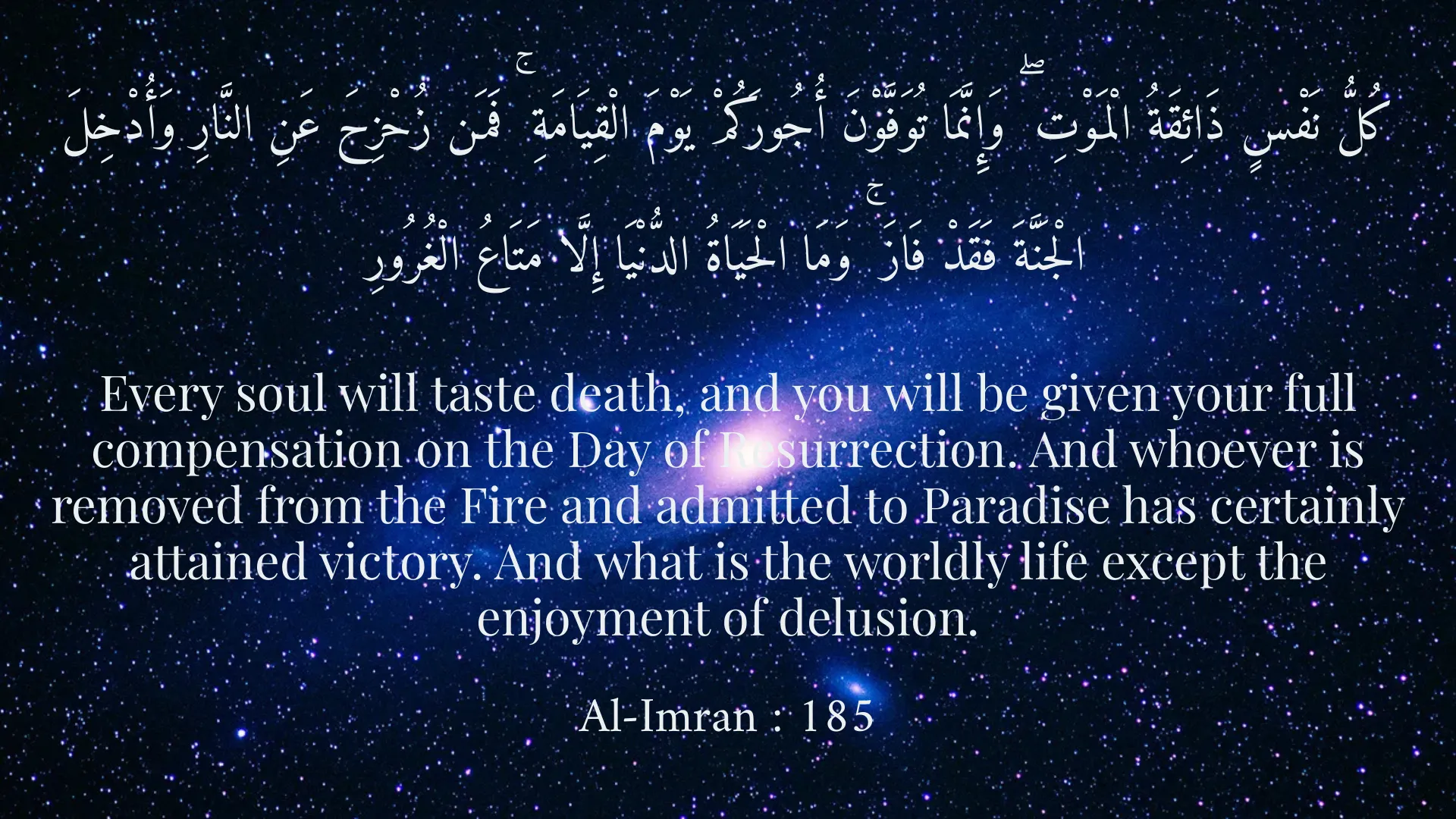
كُلُّ نَفْسٍ ذَائِقَةُ الْمَوْتِ ۖ وَإِنَّمَا تُوَفَّوْنَ أُجُورَكُمْ يَوْمَ الْقِيَامَةِ ۚ فَمَن زُحْزِحَ عَنِ النَّارِ وَأُدْخِلَ الْجَنَّةَ فَقَدْ فَازَ ۚ وَمَا الْحَيَاةُ الدُّنْيَا إِلَّا مَتَاعُ الْغُرُورِ
Every soul will taste death, and you will be given your full compensation on the Day of Resurrection. And whoever is removed from the Fire and admitted to Paradise has certainly attained victory. And what is the worldly life except the enjoyment of delusion.
Al-Imran : 185
وَهُوَ الَّذِي يَتَوَفَّاكُمْ بِاللَّيْلِ ۖ وَيَعْلَمُ مَا جَرَحْتُم بِالنَّهَارِ ۖ ثُمَّ يَبْعَثُكُمْ فِيهِ لِيُقْضَى أَجَلٌّ مُسَمًّى ۖ إِنَّ فِي ذَلِكَ لَآَيَاتٍ لِقَوْمٍ يَتَفَكَّرُونَ
And it is He who takes your souls by night and knows what you have earned by day. Then He resurrects you therein that a term specified may be fulfilled. Indeed in that are signs for a people who give thought.
Al-An'am : 60
حَتَّى إِذَا جَاءَ أَحَدَهُمُ الْمَوْتُ قَالَ رَبِّ ارْجِعُونِ
Until when death comes to one of them, he says, 'My Lord, send me back.'
Al-Mu'minun : 99
Short Story
Once upon a time, there was a man named Farhad who was deeply pondering about death and the afterlife. He wanted to know what fate awaited him after death. In his search for answers, he consulted books and knowledgeable individuals, eventually finding solace in the verses of the Quran. Through reading these verses, he felt a sense of peace and understood that life in this world was merely one stage of his eternal journey. Farhad realized that through good deeds and drawing closer to God, he could attain happiness and tranquility. From that day onward, he focused on remembering God and doing good.