Quranic Answer
Faith and righteous deeds are two essential components in Islam, each playing a vital role in the lives of believers. The intricacies of these concepts deeply influence the spiritual and moral conduct of Muslims around the world. This essay aims to explore the profound relationship between faith and righteous deeds, their significance in the Islamic doctrine, how they intertwine, and their impact on a believer's life. Faith, or 'Iman,' refers to a deep belief in God and the fundamental principles of the religion. It encompasses a comprehensive acknowledgment of the existence and oneness of Allah, belief in His messengers, holy scriptures, angels, and the Day of Judgment. All these elements constitute the core of Islamic faith and form the foundation on which a Muslim's life is built. In the Qur'an, Allah emphasizes that true faith is not merely a verbal declaration but must be reflected in a profound commitment through action. This is articulated in Surah Al-Baqarah, verse 177: "Righteousness is not that you turn your faces toward the east or the west, but [true] righteousness is in one who believes in Allah, the Last Day, the Angels, the Book, and the Prophets." This profound statement highlights that faith is fundamentally linked to one's understanding and obedience to divine principles. A crucial aspect to understand is that faith in Islam extends beyond the individual’s personal relationship with Allah; it also encompasses the necessity of engaging with the broader human community. This means that believers must cultivate a sense of responsibility not just toward themselves but also towards others. Allah calls upon believers to act righteously, which leads us to the concept of righteous deeds, an integral aspect of Islamic practice. Righteous deeds, or 'A'mal Salihah,' refer to performing good and virtuous actions in accordance with divine instructions. These deeds include a variety of actions such as praying (Salah), fasting (Sawm), giving charity (Zakat), and any other activity that leads to the pleasure of Allah and the well-being of humanity. The transcendent purpose underlying these deeds is to create a harmonious society rooted in compassion, justice, and mutual support. For example, in Surah Al-Imran, verse 92, it states: "Never will you attain the good reward until you spend from that which you love." This verse emphasizes that acts of charity and giving should stem from genuine sacrifice and attachment to one’s possessions, illustrating that righteous deeds require personal investment. The interdependence of faith and righteous deeds can be further explored through the example of prayer. Muslims are required to pray five times a day as a practical manifestation of their faith. Each prayer serves as a reminder of the divine presence in their lives and reinforces the believer’s commitment to their spiritual responsibilities. However, the act of praying is not merely a routine ritual; it embodies the belief that one is in the presence of Allah and must conduct themselves in a manner consistent with His expectations. Consequently, prayer serves as a vehicle through which faith is expressed and nurtured, highlighting the inseparability of belief and action. Moreover, righteous deeds also represent the ethical dimensions of faith. In Islam, one’s beliefs must translate into actions that promote goodness, balance, and equity in society. The teachings of Prophet Muhammad (peace be upon him) further elucidate this connection. He emphasized that the best among people are those who are most beneficial to others, illustrating that true faith manifests itself in serving humanity. This teaching reinforces the idea that righteous actions are not simply a reflection of personal piety but are also critical in shaping an ethical society. An important aspect of this discourse is the role of intention, or 'Niyyah,' in both faith and righteous deeds. In Islam, the value of an action is heavily dependent on the intention behind it. A deed performed with a sincere intention to seek the pleasure of Allah is of greater worth than one performed merely for show or personal gain. The Prophet Muhammad (peace be upon him) is reported to have said, "Actions are judged by intentions, and everyone will be rewarded according to what they intended." This principle further intertwines faith and righteous deeds, underscoring that a mere outward display of good actions without sincere intent may be insufficient in the eyes of Allah. In conclusion, the connection between faith and righteous deeds in Islam is profound and multifaceted. Faith provides the spiritual foundation that compels the believer to act righteously, while righteous deeds serve as a manifestation of that faith. The Qur'an and Hadith guide believers to develop a holistic approach to their religious practice, where every action is infused with intention, purpose, and commitment to the betterment of both oneself and society. Therefore, faith and righteous deeds are inseparable; faith without righteous actions is flawed, while righteous actions lacking faith cannot lead to ultimate success in this world or the hereafter. Believers are encouraged to cultivate both their internal faith and their external actions, thereby creating a relationship that not only defines their spirituality but significantly impacts their interactions with the world around them. Ultimately, this harmonious interplay between faith and righteous deeds stands as a testament to the depth and wisdom of Islamic teachings, challenging believers to strive towards a life of virtue, purpose, and connection with Allah.
Related Verses
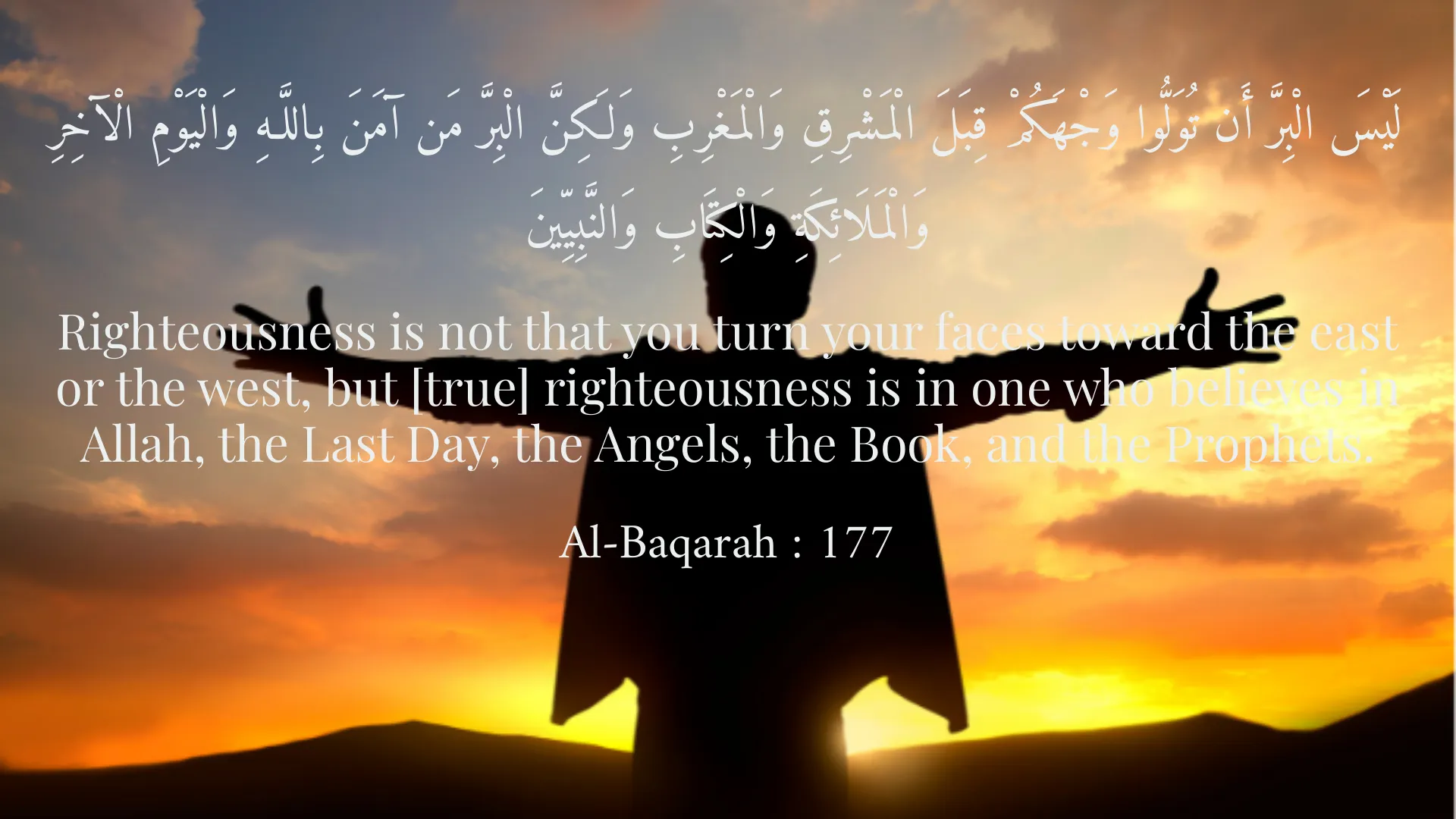
لَيْسَ الْبِرَّ أَن تُوَلُّوا وَجْهَكُمْ قِبَلَ الْمَشْرِقِ وَالْمَغْرِبِ وَلَكِنَّ الْبِرَّ مَن آمَنَ بِاللَّـهِ وَالْيَوْمِ الْآخِرِ وَالْمَلَائِكَةِ وَالْكِتَابِ وَالنَّبِيِّينَ
Righteousness is not that you turn your faces toward the east or the west, but [true] righteousness is in one who believes in Allah, the Last Day, the Angels, the Book, and the Prophets.
Al-Baqarah : 177
لن تنالوا البرّ حتّى تنفقوا ممّا تحبّون
Never will you attain the good reward until you spend from that which you love.
Al-Imran : 92
Short Story
One day, Adel was worried about his future. He recalled the verses of the Quran and realized that only with true faith and righteous deeds could he lead a peaceful life. Adel decided to remember God more each day and also help others. From then on, he felt a greater sense of happiness and peace, and his life was illuminated by the light of faith and good deeds.