Quranic Answer
The concept of love and free will in the Holy Quran is a profound and intricate one, providing deep insights into the nature of humanity and the divine relationship between Allah and mankind. This article aims to explore these themes in detail, elaborating on the significance of free will in the context of faith, morality, and human development as articulated in the holy text. The discussion will not only emphasize the freedom of choice endowed to man but also highlight how this freedom encapsulates the essence of love, trust, and accountability in the relationship between the Creator and His creation. The Quran presents humanity as a special creation of Allah, bestowed with unique gifts and responsibilities. One of these gifts is the inherent willpower and freedom to choose. This concept is foundational to understanding human existence, as Allah created man with the capacity to discern between good and evil, truth and falsehood. In Surah Al-Baqarah (2:256), Allah states, 'There is no compulsion in religion.' This core verse emphasizes that faith is a personal choice and that individuals must come to believe in Allah and His messengers voluntarily. This establishes a fundamental principle in Islam: faith should resonate with the individual's heart and intellect, rather than be imposed through coercion. Free will is not merely an abstract concept in the Quran; it is a catalyst for spiritual growth and moral responsibility. The exercises of choice in daily life reflect a person's values and beliefs. The ability to make decisions allows individuals to navigate the complexities of existence, facing various challenges that serve as tests from Allah. These challenges offer opportunities for growth, strengthening an individual's character and fostering deepened spirituality. The relationship between love and free will is profoundly illustrated in the concept of divine love within Islamic thought. Allah's love for humanity is unconditional; it allows individuals the space to make errors, learn, and return to Him with sincere repentance. The notion that Allah desires the best for His creation is paramount, as it positions free will as a means for humans to experience love, compassion, and forgiveness. The text invites believers to engage in a sincere search for truth and understanding, encouraging them to pray, reflect, and establish a genuine relationship with Allah. In Surah Al-Kahf (18:29), Allah elucidates: 'Say: The truth is from your Lord. So whoever wills - let him believe; and whoever wills - let him disbelieve.' This verse underlines that the choice of faith or disbelief lies directly with the individual. It signifies the importance of accountability; each person will ultimately bear the consequences of their choices in this life and the Hereafter. The freedom to choose signifies a form of love: a trust that Allah places in humanity to engage with Him authentically and earnestly. The journey of choosing faith is laden with potential. The Quran encourages individuals to reflect upon the signs of Allah in the cosmos, within themselves, and in historical narratives. This reflection is an exercise of the will, requiring commitment, open-mindedness, and heartful engagement. Belief in Allah and His Messenger, as noted in Surah Al-Baqarah, is characterized as finding 'the right path.' The right path is one where individuals acknowledge their free will and embrace the purpose bestowed upon them. Furthermore, it is essential to underscore the aspect of trial and tribulation that often accompanies the exercise of free will. Life is replete with tests that challenge an individual's resolve in adhering to the values of faith. These tests are designed not as punishment but as a means to encourage growth, resilience, and ultimately a closer relationship with Allah. The Quran assures believers that challenges are a part of life and that they should not deter from making the right choices based on their faith in God. In essence, the freedom of human choice is a divine attribute that signifies trust. It represents Allah's love by allowing human beings to decide their destinies, to seek to understand their purpose, and to strive towards righteousness. In this sense, the interplay between free will and divine love creates an enriching tapestry wherein humans are encouraged to cultivate love for Allah through obedience, worship, and moral excellence. Moreover, the implications of love and free will extend beyond the individual to communities and societies. When individuals exercise their free will towards understanding and accepting faith, they contribute to the moral fabric of society. Societies composed of individuals who embrace the teachings of Islam reflect the love of Allah as they promote values such as justice, compassion, and altruism. These collective choices foster an environment that encourages growth, unity, and peace. However, it is noteworthy that the challenge of free will is the potential for ethical missteps. People may choose paths that diverge from the right path, leading to discord, disbelief, or wrongdoing. The Quran acknowledges human fallibility and encourages believers to seek forgiveness and strive to realign with the truth. The mercy of Allah plays a significant role in this journey, emphasizing that love encompasses endless opportunities for forgiveness and redemption. In conclusion, the Holy Quran provides a clear articulation of love and human free will, establishing a framework that encourages individual reflection, accountability, and moral integrity. The freedom to choose is an integral part of human dignity, bestowing individuals the privilege to pursue faith, develop love for Allah, and ultimately guide themselves towards righteousness. This divine allowance for choice is a testament to the profound love Allah has for humanity, establishing a direct relationship between the Creator and His creation, and inviting all to embrace the beauty of faith voluntarily. In a world often challenged by divisiveness and uncertainty, the teachings of the Quran regarding love and free will serve as a beacon of hope, compelling humanity to seek goodness in themselves and the world around them.
Related Verses
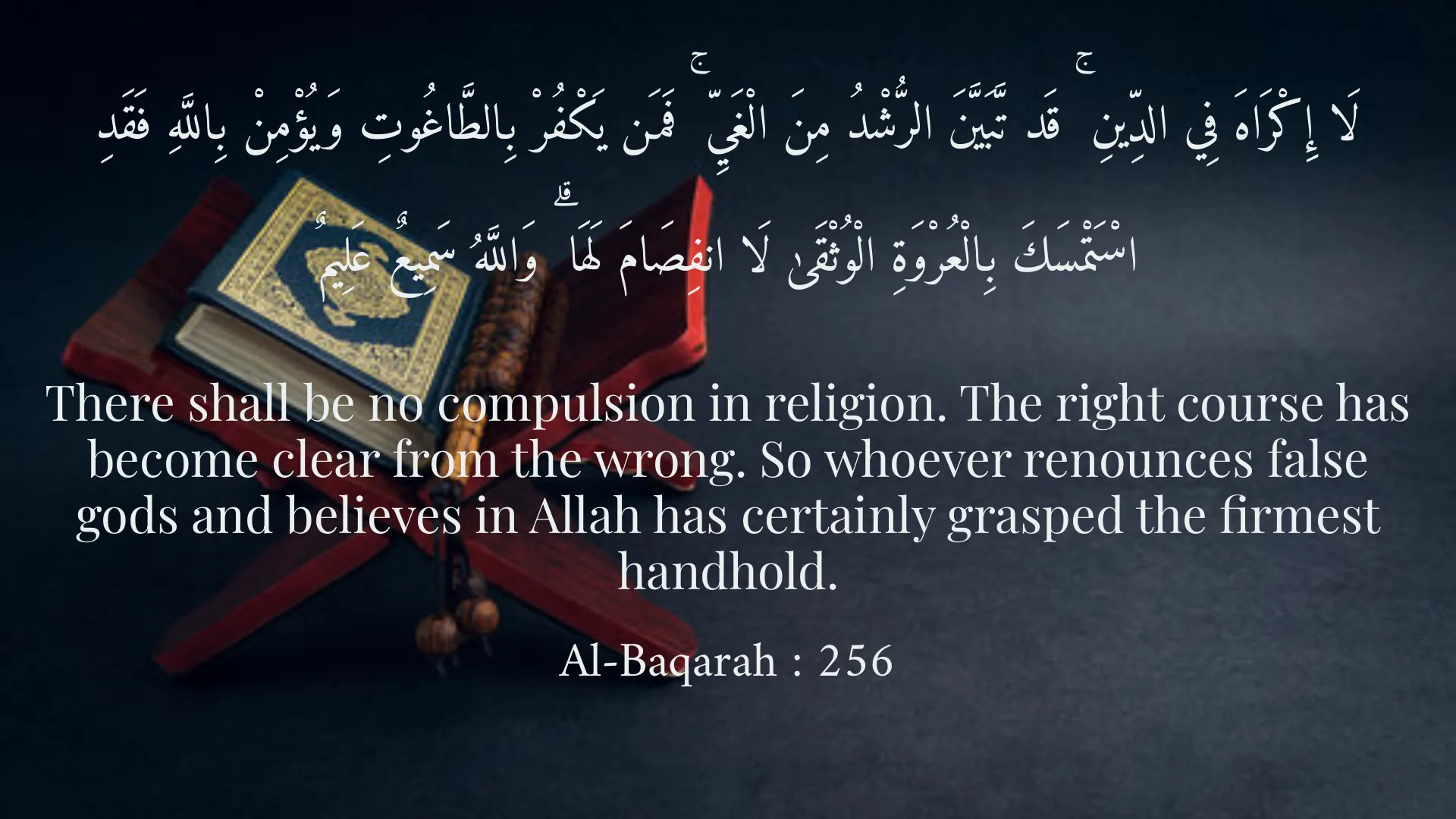
لَا إِكْرَاهَ فِي الدِّينِ ۚ قَد تَّبَيَّنَ الرُّشْدُ مِنَ الْغَيِّ ۚ فَمَن يَكْفُرْ بِالطَّاغُوتِ وَيُؤْمِنْ بِاللَّهِ فَقَدِ اسْتَمْسَكَ بِالْعُرْوَةِ الْوُثْقَىٰ لَا انفِصَامَ لَهَا ۗ وَاللَّهُ سَمِيعٌ عَلِيمٌ
There shall be no compulsion in religion. The right course has become clear from the wrong. So whoever renounces false gods and believes in Allah has certainly grasped the firmest handhold.
Al-Baqarah : 256
وَقُلْ الْحَقُّ مِن رَّبِّكُمْ ۖ فَمَن شَاءَ فَلْيُؤْمِنْ وَمَن شَاءَ فَلْيَكْفُرْ ۚ إِنَّا أَعْتَدْنَا لِلظَّالِمِينَ نَارًا أَحَاطَ بِهِمْ سُرَادِقُهَا ۖ وَإِن يَسْتَغِيثُوا يُغَاثُوا بِمَاءٍ كَالْمُهْلِ يَشْوِي الْوُجُوهَ ۖ بئسَ الشَّرَابُ وَسَاءَتْ مُرَافِقًا
And say, 'The truth is from your Lord.' So whoever wills - let him believe; and whoever wills - let him disbelieve. Indeed, We have prepared for the wrongdoers a Fire whose walls will surround them.
Al-Kahf : 29
Short Story
Once upon a time, a young man named Hasan had many questions in his heart about life and its purpose. He sat under a large tree in the garden near his house, thinking deeply. Suddenly, the chirping of a small bird caught his attention. The bird was flying freely in the air in search of seeds. Hasan realized that Allah also created man with a special purpose of freedom, allowing him to choose his path. He decided to draw closer to God in his life by embracing this divine gift.