Quranic Answer
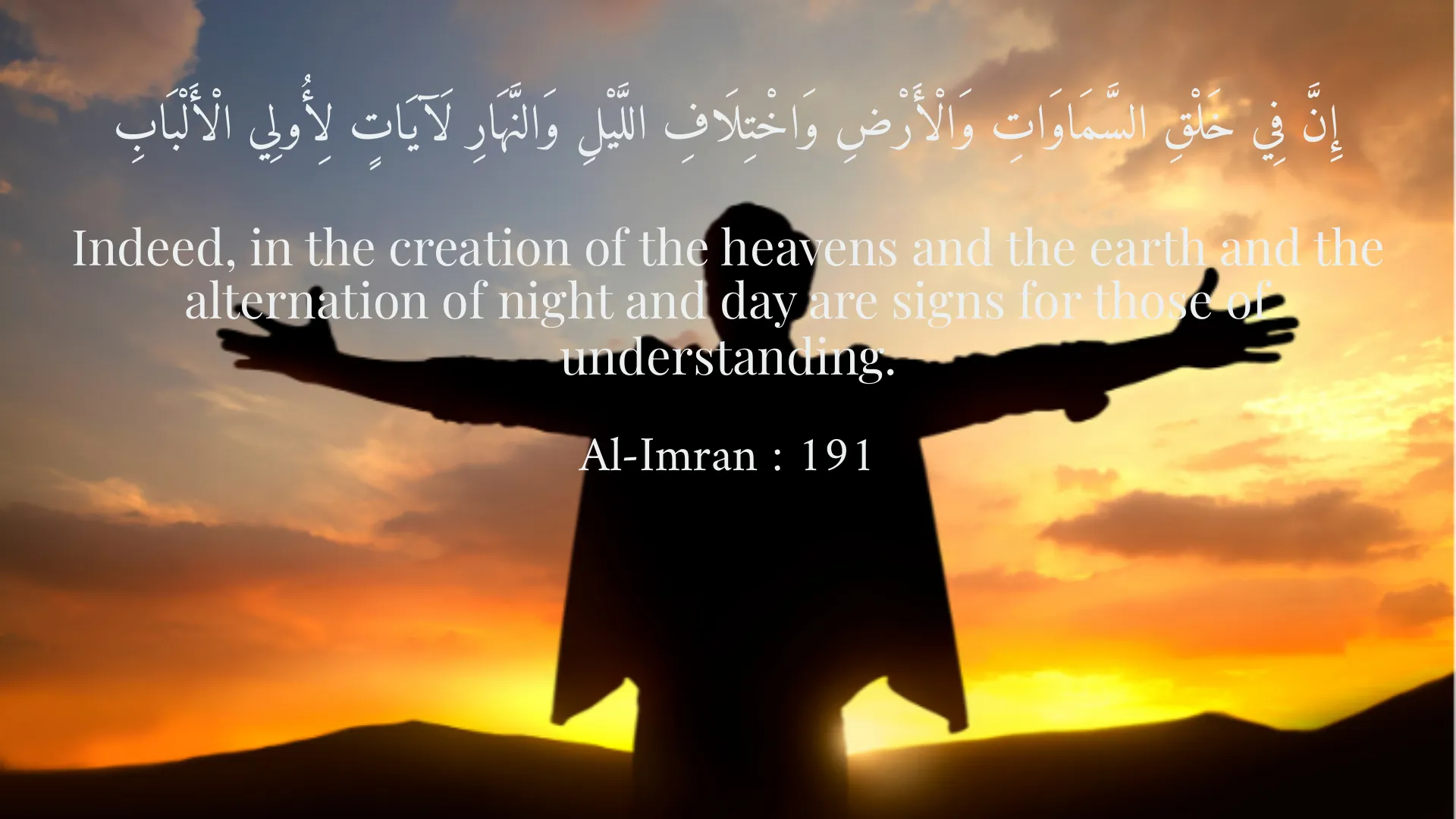
The Holy Quran is a profound text that serves as a guiding light for millions of believers around the world. Among its many teachings, one of the most prominent themes revolves around faith in Allah's existence and the signs He has created to lead humanity to that understanding. The Quran continuously invites its readers to ponder and reflect on the world around them, urging them to find evidence of divine existence within creation itself. The encouragement to recognize these signs is not just a call for belief; it is a thoughtful encouragement to engage with the world in a way that reveals deeper truths about existence and the divine. In Surah Al-Imran, verse 191, Allah emphasizes the importance of contemplation when he states: "Indeed, in the creation of the heavens and the earth and the alternation of night and day are signs for those of understanding." This verse illustrates a crucial point; creation is not merely the product of random occurrences, but rather a deliberate act that reflects the greatness and planning of its Creator. The intricate balance in the ecosystem—how the sun rises and sets, how seasons change, and how life flourishes—are not random happenstances but are signs for believers to acknowledge and understand. As individuals journey through life, it is not uncommon for doubts to form regarding the existence of God, especially when one encounters significant trials or challenges. Doubt can stem from a variety of sources: lack of understanding, personal hardships, or even from a scientific perspective that seeks empirical evidence. In today's world, where technology and science have provided explanations for many phenomena, some might question traditional religious teachings or find themselves at a crossroads where their faith is concerned. In Surah Al-Mu'minun, verses 12 to 14, Allah points to the stages of human creation: "And certainly We created man from an extract of clay; then We made him a sperm-drop in a firm lodging; then We made the sperm-drop a clinging substance; then We made the clinging substance a lump of flesh..." These verses highlight a beautiful assertion—that humanity's existence is a manifestation of divine creation. Each stage of development underscores Allah's involvement and emphasizes the notion that we, as beings, are a part of a greater design. The intricate process of human development from conception to birth further serves to inspire awe and wonder about the Creator. Despite the clarity of these signs, it is a reality that individuals with scientific or philosophical viewpoints may wrestle with beliefs about God. They often find themselves in a tension where faith and reason seem to conflict. This struggle is particularly poignant in challenging times when life's difficulties seem overwhelming, and the reliability of faith may appear uncertain. Yet, during such tumultuous periods, the Quran provides a crucial reminder: "Indeed, patience is with faith" (Surah Al-Baqarah, verse 153). This verse encapsulates a fundamental principle in Islam; that faith is not devoid of challenges but rather intertwined with patience and perseverance through trials. The hardships one faces can serve as tests of faith, prompting believers to deepen their understanding and connection with Allah. In moments of despair or uncertainty, the Quran encourages believers to take a step back, reflect on the verses, and seek solace in the signs that Allah has laid before them. Through contemplation and reflection on creation, believers are reminded that they are not isolated beings, but part of a grand design orchestrated by a compassionate Creator. The challenges and trials that may induce doubt can also serve as opportunities for growth, prompting believers to turn to their faith and the teachings of the Quran for guidance. In conclusion, the relationship between faith and understanding is profoundly illustrated in the Holy Quran. Allah's calls to contemplation and understanding serve not only as an invitation toward belief but also as a framework for navigating the complexities of life. Everyday signs, the grandeur of creation, and even the intricate processes of human development all testify to Allah’s existence and omnipotence. While doubt may eclipse faith during challenging moments, the Quran stands as a reminder that with patience comes understanding. Ultimately, embracing the journey of faith involves actively engaging with the divine signs around us, allowing us to anchor our beliefs in a reality that transcends mere existence. It is through this careful navigation of faith and reflection that individuals can find peace, strength, and connection with Allah, even in their darkest hours.
Related Verses
إِنَّ فِي خَلْقِ السَّمَاوَاتِ وَالْأَرْضِ وَاخْتِلَافِ اللَّيْلِ وَالنَّهَارِ لَآيَاتٍ لِأُولِي الْأَلْبَابِ
Indeed, in the creation of the heavens and the earth and the alternation of night and day are signs for those of understanding.
Al-Imran : 191
وَلَقَدْ خَلَقْنَا الْإِنْسَانَ مِن سُلَالَةٍ مِّن طِينٍ
And certainly We created man from an extract of clay.
Al-Mu'minun : 12
إِنَّ اللَّهَ مَعَ الصَّابِرِينَ
Indeed, Allah is with the patient.
Al-Baqarah : 153
Short Story
One day, a man named Ali had become hopeless and anxious, as he faced many challenges in his life. He frequently contemplated issues such as the existence of God and had lost interest in religion for various reasons. However, one day while strolling in the park, he looked up at the sky, and the beauty of nature engulfed him in thought. He recalled the verses of the Quran and decided to pay more attention to the signs of God. From that day on, Ali noticed a greater sense of peace in his life, and his faith in God was renewed.