Quranic Answer
In the journey of spiritual life, one of the most profound questions that often arises in the hearts and minds of believers is, "Why do our prayers sometimes go unanswered?" This question, rooted deeply in the human experience, invokes a need to explore the nature of prayer, divine communication, and the very essence of faith. The answer to this question is embedded in the Holy Quran, where Allah Himself states in Surah Al-Mu'min, verse 60: "And your Lord says, 'Call upon Me; I will respond to you.'" This declaration serves as a foundation for understanding the relationship between mankind and the Divine, suggesting that prayer is not just an act of asking, but a profound means of connecting with Allah. However, it is not uncommon for believers to feel disheartened when their prayers appear to go unanswered. This experience can stem from various reasons, and it is essential to contemplate them to cultivate a deeper understanding of prayer and patience in faith. Understanding Divine Timing Firstly, one of the key factors to consider is the concept of divine timing. God’s timing is inherently different from ours; as humans, we often seek immediate responses to our supplications. Allah, in His infinite wisdom, may choose to answer our prayers at a time that aligns more closely with our ultimate well-being, rather than our immediate desires. This distinction is crucial in grasping the broader picture of divine intervention. In our fast-paced world, the notion of waiting can be challenging. However, waiting can also be an opportunity for growth, reflection, and strengthening of faith. It teaches us patience, allowing us to see beyond our current circumstances and trust in the larger plan that Allah has for us. For many believers, the act of waiting, infused with prayer, becomes a journey in itself — a journey that fosters resilience and deeper devotion. Aligning Prayers with True Needs Moreover, our prayers may not always align with our true needs. Allah, in His omniscience, sees the intricacies of our lives far better than we can. There are instances when we passionately pray for something, convinced of its necessity only to realize later that Allah was withholding it because He had something better in store for us. This speaks to the depth of divine understanding versus human perception. For example, a person may fervently pray for a particular job, believing it to be their ideal role, only to face rejection. Later, they may find a position that better matches not only their skills but also brings about greater satisfaction and fulfillment. This phenomenon reflects the concept that Allah’s plans may surpass our limited vision, urging us to trust in His greater wisdom and benevolence. The Blessing of Prayer On the other hand, it is crucial to recognize that the act of praying itself is a blessing. Through prayer, we find a sacred space where we can unburden our hearts and minds. It offers a platform for self-expression, vulnerability, and communion with the Divine. In Surah Al-Baqarah, verse 186, Allah declares, "And when My servants ask you concerning Me, indeed I am near." This proclamation reiterates the significance of prayer and emphasizes that God is always listening. It serves as a reminder that even when the answer to our prayers may not manifest as we desire, the rapport we cultivate through our supplications affirms our relationship with Allah. In essence, prayer becomes less about the immediate outcomes and more about the closeness we foster with the Almighty. The Role of Faith and Patience Ultimately, it is essential to maintain faith in Allah and cultivate patience amidst feelings of despair. The Quran emphasizes these virtues repeatedly, urging believers to remain steadfast in their trust while navigating difficult times. In the face of unanswered prayers, understanding that faith is multifaceted and dynamic can lead to a more profound reconciliation with our circumstances. Patience, in Islamic philosophy, is not merely a passive waiting but an active state of engagement with life’s experiences. It encourages believers to continue praying, reflecting, and understanding that Allah's plan is potentially more significant than personal desires. This perspective encourages believers to look for the lessons in their trials, the blessings concealed in challenges, and the strength that emerges from perseverance. Conclusion In conclusion, the question of why prayers go unanswered is one that invites deep reflection and understanding within the context of one’s faith journey. The Holy Quran explicitly invites believers to communicate with Allah, assuring them that their prayers will be heard. However, the intricacies of divine timing, the alignment of prayers with actual needs, and the growth fostered through the practice of patience are aspects that deeply enrich the experience of prayer. Ultimately, prayer is more than just a call for assistance; it is a living testament to our relationship with Allah — one that fosters closeness, insight, and serenity amid the uncertainties of life. Therefore, as believers, we are encouraged to continue praying with an open heart, seeking a connection with the Divine, and trusting that while we may not always understand the outcomes, we are embraced by Allah’s infinite wisdom and love.
Related Verses
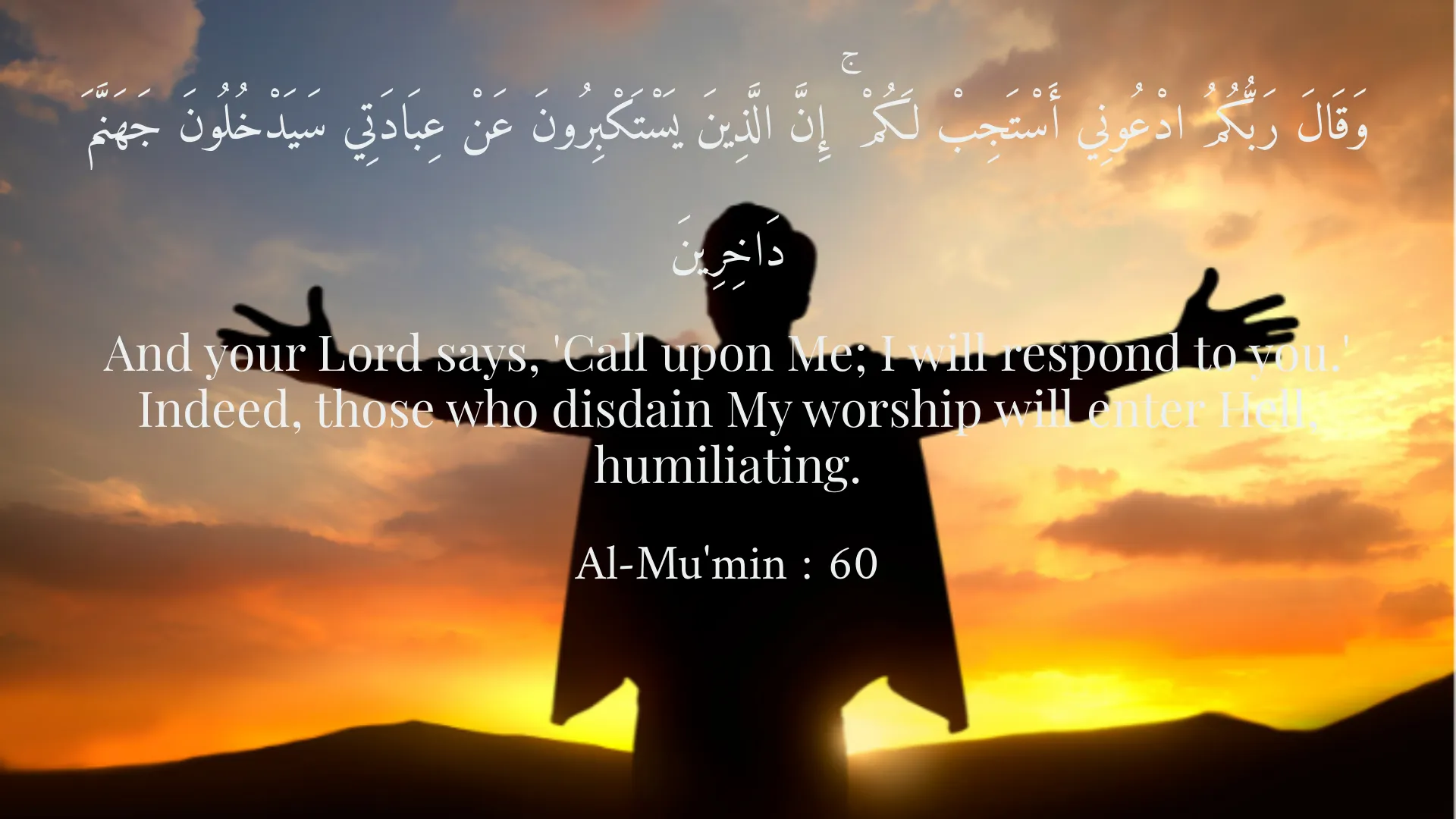
وَقَالَ رَبُّكُمُ ادْعُونِي أَسْتَجِبْ لَكُمْ ۚ إِنَّ الَّذِينَ يَسْتَكْبِرُونَ عَنْ عِبَادَتِي سَيَدْخُلُونَ جَهَنَّمَ دَاخِرِينَ
And your Lord says, 'Call upon Me; I will respond to you.' Indeed, those who disdain My worship will enter Hell, humiliating.
Al-Mu'min : 60
وَإِذَا سَأَلَكَ عِبَادي عَنِّي فَإِنِّي قَرِيبٌ ۖ أُجِيبُ دَعْوَةَ الدَّاعِ إِذَا دَعَانِ ۚ فَلْيَسْتَجِيبُوا لِي وَلْيُؤْمِنُوا بِي لَعَلَّهُمْ يَرْشُدُونَ
And when My servants ask you concerning Me, indeed I am near. I respond to the supplicant when he calls upon Me.
Al-Baqarah : 186
Short Story
There is a story of a faithful man who prayed for many years to have a child but saw no response. He trusted God and knew his prayer would be answered in due time. After several years, his wife became pregnant, and he realized that his patience and faith in God had been rewarded in the best way.