Quranic Answer
Life as a human is an intricate tapestry woven with threads of challenges, adversities, and profound mysteries that often leave us questioning the very fabric of our existence. From health challenges, financial burdens, relational strains, to the loss of loved ones, life’s intrinsic difficulties can be overwhelming. Among the most poignant questions we confront on our spiritual journey is, why are our prayers not answered in a timely manner? This inquiry reflects a universal human experience and invites us to delve into the theological depths of divine wisdom and timing. In the Holy Quran, one of the central texts of Islam, the relevance of prayer and the nature of divine response are beautifully articulated in Surah Al-Baqarah, verse 186. Allah states, 'And when My servants ask you concerning Me, indeed I am near. I respond to the invocator when he calls upon Me.' This assertion underscores a fundamental belief in the nearness of Allah to His servants and reassures us that our prayers are not cast into the void; rather, they are acknowledged and heard. However, the issue arises when we do not receive swift responses to our heartfelt supplications. This predicament can be attributed to several factors, all of which fall under the purview of divine wisdom. One conceivable reason is the infinite knowledge and wisdom possessed by Allah. In His omniscience, Allah understands the perfect timing for answering prayers, often in ways that transcend human understanding. Our temporal perspective can limit our appreciation of divine timing; we may expect answers that align with our immediate desires, yet Allah’s wisdom may suggest that those answers are best revealed at a later point in our lives. Another significant aspect to consider is that our prayers might not always align with what is ultimately good for us. From a finite human viewpoint, we might fervently wish for certain outcomes—perhaps a new job, healing from an illness, or restoration of a broken relationship. However, it’s possible that such requests may not align with the greater plan that Allah has for us. In these situations, it is critical to trust in Allah's plan and to recognize that unanswered prayers may redirect us toward the best course of action for our souls. Additionally, the act of praying is itself a profound journey of faith that nurtures patience and resilience within us. The Quran emphasizes this in Surah Aal-E-Imran, verse 186, where Allah proclaims, 'And We will surely test you with something of fear and hunger and a loss of wealth and lives and fruits, but give good tidings to the patient.' Here, the essence of testing through trials is paramount; Allah may intentionally place us in challenging circumstances that compel us to cultivate patience, faith, and endurance. Trials and tribulations play a crucial role in shaping our character and nurturing spiritual growth. Each period of struggle can be seen as a steppingstone leading us toward a greater understanding of ourselves and the essence of faith. The concept of patience in Islam transcends mere endurance; it’s about trust in Allah's timing and wisdom. When faced with adversities, we must remind ourselves that our struggles serve a higher purpose, one that may not always be apparent at the moment. Indeed, this brings us back to the crux of prayer. Allah is ever present and attentive to our needs. While answers to our prayers may arrive later than we anticipate, or perhaps in a form we do not recognize, it is crucial to remain steadfast. The delay can sometimes stem from the necessity for us to develop virtues like humility, understanding, and resilience that can only be forged through patience and trust in divine timing. In times of unanswered prayers, it can be helpful to engage in acts of gratitude and remembrance of Allah through dhikr (remembrance). Fostering an attitude of gratitude can transform our perspective, allowing us to appreciate the blessings in our lives even amidst troubling circumstances. Moreover, it is within our prayers that we can pour out our hearts, express our vulnerabilities, and seek the company of our Creator. This spiritual connection can help soothe our worries and anxieties, replacing feelings of despair with hope and trust. The comforting belief that Allah knows what is best for us allows us to let go of our burdens and embrace a journey of faith. Additionally, it is paramount to remain connected with our community during these times. Engaging in communal prayers and reaching out for support can bolster our faith and provide us with reassurance. Sharing our experiences with like-minded individuals can instill hope and encouragement in both ourselves and others. Ultimately, while the notion of unanswered prayers can evoke feelings of doubt and confusion, it’s essential to acknowledge that prayers are answered in myriad ways—whether immediate, delayed, or answered in another form entirely. We may find ourselves receiving blessings we did not even think to ask for, resulting in outcomes that align with a higher purpose known only to Allah. Herein lies the beauty of faith—learning to trust in the unseen. Our limited human understanding cannot always grasp the profundity of divine wisdom, but through unwavering faith, we can affirm that Allah’s plans are far superior to our own. By cultivating patience, surrendering our wishes, and continuing our prayers, we rise above our immediate desires and yield ourselves to the divine will. Life, in all its complexity, teaches us that patience is not merely waiting; it is a transformative journey of growth, understanding, and reliance on our Creator. Allah is always near, and as we navigate our prayers and tribulations, let us hold tight to the belief that ultimately, what is best for us will come to pass.
Related Verses
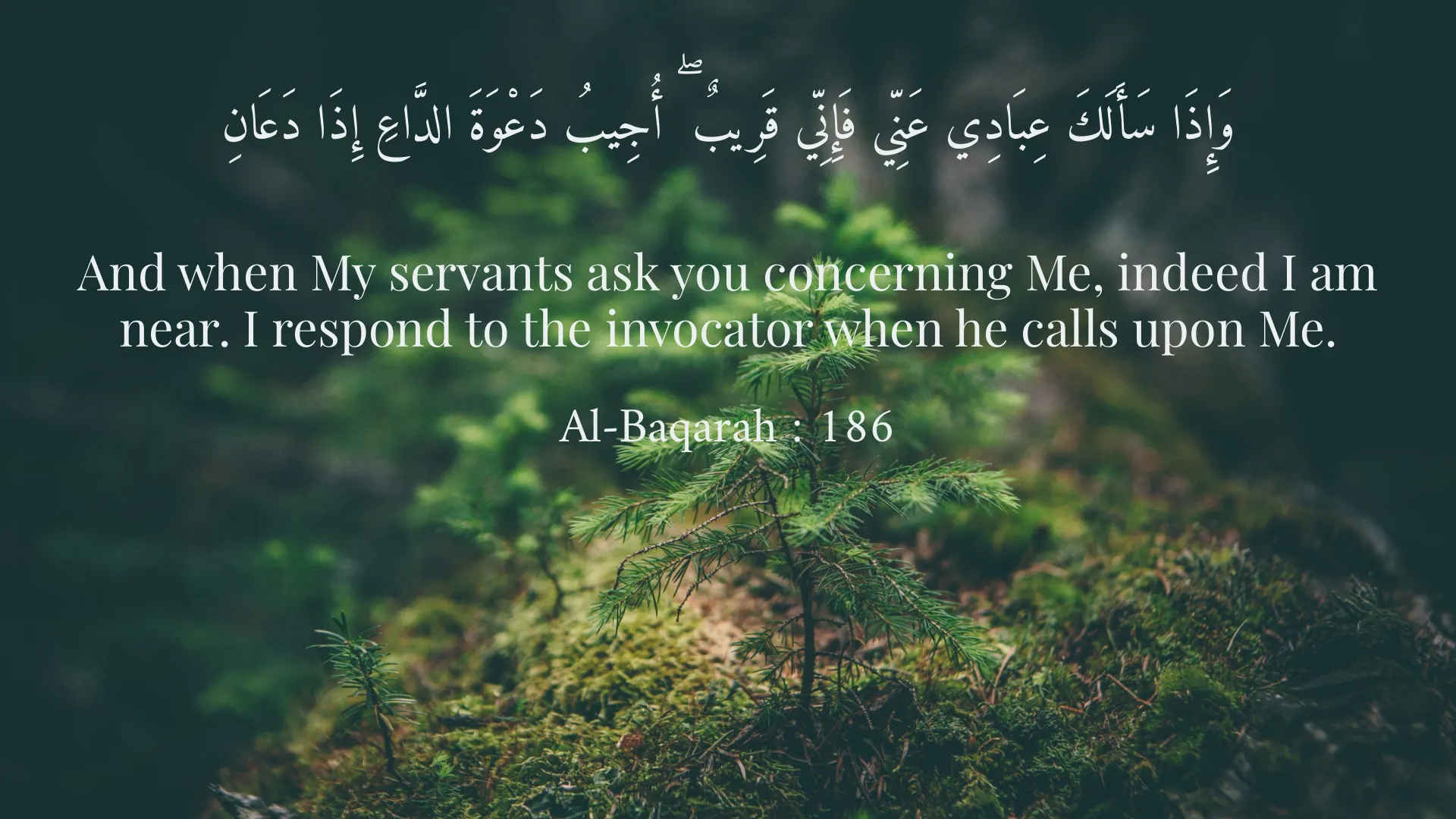
وَإِذَا سَأَلَكَ عِبَادِي عَنِّي فَإِنِّي قَرِيبٌ ۖ أُجِيبُ دَعْوَةَ الدَّاعِ إِذَا دَعَانِ
And when My servants ask you concerning Me, indeed I am near. I respond to the invocator when he calls upon Me.
Al-Baqarah : 186
وَنَبْلُوكُم بِشَيْءٍ مِّنَ الْخَوْفِ وَالْجُوعِ وَنَقْصٍ مِّنَ الْأَمْوَالِ وَالْأَنفُسِ وَالثَّمَرَاتِ ۗ وَبَشِّرِ الصَّابِرِينَ
And We will surely test you with something of fear and hunger and a loss of wealth and lives and fruits, but give good tidings to the patient.
Aal-E-Imran : 186
Short Story
One day, a man named Ali had made a heartfelt prayer but felt as though he saw no response or sign from Allah. He recalled the verse from Surah Al-Baqarah and realized that Allah had promised to listen to prayers. Ali decided to be patient and told himself, 'Allah is all-knowing and knows the right time.' Over time, suddenly a blessing came to him, and he came to believe that his patience and faith were noticed by Allah.