Quranic Answer
The Divine Trials and Their Significance in the Holy Quran Introduction The concept of trials and tribulations is fundamental in various religious teachings, and in Islam, it is a recurring theme emphasized in the Holy Quran. The Quran presents tests from Allah not merely as challenges but as profound opportunities for growth and spiritual elevation. This article delves into the implications of divine tests as depicted in the Quran, primarily through Surah Al-Baqarah and other references, exploring their significance in strengthening faith, manifesting resilience, and ultimately nurturing a deeper connection with the Almighty. Understanding the Divine Tests In Surah Al-Baqarah, verse 155, Allah states, "And certainly, We shall test you with something of fear, hunger, and a loss of wealth and lives and fruits." This verse poignantly highlights the various dimensions of divine tests. They can manifest in forms of fear—be it fear of loss, insecurity, or uncertainty; hunger, which relates not just to physical deprivation but also to spiritual hunger; and loss, which includes not only material possessions but also loved ones. Through such trials, Allah aims to evaluate the faith and sincerity of human beings. The essence of trials lies not merely in facing them, but rather in how individuals respond to the challenges set before them. In many ways, these tests serve to reinforce the spiritual fabric of a person's identity. They are instrumental in building resilience and generating a sense of reliance on Allah's support. These hardships often lead to personal reflection, helping individuals understand their strengths and weaknesses better. The very act of confronting trials can catalyze significant spiritual growth, compelling individuals to turn towards their faith more earnestly in search for solace and guidance. The Purpose of Trials and Tribulations Divine tests serve multiple purposes. First and foremost, they are a means through which Allah seeks to elevate the spiritual status of His servants. By imposing tougher tests on certain individuals, Allah is facilitating their journey toward growth and perfection. Such divinely orchestrated challenges act as a crucible, shaping individuals into more faithful, compassionate, and resilient beings. The Prophet Muhammad (peace be upon him) elucidated that trials are indicative of Allah's love for His believers. As indicated in authentic Hadiths, the more severe the trial, the closer the person is to Allah, implying that such challenges are marks of divine affection rather than mere punishments. This idea is further echoed in Surah Al-Imran, verse 186, which states, "You will surely be tried." These tests are not random occurrences; they emphasize the wisdom embedded within Allah's plan for humanity. They serve as reminders of the transient nature of worldly life and highlight human limitations, fostering an understanding that reliance should be placed upon Allah alone. Manifesting Patience and Resilience One of the most significant lessons derived from facing trials is the development of patience (Sabr) and resilience—a theme heavily reinforced in Islamic teachings. The Quran consistently emphasizes the importance of patience during adversities. Patience is portrayed not just as a passive endurance of hardship but as an active engagement with one's faith despite challenges. The endurance displayed during trials is transformative and can lead to an enriched spiritual experience. For many, hardships become a sanctuary where individuals can reconnect with their faith and contemplate Allah's creation. During these times, the realization of one’s dependence on Allah becomes clear, forging a stronger relationship built on trust and sincerity. The ultimate objective is to emerge from trials with a renewed sense of purpose and a more profound appreciation for faith. Individuals often find solace in the remembrance of Allah, realizing that challenges bring forth opportunities for reflecting on their reliance on divine support. Community and Mutual Support Moreover, trials emphasize the importance of community and human relationships. During hardships, individuals often band together to support one another, showcasing human compassion and solidarity. The capacity to help others during their difficulties is a manifestation of the human qualities that Allah nurtures through tests. In this sense, trials fortify spiritual connections not only with Allah but also with fellow beings. They provide moments for people to exhibit kindness, empathy, and understanding, reminding the community of the importance of standing together during adversities. In essence, Allah's tests open avenues for communal growth and enhance mutual appreciation among individuals. The struggles faced give rise to stronger bonds and demonstrate how reliance on one another can serve as a means of alleviating suffering and strife. Furthermore, the sharing of stories of resilience and strength can encourage others, enabling a cycle of support and reinforcing faith within the community. Conclusion Ultimately, the hardships that one endures throughout life serve as a vital part of a believer’s journey toward reaching spiritual heights. The divinely inspired tests elucidate that challenges are integral to the refining process of one’s faith. For the pious, life's difficulties manifest not just as obstacles, but as spiritual reflections that draw them closer to Allah, providing lessons that echo throughout their lives. The deeper connection with Allah forged through trials leads to enlightenment, understanding, and ultimately a state of tranquility amidst worldly turbulence. Thus, divine trials are not an expression of abandonment but rather the embodiment of God's love, guiding humanity through the labyrinth of life towards spiritual fulfillment.
Related Verses
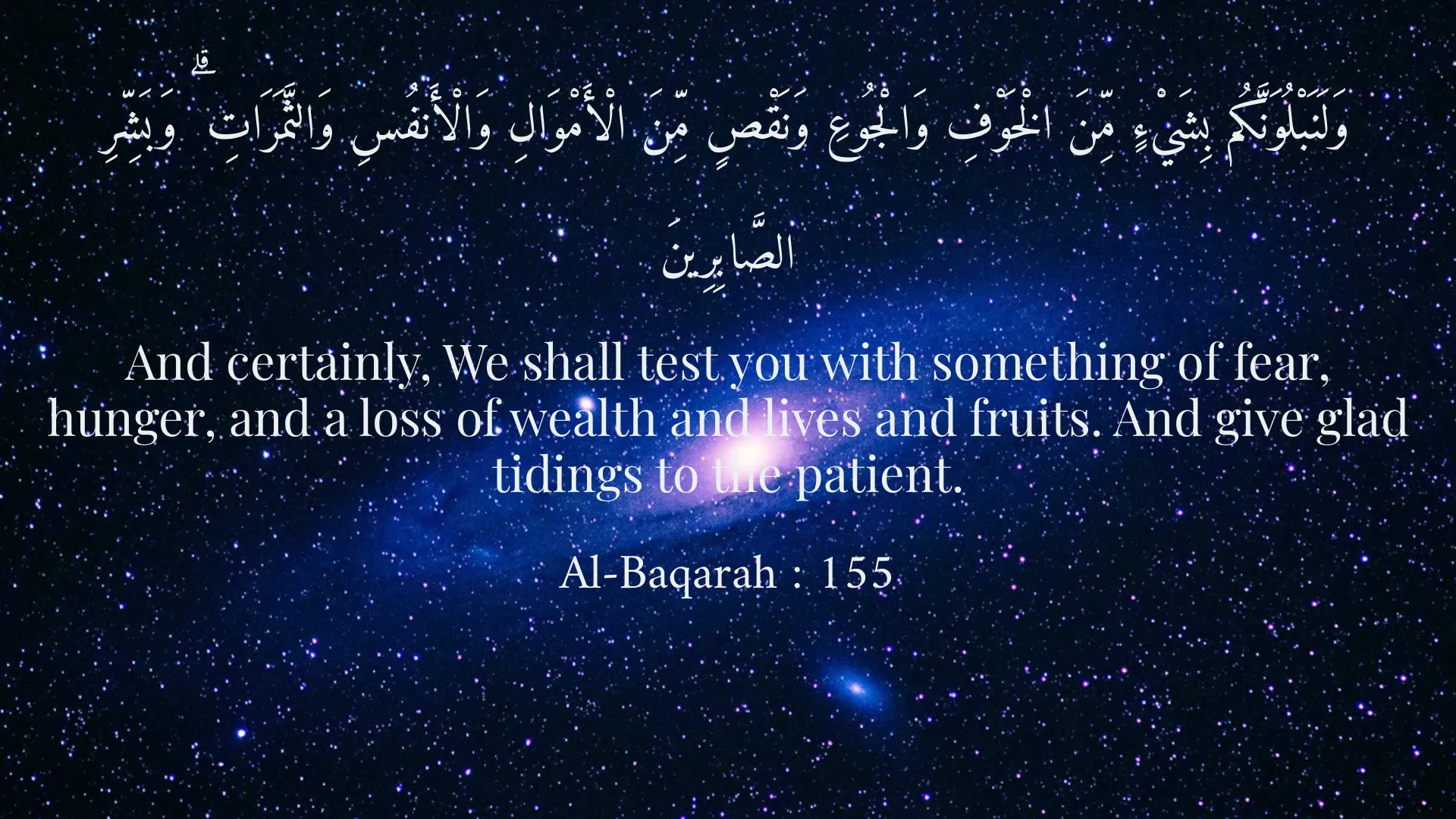
وَلَنَبْلُوَنَّكُم بِشَيْءٍ مِّنَ الْخَوْفِ وَالْجُوعِ وَنَقْصٍ مِّنَ الْأَمْوَالِ وَالْأَنفُسِ وَالثَّمَرَاتِ ۗ وَبَشِّرِ الصَّابِرِينَ
And certainly, We shall test you with something of fear, hunger, and a loss of wealth and lives and fruits. And give glad tidings to the patient.
Al-Baqarah : 155
لَتُبْلَوُنَّ فِي أَمْوَالِكُمْ وَأَنفُسِكُمْ ۖ وَلَتَسْمَعُنَّ مِنَ الَّذِينَ أُوتُوا الْكِتَابَ مِن قَبْلِكُمْ وَمِنَ الَّذِينَ أَشْرَكُوا أَذًى كَثِيرًا ۖ وَإِن تَصْبِرُوا وَتَتَّقُوا فَإِنَّ ذَٰلِكَ مِنْ عَزْمِ الْأُمُورِ
You will surely be tried in your possessions and your selves; and you will surely hear from those who were given the Scripture before you and from those who associate others with Allah much abuse. But if you are patient and fear Allah, it is the best course.
Al-Imran : 186
Short Story
One day, a person named Amir was making a prayerful supplication to Allah, asking, 'Why do I always face more difficulties in my life?' At that moment, a gentle breeze touched his face, and he felt that pain and suffering should be seen as a gift. He decided to turn every hardship into a chance for positive change and to grow closer to Allah. In the end, he realized that these tests made him stronger and fostered his spiritual growth.