Quranic Answer
In Islam, Hijab is recognized as an important principle that is recommended to all believers based on Quranic verses and the teachings of Prophet Muhammad. The concept of Hijab extends far beyond being a mere piece of clothing; it embodies a holistic approach to modesty, morality, and the dynamics of gender interaction within Islamic society. The Quran is filled with guidance on the matter, providing a clear directive not only for women but also for men. This article will delve deeply into the significance of Hijab in Islam, its implications for both genders, how it influences social security, and its broader impact on society. The term "Hijab" literally means to cover or to hide. In the context of Islamic teachings, it refers primarily to the modest dress codes prescribed for Muslim women, which includes the covering of the body except for the face and hands in many interpretations. However, the principles of Hijab extend to men as well. In Surah An-Nur (Chapter of Light), verse 30, Allah commands men to lower their gaze and guard their modesty. This directive highlights the mutual responsibility for modesty shared by both men and women within Islamic teachings. Following up with verse 31 of the same surah, Allah instructs women to maintain their Hijab and not to reveal their beauty except to close relatives and those whom they set as guardians. This verse illustrates the underlying philosophy of Hijab: it is not merely a restriction but rather a means of self-respect, protection, and social dignity. It is important to note that the commandments for Hijab were delivered during a time of transition in society when women were often subjected to exploitation and objectification. In this light, the rules surrounding Hijab can be seen as measures aimed at fostering respect and safeguarding the honor of women. Furthermore, the significance of Hijab is reinforced in Surah Al-Ahzab (Chapter of the Confederates), verse 59, where Allah instructs the Prophet Muhammad to tell his wives, daughters, and the believing women to draw their cloaks around them so that they may be recognized and not harassed. This verse offers insight into the social context of Hijab—it serves as a protective barrier that identifies Muslim women while simultaneously affording them a level of safety and security in society. The emphasis on recognition as a protective mechanism signifies that Hijab is inherently tied to the preservation of dignity and honor in the community. Moreover, Hijab is viewed as a measure to maintain familial harmony and a cohesive social environment. By adhering to the principles of Hijab, individuals are reminded of their responsibilities towards one another within a community setting. This collective obligation fosters an atmosphere of mutual respect, where every individual's dignity is championed. As such, Hijab contributes significantly to social stability, paving the way for a healthier and more humane society. The alternative perspectives regarding Hijab, including criticisms framed in the context of autonomy and choice, play a role in broader discussions about the concept. While some argue that Hijab can impede freedom or serve as an oppressive instrument, proponents emphasize that the choice to wear Hijab is deeply personal and often a strong manifestation of faith. The act of wearing Hijab is an expression of one's commitment to the values enshrined in Islam and signifies a conscious choice to uphold the commandments of Allah. Moreover, Hijab is also observed at different levels of observance, varying from cultural expressions to doctrinal mandates. For many women, wearing a Hijab becomes a form of empowerment, illustrating their identity as Muslims amidst diverse societies. It prompts a dialogue about self-expression, cultural identity, and religious dedication. This dimension is particularly relevant in Western societies where Hijab is often a visible symbol of faith, prompting conversations about tolerance, understanding, and acceptance. From a social perspective, Hijab fosters an environment that encourages individuals to see beyond physical appearances—focusing instead on character, intellect, and actions. This shift challenges the societal norms that prioritize superficial judgments based on appearance and encourages a culture that values inner qualities. In this sense, Hijab can serve as an antidote to materialism and the objectification often prevalent in modern societies. Additionally, the practice of Hijab creates opportunities for educational and public discourse on issues of gender equity and rights within Islamic teachings. Many Muslim scholars and activists advocate that true empowerment for women is rooted in the understanding and practice of their faith, as it articulates principles of equality, respect, and honor. By framing Hijab within this empowering context, the necessity for broader engagement in discussions about gender issues is emphasized, showing that Hijab can serve as a bridge between traditional Islamic values and contemporary challenges. It is essential, however, to address that any discussion of Hijab must also recognize the diversity within the Muslim community. Interpretations and implementations of Hijab can vary significantly based on cultural, geographical, and individual factors. This plurality acknowledges that experiences with Hijab are not monolithic but shaped by a myriad of influences, including social and familial backgrounds. In conclusion, Hijab is more than just a religious obligation; it is a comprehensive principle that embodies modesty, dignity, and protection for women, and a reminder for men to exercise respect and responsibility. As a practice deeply rooted in Islamic teachings, it serves as a bulwark against social degradation and works to cultivate a sense of community and mutual respect. The discourse surrounding Hijab continues to evolve, reflecting broader societal changes, yet its fundamental role as a means of preserving individual dignity remains unwavering. For many, wearing Hijab is an affirmation of faith and a conscious choice that shapes their identity in profound ways. Therefore, understanding and honoring the principles surrounding Hijab is essential for fostering constructive dialogues within and outside the Muslim community, contributing to a more inclusive and respectful society.
Related Verses
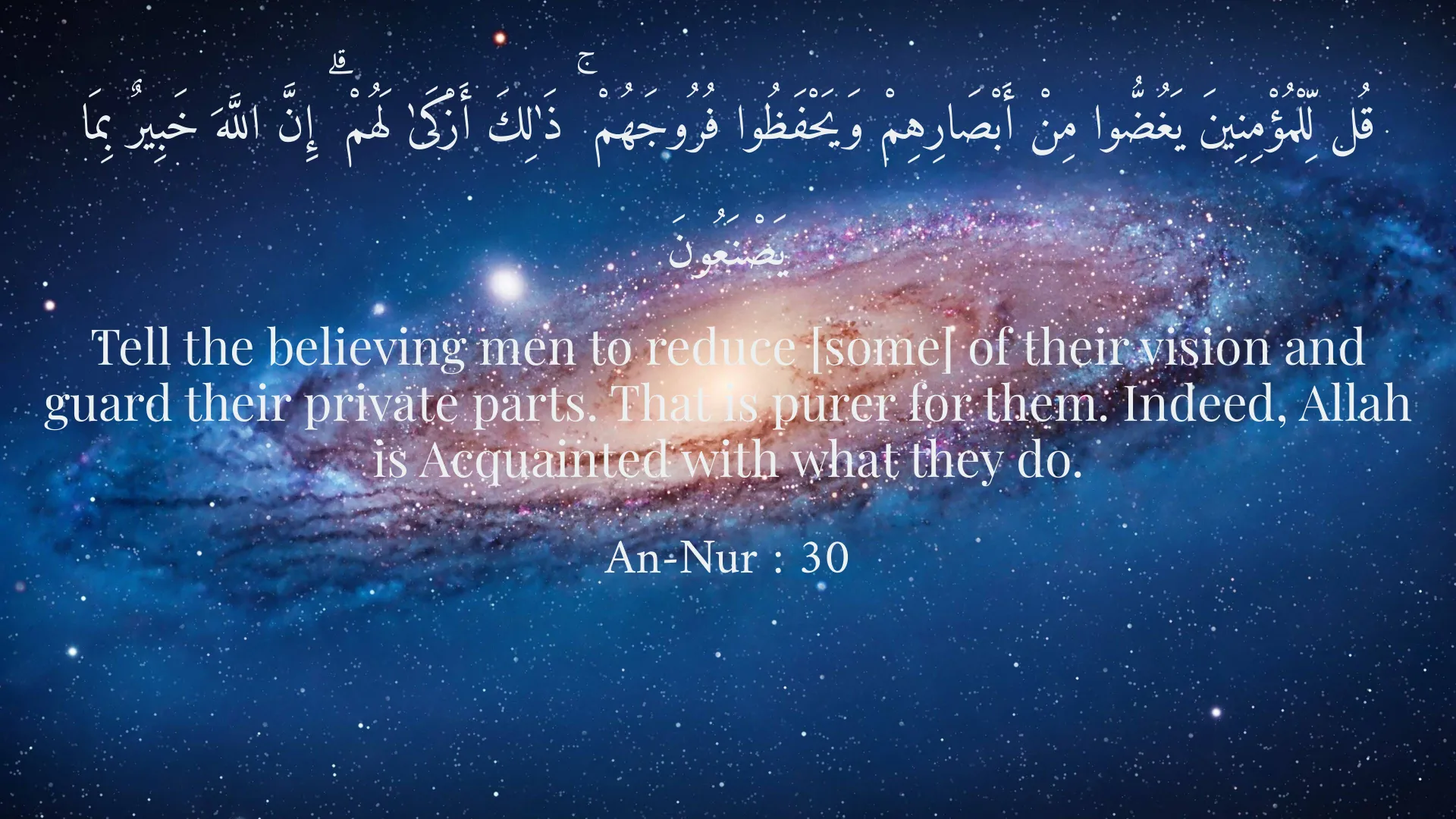
قُل لِّلْمُؤْمِنِينَ يَغُضُّوا مِنْ أَبْصَارِهِمْ وَيَحْفَظُوا فُرُوجَهُمْ ۚ ذَٰلِكَ أَزْكَىٰ لَهُمْ ۗ إِنَّ اللَّهَ خَبِيرٌ بِمَا يَصْنَعُونَ
Tell the believing men to reduce [some] of their vision and guard their private parts. That is purer for them. Indeed, Allah is Acquainted with what they do.
An-Nur : 30
وَقُل لِّلْمُؤْمِنَاتِ يَغْضُضْنَ مِنْ أَبْصَارِهِنَّ وَيَحْفَظْنَ فُرُوجَهُنَّ وَلَا يُبْدِينَ زِينَتَهُنَّ إِلَّا مَا ظَهَرَ مِنْهَا ۖ وَليَضْرِبْنَ بِخُمُرِهِنَّ عَلَىٰ جُيُوبِهِنَّ ۗ وَلَا يُبْدِينَ زِينَتَهُنَّ إِلَّا لِبُعُولَتِهِنَّ أَوْ آبَائِهِنَّ أَوْ آبَائِ بُعُولَتِهِنَّ أَوْ أَبْنَائِهِنَّ أَوْ أَبْنَاءِ بُعُولَتِهِنَّ أَوْ إِخْوَانِهِنَّ أَوْ بَنِي إِخْوَانِهِنَّ أَوْ بَنَاتِهِنَّ أَوْ نِسَائِهِنَّ أَوْ مَا مَلَكَتْ أَيْمَانُهُنَّ ۗ وَلْيَضْرِبْنَ بِخُمُرِهِنَّ عَلَىٰ جُيُوبِهِنَّ ۚ وَلَا يُبْدِينَ زِينَتَهُنَّ إِلَّا لِمَن ذَكَرَ
And tell the believing women to reduce [some] of their vision and guard their private parts and not reveal their adornment except that which [ordinarily] appears thereof. And to draw their veils all over their chests.
An-Nur : 31
يَا أَيُّهَا النَّبِيُّ قُل لِّأَزْوَاجِكَ وَبَنَاتِكَ وَنِسَاءِ الْمُؤْمِنِينَ يُدْنِينَ عَلَيْهِنَّ مِنْ جَلابِيبِهِنَّ ۚ ذَٰلِكَ أَدْنَىٰ أَن يُعْرَفْنَ فَلَا يُؤْذَيْنَ ۗ وَكَانَ اللَّهُ غَفُورًا رَّحِيمًا
O Prophet, tell your wives and your daughters and the women of the believers to draw their cloaks over themselves. That is more suitable that they will be known and not abused. And ever is Allah Forgiving and Merciful.
Al-Ahzab : 59
Short Story
One day, a believing woman was walking in the street with her child. She dressed in Hijab, reflecting dignity and respect in society. Her child asked, 'Mother, why do you dress this way?' She replied, 'This Hijab is a sign of my faith, and I want to invite my community to peace and security.' The child listened with pride and felt that his mother was not only beautiful but also strong.