Quranic Answer
The Holy Quran serves as a guiding light for the lives of Muslims, providing not only spiritual wisdom but also practical guidance on how to lead a life filled with goodness and positivity. Among its many themes, one of the most significant is the emphasis on doing good deeds and taking the initiative to help others. Good deeds are often portrayed as the ultimate manifestation of one’s faith and belief in Allah, and they serve as a crucial parameter for measuring righteousness and spiritual fulfillment. Through various verses, the Quran elucidates the concept of good deeds, the importance of taking proactive steps in executing them, and the profound impact they have not only on the individual but also on society at large. To begin with, in Surah Al-Baqarah, verse 177, Allah conveys a comprehensive definition of what it means to be righteous. The verse states, "Righteousness is not that you turn your faces toward the east or the west, but righteousness is in one who believes in Allah, the Last Day, the Angels, the Book, and the Prophets, and gives his wealth, in spite of love for it, to relatives, orphans, the needy, the traveler, those who ask [for help], and for freeing slaves; [and who] establishes prayer and gives zakah; [those who] fulfill their promise when they promise; and [those who] are patient in poverty and hardship and during battle. Those are the ones who have been true, and it is those who are the righteous." This powerful verse elucidates that righteousness transcends mere physical rituals or directional worship; rather, it is deeply anchored in faith, compassion, charity, and patience. The phrase "in spite of love for it" emphasizes an essential aspect of good deeds—namely, sacrifice. It is not enough to merely give; one must do so willingly and in acknowledgment of the inherent value of the objects or benefits being surrendered. This brings us to another poignant verse in Surah Al-Imran, verse 92, which states, "Never will you attain good until you spend from that which you love, and whatever you spend, indeed, Allah is Knowing of it." Here, the Quran draws attention to the necessity of selflessness in charitable acts, stressing that genuine goodness is realized through sacrifices of both material wealth and emotionally significant possessions. One might question why this emphasis on sacrifice is so vital in the realm of good deeds. The very act of sacrificing what is dear to us creates a deeper connection between the giver and the act itself. It fosters gratitude for what one possesses and promotes a sense of empathy towards those who are less fortunate. This cycle of giving not only enriches the lives of others but also enhances the giver’s character, aligning them closer to divine ethics and moral standards. Continuing with the theme of saving lives, in Surah Al-Ma'idah, verse 32, we encounter another profound teaching: "Because of that, We decreed upon the Children of Israel that whoever kills a soul unless for a soul or for corruption [done] in the land—it is as if he had slain mankind entirely. And whoever saves one—it is as if he had saved mankind entirely." This verse highlights the immense value of life and emphasizes that each act of kindness has the potential to impact humanity on a grand scale. To save a single life is to participate in the preservation of the entire human race. This invites believers to view their capacity for good not just within societal confines but as a cosmic responsibility that extends beyond their immediate communities. The encouragement to engage in acts of kindness and altruism transcends the barriers of community and locality, emphasizing a universal moral duty. The Quran constantly reiterates that the universe is interconnected and that one's actions can have rippling effects. Hence, engaging in good deeds establishes a necessary bond among individuals, transforming even mundane interactions into opportunities for significant impact. Furthermore, taking the initiative in doing good is both a personal and a communal endeavor. When an individual leads by example, they inspire those around them to follow suit, cultivating a culture of kindness and support. It establishes a paradigm where goodness becomes an intrinsic part of the fabric of society. Through acts of charity, compassion to the needy, and simple gestures of kindness, communities can work toward achieving harmony and collective growth. This collective affiliation fosters an environment wherein individuals become better human beings, nurturing empathy and cooperation. Moreover, the results of engaging in good deeds extend beyond community welfare; they also attain divine favor and satisfaction. By striving to do good, a believer distances themselves from the potential wrath of Allah while simultaneously seeking His pleasure. This intrinsic motivation for goodness becomes an integral part of a believer’s life, guiding them toward a path paved with blessings. Acts of beneficence foster not only personal fulfillment but also create an ambiance where care and compassion become normalized behaviors. Consequently, we witness a transformation not only within individuals but also within communities, generating a positive feedback loop that contributes to the holistic betterment of society. As one feels the joy of giving, others are encouraged to act similarly, leading to a cycle of kindness that can break through barriers and unite hearts across diverse backgrounds. In conclusion, the Holy Quran places immense importance on engaging actively in good deeds as a reflection of one's faith and morality. Each piece of guidance offers valuable insights into the nature of righteousness, emphasizing the need for selflessness and the immense value of preserving life. Taking the initiative in doing good is not merely an obligatory act but a proactive step towards creating a more compassionate and nurturing world. By embodying these principles, believers can bring about genuine happiness—not just in their lives but also in the lives of those they touch. Ultimately, it becomes clear that the practice of good deeds leads individuals to not only a more fulfilling existence but also to a broader understanding of humanity itself, rooting their actions in love, sacrifice, and divine purpose.
Related Verses
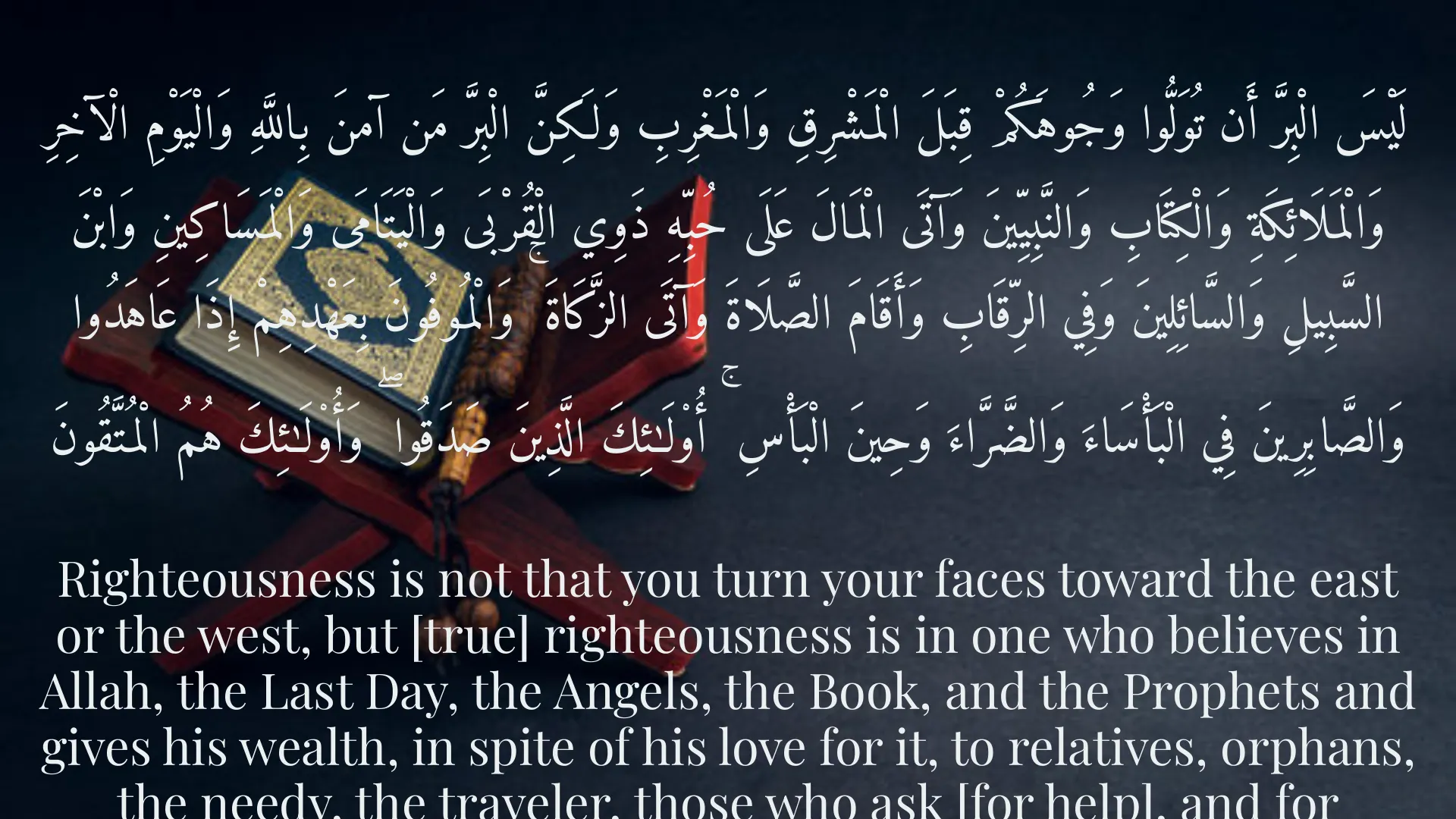
لَيْسَ الْبِرَّ أَن تُوَلُّوا وَجُوهَكُمْ قِبَلَ الْمَشْرِقِ وَالْمَغْرِبِ وَلَكِنَّ الْبِرَّ مَن آمنَ بِاللَّهِ وَالْيَوْمِ الْآخِرِ وَالْمَلَائِكَةِ وَالْكِتَابِ وَالنَّبِيِّينَ وَآتَى الْمَالَ عَلَى حُبِّهِ ذَوِي الْقُرْبَى وَالْيَتَامَى وَالْمَسَاكِينِ وَابْنَ السَّبِيلِ وَالسَّائِلِينَ وَفِي الرِّقَابِ وَأَقَامَ الصَّلَاةَ وَآتَى الزَّكَاةَ ۚ وَالْمُوفُونَ بِعَهْدِهِمْ إِذَا عَاهَدُوا وَالصَّابِرِينَ فِي الْبَأْسَاءَ وَالضَّرَّاءَ وَحِينَ الْبَأْسِ ۚ أُو۟لَـٰئِكَ الَّذِينَ صَدَقُوا ۖ وَأُو۟لَـٰئِكَ هُمُ الْمُتَّقُونَ
Righteousness is not that you turn your faces toward the east or the west, but [true] righteousness is in one who believes in Allah, the Last Day, the Angels, the Book, and the Prophets and gives his wealth, in spite of his love for it, to relatives, orphans, the needy, the traveler, those who ask [for help], and for freeing slaves; and [those who] establish prayer and give zakah; [those who] fulfill their promise when they promise; and [those who] are patient in poverty and hardship and during battle. Those are the ones who have been true, and it is those who are the righteous.
Al-Baqarah : 177
لَن تَنَالُوا الْبِرَّ حَتَّى تُنفِقُوا مِمَّا تُحِبُّونَ ۗ وَمَا تُنفِقُوا مِن شَيْءٍ فَإِنَّ اللَّهَ بِهِۦ عَلِيمٌ
Never will you attain good until you spend from that which you love. And whatever you spend, indeed, Allah is Knowing of it.
Al-Imran : 92
مَن قَتَلَ نَفْسًا بِغَيْرِ نَفْسٍ أَوْ فَسَادٍ فِي الْأَرْضِ فَكَأَنَّمَا قَتَلَ النَّاسَ جَمِيعًا ۗ وَمَن أَحْيَاهَا فَكَأَنَّمَا أَحْيَا النَّاسَ جَمِيعًا ۗ وَقَدْ جَاءَتْهُمْ رُسُلُنَا بِالْبَيِّنَاتِ ثُمَّ إِنَّ كَثِيرًا مِّنْهُمْ بَعْدَ ذَٰلِكَ فِي الْأَرْضِ لَمُسْرِفُونَ
Because of that, We decreed upon the Children of Israel that whoever kills a soul unless for a soul or for corruption [done] in the land - it is as if he had slain mankind entirely. And whoever saves one - it is as if he had saved mankind entirely. And already there came to them Our messengers with clear signs. Then indeed, many of them, even after that, throughout the land were transgressors.
Al-Ma'idah : 32
Short Story
One day, a young man named Hossein recalled the Quranic verses and realized how taking the initiative to do good could change his life and others. He decided to help orphans in his neighborhood. On his first day, he took some food and books to the orphans' house. When he saw the shining faces of the children looking at him with joy and smiles, he felt a warmth in his heart. From that day onwards, Hossein became engaged in charitable activities and continued to help the needy. He realized that with every small act, he was brightening another world.