Quranic Answer
The Importance of Perseverance in Good Deeds and Charity in the Holy Quran The Holy Quran, as the ultimate scripture of Islam, serves not only as a guidebook for individual behavior but also as a comprehensive manual for societal well-being. One of the salient features highlighted within its sacred verses is the significance of perseverance in good deeds and charitable actions. Throughout the Quran, Allah Al-Mighty emphasizes the necessity for believers to strive continuously in their pursuit of righteousness. This theme of steadfastness in performing good acts is paramount in fostering an ethical and compassionate society. In Surah Al-Baqarah, verse 82, Allah reassures believers that those who have faith and engage in righteous deeds will be rewarded with entrance into paradise without a hint of fear of punishment. This profound verse underscores a crucial point: that the struggle for continuous good acts is not in vain; rather, it is a pathway toward divine mercy and ultimate salvation. In this context, one might argue that perseverance in good deeds is fundamental to ensuring God’s pleasure. It is an exhortation to keep pushing forward, regardless of the challenges an individual may face. Additionally, the Quran articulates the import of motivation accompanying good deeds. In Surah Fussilat, verse 33, it states: "And who is better in speech than one who invites to Allah and does righteousness and says, ‘Indeed, I am of the Muslims'?” This verse implicates an element of advocacy in doing good—sharing the message of righteousness and being an embodiment of it. Consequently, those who persistently engage in good deeds are not solely transforming their lives but are also acting as catalysts for inspiring others to walk the righteous path. Interestingly, this phenomenon can also be observed in the broader social context, where the act of reaching out with kindness encourages collective betterment. When one engages in charitable acts, the ripples of their actions extend far beyond their immediate environment, encouraging others to participate in similar acts of goodwill. In the Quranic context, there lies an inherent connection between doing good and actively calling others toward the path of Islam. This duality of action and invitation underscores the Islamic principle that one's good deeds serve a greater purpose, aiming not only at individual salvation but also at achieving a broader social harmony. Moreover, the act of persevering in good deeds and charitable actions holds transformative power over one's inner life. Psychology has consistently shown that acts of kindness promote happiness and emotional well-being. When individuals extend help to others, be it through voluntary services, donations, or just simple acts of kindness, they experience increased feelings of satisfaction and joy. This transformation elucidates the psychological aspect of the Quran's teachings on good deeds. The divine injunctions on charity and kindness are rooted not only in the spiritual realm but also in tangible social and psychological benefits that manifest in everyday life. Consequently, the importance of persevering in good deeds cannot be overstated, as it acts as a bidirectional conduit between individual spiritual fulfillment and collective social welfare. Striving towards moral excellence through continuous acts of kindness has a two-fold effect: facilitating personal happiness while simultaneously contributing to societal improvement. The Quran encourages its adherents to view charitable acts as an expression of faith. In this light, every act of kindness becomes an opportunity to connect more deeply with Allah, enhancing one's spirituality. It serves as a reminder that through our efforts, no matter how small, we are participating in creating a more just and equitable world. Such a perspective aligns with the overarching goals of all major religions, which espouse the virtues of compassion, charity, and human dignity. As we navigate daily life, cultivating a habit of persistent good works offers a pathway to inner peace and personal fulfillment. Engaging with the various forms of generosity—whether through time, resources, or actions—becomes an avenue for spiritual growth. Each charitable deed can be likened to an investment in one’s own soul, whereby returns manifest in the form of happiness, tranquility, and a sense of purpose. This spiritual investment echoes the Quranic sentiment that there lies a profound reward for those who stay true to the path of righteousness. In conclusion, the importance of perseverance in good deeds and charity is profoundly articulated throughout the Holy Quran. It serves as both a personal spiritual endeavor and a societal imperative, encompassing the essence of Islamic teachings. Engaging in continuous acts of goodness not only assures divine pleasure but also fosters communal harmony and individual happiness. Therefore, the call to action is clear: believers are encouraged to maintain steadfastness in their good works as they journey through life. This commitment to do good—aligned with the principles of compassion and charity—is essential to living a life of faith, purpose, and impact. Ultimately, perseverance in good deeds is more than a religious obligation; it is a pillar of both individual satisfaction and a collective societal legacy.
Related Verses
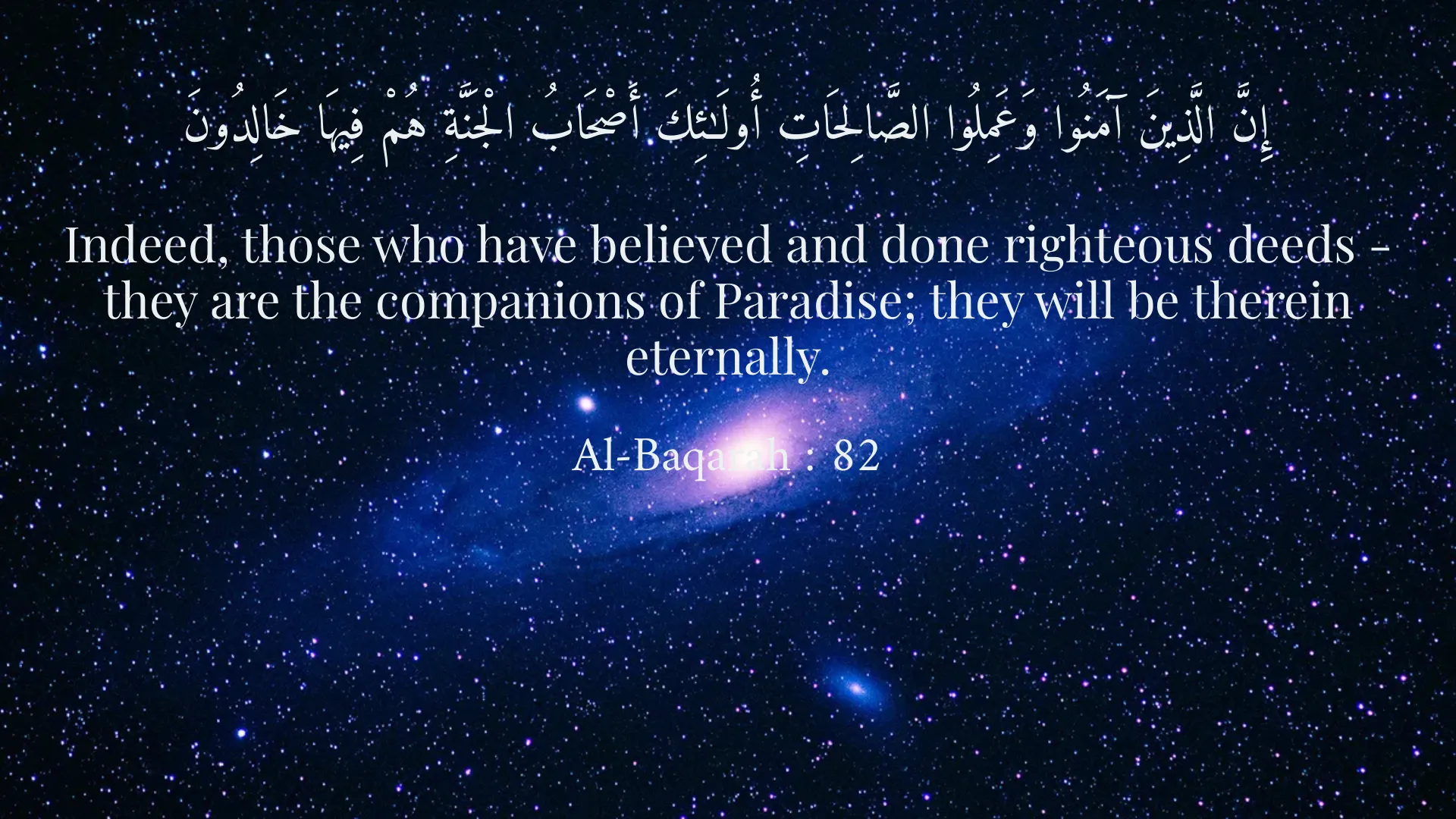
إِنَّ الَّذِينَ آمَنُوا وَعَمِلُوا الصَّالِحَاتِ أُولَـٰئِكَ أَصْحَابُ الْجَنَّةِ هُمْ فِيهَا خَالِدُونَ
Indeed, those who have believed and done righteous deeds - they are the companions of Paradise; they will be therein eternally.
Al-Baqarah : 82
وَمَنْ أَحْسَنُ قَوْلًا مِمَّنْ دَعَا إِلَى اللَّهِ وَعَمِلَ صَالِحًا وَقَالَ إنَّنِي مِنَ الْمُسْلِمِينَ
And who is better in speech than one who invites to Allah and does righteousness and says, 'Indeed, I am of the Muslims'?
Fussilat : 33
Short Story
Once upon a time, a young man named Sajjad decided to change his life. He tried to help others as much as possible every day, whether in small or big tasks. Over time, he felt his life was filled with joy and peace. When asked why he continued these acts, he said, "I know that every good deed I do not only satisfies me but also brings me closer to God."