Quranic Answer
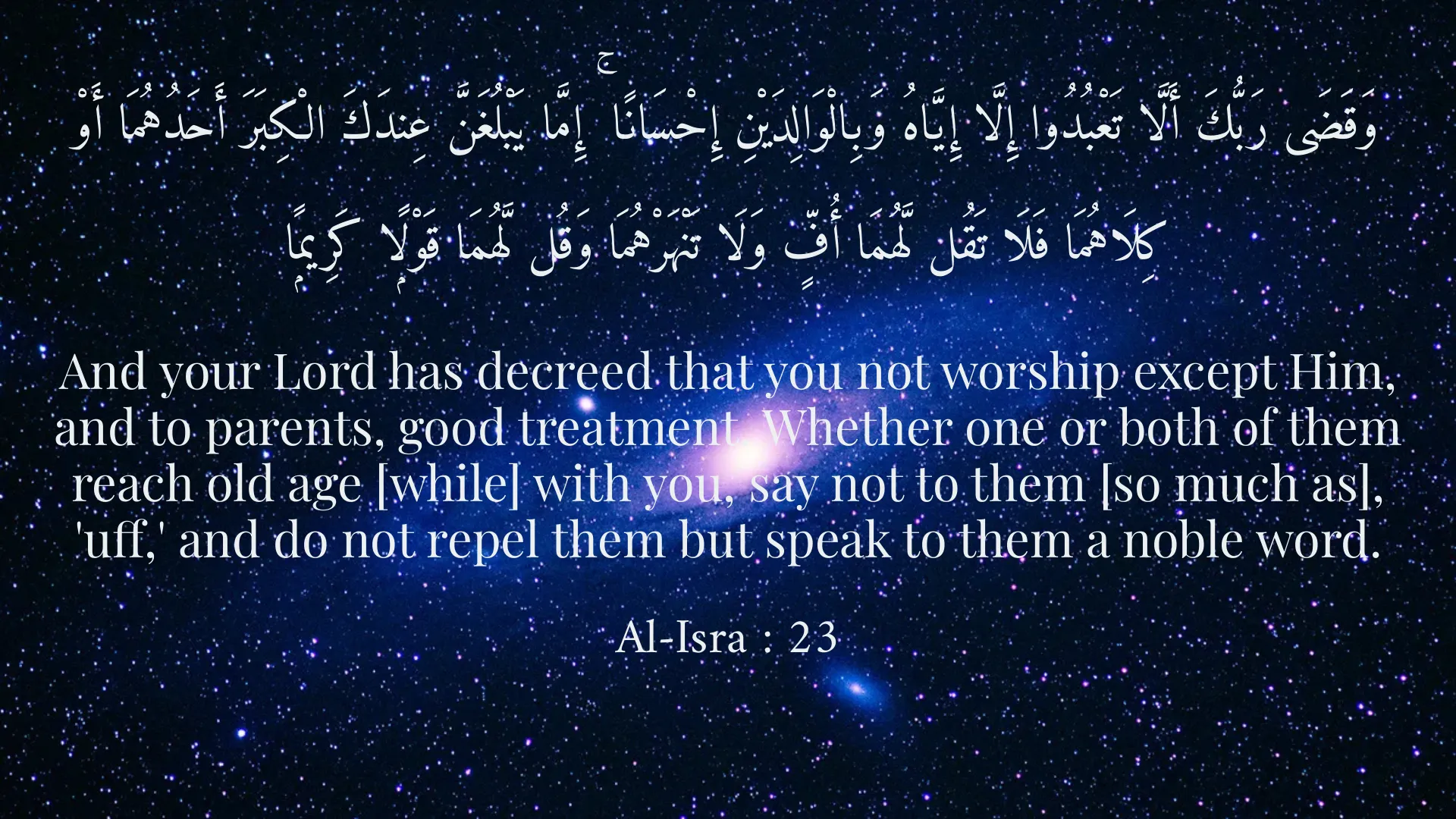
In the Holy Quran, honoring parents is emphasized as one of the fundamental values of society that forms the very backbone of family life and, by extension, a harmonious community. The concept of filial piety is so crucial that it is woven into the fabric of Islamic teachings, where it is regarded as an intrinsic duty of every believer. This theme of honoring one's parents is beautifully encapsulated in Surah Al-Isra, verse 23, where Allah states: "And your Lord has decreed that you not worship except Him, and to parents, good treatment. Whether one or both of them reach old age [while] with you, say not to them [so much as], 'uff,' and do not repel them but speak to them a noble word.” This verse elucidates the immense importance of family dynamics and emphasizes the necessity of showing respect and care for one’s parents, a concept that has profound implications for the lives of believers. The Quran encapsulates the values of compassion, respect, and duty towards parents. It stresses that parents play a crucial role in the lives of their children, providing not merely the physical sustenance that comes with nurturing but also a moral framework upon which children base their understanding of the world. Parents work tirelessly and selflessly to ensure the well-being of their offspring, often making countless sacrifices that may go unnoticed. The impact of these sacrifices shapes the development of their children's identities and influences their perceptions of faith, morality, and respect for others. Thus, the respect and honor afforded to parents is not merely a cultural norm; it is a divine command that commands attention and adherence. The teachings of the Quran also delve into the intricacies of the parent-child relationship, particularly as parents age and their need for care intensifies. In Surah Luqman, verse 14, it is stated: "And We have enjoined upon man [care] for his parents. But if they endeavor to make you associate with Me that of which you have no knowledge, do not obey them.” Here, the text acknowledges that while the respect and care for parents are paramount, there is an important caveat regarding differing religious beliefs. This verse strikes a delicate balance between parental respect and personal convictions, suggesting that while one should always uphold kindness and compassion towards parents, it does not extend to any actions that compromise one's faith or beliefs. This highlights the nuanced approach that Islam takes towards the familial bond, emphasizing the importance of communication, mutual respect, and understanding. Ultimately, the Quran teaches that the act of honoring parents is not just a religious obligation; it is a vital element in promoting peace, love, and unity within the family unit. Indeed, a family that honors its elders fosters an environment conducive to love and harmony. When children learn the value of caring for their parents, they grow into adults who are similarly empathetic and compassionate, thereby perpetuating a cycle of respect through generations. This cycle of mutual respect and dignity is fundamental in shaping a society rich in moral values. Honoring parents transcends mere obedience; it encompasses actively engaging with them, understanding their needs, and expressing love and appreciation for their sacrifices. In a world increasingly characterized by individualism and disconnection, the Quran's emphasis on honoring parents offers a timeless reminder of the significance of family bonds. By nurturing these relationships, believers are encouraged to cultivate a moral compass that aligns with the teachings of the Quran, ultimately leading to spiritual growth for both parents and children. Moreover, the teachings of the Quran on parental respect can also be seen as a framework for building a cohesive community. When individuals grasp the importance of honoring their parents, they are more likely to extend that respect and care to others within the community. This can cultivate an atmosphere of support, cooperation, and empathy that benefits everyone. Indeed, the lessons learned at home about honoring parents become the foundation for how individuals interact with society at large. Therefore, the act of respecting parents serves not only to fulfill a religious duty but also to contribute to the overall well-being of society. In conclusion, the Quran places a significant emphasis on the importance of honoring parents within the religious and societal framework. This commitment to familial respect encourages not only the nurturing of individual character but also the cultivation of compassionate communities rooted in love and empathy. As individuals strive to honor their parents, they embody the values espoused in the Quran, leading to both personal enlightenment and collective harmony. Honoring one’s parents is indeed one of the pillars that sustain not just families but the broader fabric of society. To disregard this sacred bond is to forsake a crucial aspect of spiritual development and communal peace.
Related Verses
وَقَضَى رَبُّكَ أَلَّا تَعْبُدُوا إِلَّا إِيَّاهُ وَبِالْوَالِدَيْنِ إِحْسَانًا ۚ إِمَّا يَبْلُغَنَّ عِندَكَ الْكِبَرَ أَحَدُهُمَا أَوْ كِلَاهُمَا فَلَا تَقُل لَّهُمَا أُفٍّ وَلَا تَنْهَرْهُمَا وَقُل لَّهُمَا قَوْلًۭا كَرِيمًۭا
And your Lord has decreed that you not worship except Him, and to parents, good treatment. Whether one or both of them reach old age [while] with you, say not to them [so much as], 'uff,' and do not repel them but speak to them a noble word.
Al-Isra : 23
وَوَصَّيْنَا الْإِنْسَانَ بِوَالِدَيْهِ ۚ أَنِ اشْكُرْ لِي وَلِوَالِدَيْكَ إِلَيَّ الْمَصِيرُ
And We have enjoined upon man [care] for his parents. But if they endeavor to make you associate with Me that of which you have no knowledge, do not obey them.
Luqman : 14
Short Story
One day, Adel was pondering about his life and wondered what mattered most to him. He recalled the verses of the Quran and realized that recognizing life's priorities was essential. He then decided to focus more on establishing a connection with God while also devoting kindness to his parents. After some time, Adel noticed that his life had changed, and he felt a greater sense of peace.