Quranic Answer
The question you've posed is profoundly insightful, touching upon a core tenet of divine justice and the mechanism of reward and recompense within the Quranic perspective. Does fruitless effort also have a reward from God? The unequivocal answer, based on the teachings of the Holy Quran, is "yes." From an Islamic standpoint, the value of an action is not solely confined to its apparent outcome. Rather, intention (niyyah), sincerity, persistence in effort, and steadfastness on the path of truth hold immense significance. Unlike human metrics, which often hinge on tangible, measurable successes, Allah Almighty looks at the depth of hearts, the purity of intentions, and the sincerity of sincere struggles. The Holy Quran, in numerous verses, addresses the fact that human deeds, even if they do not yield a tangible result in appearance, are preserved by Allah and carry their own reward. This principle is one of the foundations of hope for believers and a powerful motivator for continuing on the path despite difficulties and disappointments. For instance, in Surah Al-Kahf, verse 30, Allah says: "Indeed, those who have believed and done righteous deeds - We will not allow to be lost the reward of any who did well in deeds." This verse clearly states that the reward for a good deed, even if it does not lead to the outcome we anticipate, will not be wasted. What is crucial is "ihsan al-amal" – doing the deed excellently and sincerely – not merely achieving a specific result. In Surah At-Tawbah, verse 120, Allah speaks about the reward for those who strive in His cause: "That is because they are not afflicted by thirst or fatigue or hunger in the cause of Allah, nor do they tread any ground that enrages the disbelievers, nor do they inflict upon an enemy any infliction but that is recorded for them as a righteous deed. Indeed, Allah does not allow to be lost the reward of the doers of good." This verse explicitly demonstrates that even the hardships and efforts expended in the path of Allah, irrespective of whether they lead to ultimate victory or not, are considered righteous deeds in themselves and carry a reward. The implication is not that the outcome is irrelevant, but rather that even if the desired outcome is not achieved, the effort itself and the good intention behind it hold immense value in the sight of God. A striking example of this concept is the endeavors of the Prophets and divine saints. Many prophets preached for years, and perhaps only a few believed in them, such as Prophet Noah (peace be upon him) who invited his people for over 900 years, yet only a small number embraced faith. Were their efforts fruitless? Absolutely not! Allah bestows upon them the full and boundless reward for their struggles, patience, and perseverance. This illustrates that our duty is to strive, and the outcome is ultimately in Allah's hands. We are enjoined to fulfill our duties with the purest intention and the most sincere action, and the reward for that rests with the Lord. Another vital point is the role of trials and tribulations in life's journey. Sometimes, a person exerts great effort but does not achieve the desired outcome; this can itself be a test from Allah to gauge the individual's patience, reliance on God, and steadfastness. In such circumstances, if a servant, despite the difficulties and apparent lack of success, does not abandon effort and hope, and puts their trust in Allah, their effort will not only be rewarded but will also receive an even greater and more valuable recompense for their patience and reliance. This reward can manifest in spiritual growth, inner peace, forgiveness of sins, and ultimately, eternal salvation in the Hereafter. This concept teaches us that we must always be hopeful in divine mercy and grace, and no effort made with pure intention and for the sake of Allah will ever be fruitless. In Surah Al-Imran, verse 195, we read: "So their Lord accepted from them, [saying], 'Never will I allow to be lost the work of [any] doer among you, whether male or female; you are of each other. So those who emigrated or were expelled from their homes or were harmed in My cause or fought or were killed - I will surely remove from them their misdeeds, and I will surely admit them to gardens beneath which rivers flow as reward from Allah, and Allah with whom is the best of reward.'" This verse explicitly mentions "being harmed in My cause" and "being killed," which might not lead to a military victory in appearance, yet a tremendous divine reward is promised for them. Therefore, the Quranic perspective on effort is comprehensive and profound, transcending superficial metrics of success and failure. Every sincere effort made with pure intention for the sake of Allah, whether it yields a material result or not, is recorded in a person's book of deeds and holds its own reward. This reward may manifest as blessings in life, spiritual tranquility, or, in its most exalted form, immense rewards in the afterlife. This principle is a great source of hope and motivation for every believer to always tread the path of good with confidence and reliance on Allah, even if the path is full of challenges and appears fruitless. Let us know that Allah never overlooks the sincere efforts of His servants, and every atom of good deed is preserved with Him. This is the absolute divine justice that prevents us from despairing in the face of difficulties and invites us to persist in our endeavors. This hope, in itself, is one of the greatest spiritual rewards, rooted in the heart of the believer, empowering them to continue their journey.
Related Verses
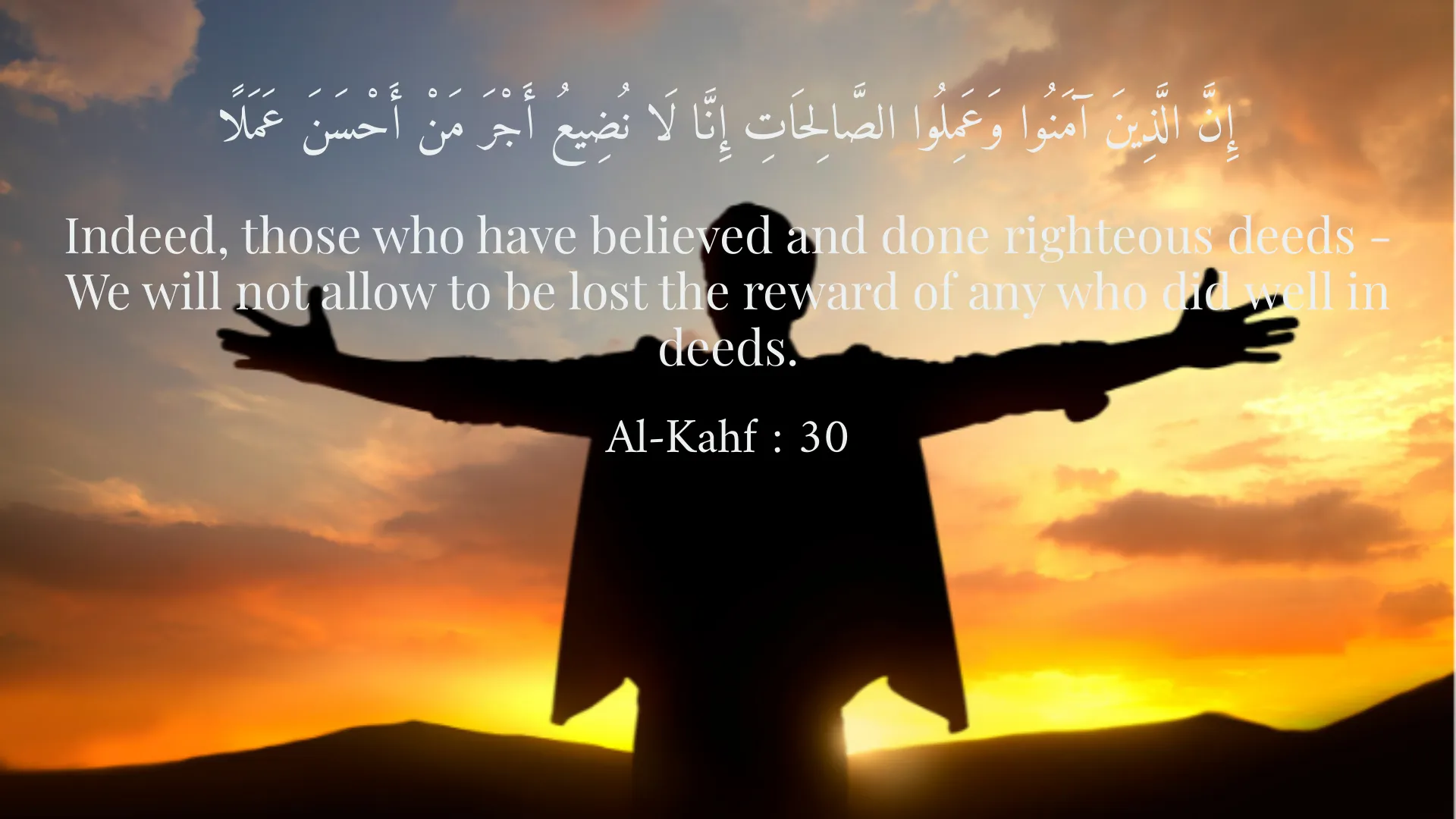
إِنَّ الَّذِينَ آمَنُوا وَعَمِلُوا الصَّالِحَاتِ إِنَّا لَا نُضِيعُ أَجْرَ مَنْ أَحْسَنَ عَمَلًا
Indeed, those who have believed and done righteous deeds - We will not allow to be lost the reward of any who did well in deeds.
Al-Kahf : 30
ذَلِكَ بِأَنَّهُمْ لَا يُصِيبُهُمْ ظَمَأٌ وَلَا نَصَبٌ وَلَا مَخْمَصَةٌ فِي سَبِيلِ اللَّهِ وَلَا يَطَئُونَ مَوْطِئًا يَغِيظُ الْكُفَّارَ وَلَا يَنَالُونَ مِنْ عَدُوٍّ نَيْلًا إِلَّا كُتِبَ لَهُم بِهِ عَمَلٌ صَالِحٌ ۚ إِنَّ اللَّهَ لَا يُضِيعُ أَجْرَ الْمُحْسِنِينَ
That is because they are not afflicted by thirst or fatigue or hunger in the cause of Allah, nor do they tread any ground that enrages the disbelievers, nor do they inflict upon an enemy any infliction but that is recorded for them as a righteous deed. Indeed, Allah does not allow to be lost the reward of the doers of good.
At-Tawbah : 120
فَاسْتَجَابَ لَهُمْ رَبُّهُمْ أَنِّي لَا أُضِيعُ عَمَلَ عَامِلٍ مِّنكُم مِّن ذَكَرٍ أَوْ أُنثَىٰ ۖ بَعْضُكُم مِّن بَعْضٍ ۖ فَالَّذِينَ هَاجَرُوا وَأُخْرِجُوا مِن دِيَارِهِمْ وَأُوذُوا فِي سَبِيلِي وَقَاتَلُوا وَقُتِلُوا لَأُكَفِّرَنَّ عَنْهُمْ سَيِّئَاتِهِمْ وَلَأُدْخِلَنَّهُمْ جَنَّاتٍ تَجْرِي مِن تَحْتِهَا الْأَنْهَارُ ثَوَابًا مِّنْ عِندِ اللَّهِ ۗ وَاللَّهُ عِندَهُ حُسْنُ الثَّوَابِ
So their Lord accepted from them, [saying], 'Never will I allow to be lost the work of [any] doer among you, whether male or female; you are of each other. So those who emigrated or were expelled from their homes or were harmed in My cause or fought or were killed - I will surely remove from them their misdeeds, and I will surely admit them to gardens beneath which rivers flow as reward from Allah, and Allah with whom is the best of reward.'
Ali 'Imran : 195
Short Story
A dervish was sitting by a well, laboriously pulling out a bucket, whose rope would often break, sending it back down. A passerby saw him and asked, "O dervish, why do you exert such effort? Each time you pull up a bucket, it falls back into the well, and you get no water. Do you not know that this well is dry?" The dervish replied with a smile, "O friend, I am not striving for water. I am striving so that the rope of my determination and will does not weaken. I move these hands so they do not forget that one must strive, even if no result is seen. My reward lies in the effort itself, not in the water that comes from the well." The passerby was astonished and realized that the value of work is not always in its product, but in the essence of the action itself and pure intention.