Quranic Answer
In the Holy Quran, Allah emphasizes His mercy and forgiveness above all else. This theme resonates profoundly throughout the sacred text, serving as a source of hope and comfort for believers. The Quran provides a detailed account of Allah's mercy, reiterating that no matter how grave one's sins may be, there exists a pathway to redemption through sincere repentance. The importance of understanding Allah’s forgiveness cannot be overstated, as it encourages individuals to continuously seek a deeper connection with their Creator while promoting a spirit of humility and accountability. One of the pivotal verses that highlight this central theme of mercy and forgiveness is found in Surah Az-Zumar, verse 53. Here, Allah addresses His devoted servants, stating: 'O My servants who have believed, do not despair of the mercy of Allah. Indeed, Allah forgives all sins. Indeed, it is He who is the Forgiving, the Merciful.' This invocation is not just a mere reassurance; it serves as a powerful reminder that the mercy of Allah is all-encompassing. The phrase 'do not despair' underscores a critical message in Islam — the idea that believers should never give up on Allah's mercy, regardless of the severity of their transgressions. The assurance provided in this verse is reinforced by the constant affirmation of Allah's attribute as 'The Forgiving, the Merciful.' In Islam, Allah's mercy is considered one of His most defining characteristics. It is emphasized that Allah’s forgiveness is not contingent upon the magnitude of one’s sins; rather, it is freely accessible to all who sincerely turn back to Him with remorseful hearts. This opens a pathway for individuals, regardless of their past, to seek forgiveness and strive for a better future. In addition to verse 53 of Surah Az-Zumar, the Quran addresses the importance of repentance in Surah An-Najm, verse 30, where it states that Allah approaches those who draw near to Him and forgives their sins. This verse encapsulates the reciprocal nature of the relationship between Allah and believers. It suggests that as individuals take steps towards spirituality, seeking Allah in earnestness, they will find Allah extending His hand towards them with forgiveness. This divine promise encourages believers to initiate the journey of repentance, knowing that Allah is always available to guide and protect them on their path. The scope of Allah's forgiveness is infinite. The Quran elucidates that even the deepest sins can be cleansed through genuine repentance. It emphasizes that no sin is too substantial to be forgiven; the crucial factor lies in the authenticity of one's remorse and the earnest intention to change one's ways. In Islam, this acknowledgment of wrongdoing is not merely about verbalizing regret but involves a profound transformation of the heart. When a person sincerely desires Allah to forgive their sins, they are effectively opening up themselves to receive Allah's boundless mercy. Furthermore, Islamic teachings elucidate that repentance, or 'Tawbah,' is not just a one-off act but a continuous journey. It encourages believers not only to seek forgiveness for their past sins but to adopt a stance of constant self-reflection and improvement. Each day presents an opportunity to strengthen one's character and faith, incrementing efforts towards righteousness and integrity. The process of repentance involves recognizing one’s faults, abandoning them, and making a commitment to pursue a life aligned with Allah’s guidance. The Quran contains numerous references to Allah’s forgiveness, boldly portraying Him as the most generous and unforgettable Forgiver. For instance, Surah Al-Furqan, verse 70 describes the qualities of the believers by stating: 'And those who do not invoke with Allah another deity or kill the soul which Allah has forbidden, and do not commit unlawful sexual intercourse. And whoever should do that will meet a penalty. The punishment will be multiplied for him on the Day of Resurrection, and he will abide therein, humiliated.' However, the verse goes on to provide hope: 'Except for those who repent, believe and do righteous work. For them Allah will replace their evil deeds with good. And ever is Allah Forgiving and Merciful.' This essence of faith, coupled with the hope imbued in Allah's promise, cultivates a nurturing environment for growth and evolution. It engenders a belief that Allah is not just a strict judge but rather a compassionate guide who recognizes the human experience's challenges and complexities. Moreover, Allah promises forgiveness to anyone who intends to sin and then repents from it. This illustrates that the mere intention to recognize one's faults and seek forgiveness can lead to a divine transformation. The significance of genuine repentance is that's essential in nourishing a believer's soul and maintaining spiritual balance. In conclusion, Allah's mercy reflects His inherent nature and the very essence of the Islamic faith. The Holy Quran offers believers a wealth of verses dedicated to assuring them of Allah’s endless forgiveness. Understanding this aspect nurtures a hopeful outlook on life, encouraging individuals to harbor aspirations for personal growth while remaining accountable to their Creator. The idea that anyone, regardless of their past, can attain Allah's mercy through sincere repentance serves as a crucial operative principle within Islam. Therefore, it is incumbent upon every believer to embrace this mercy, striving to cultivate a heart full of humility and devotion, ever-sensitive to the grace and benevolence of Allah. As Allah invites humanity into a relationship marked by forgiveness, love, and mercy, it becomes each individual's duty to take that first step towards Him with an open heart.
Related Verses
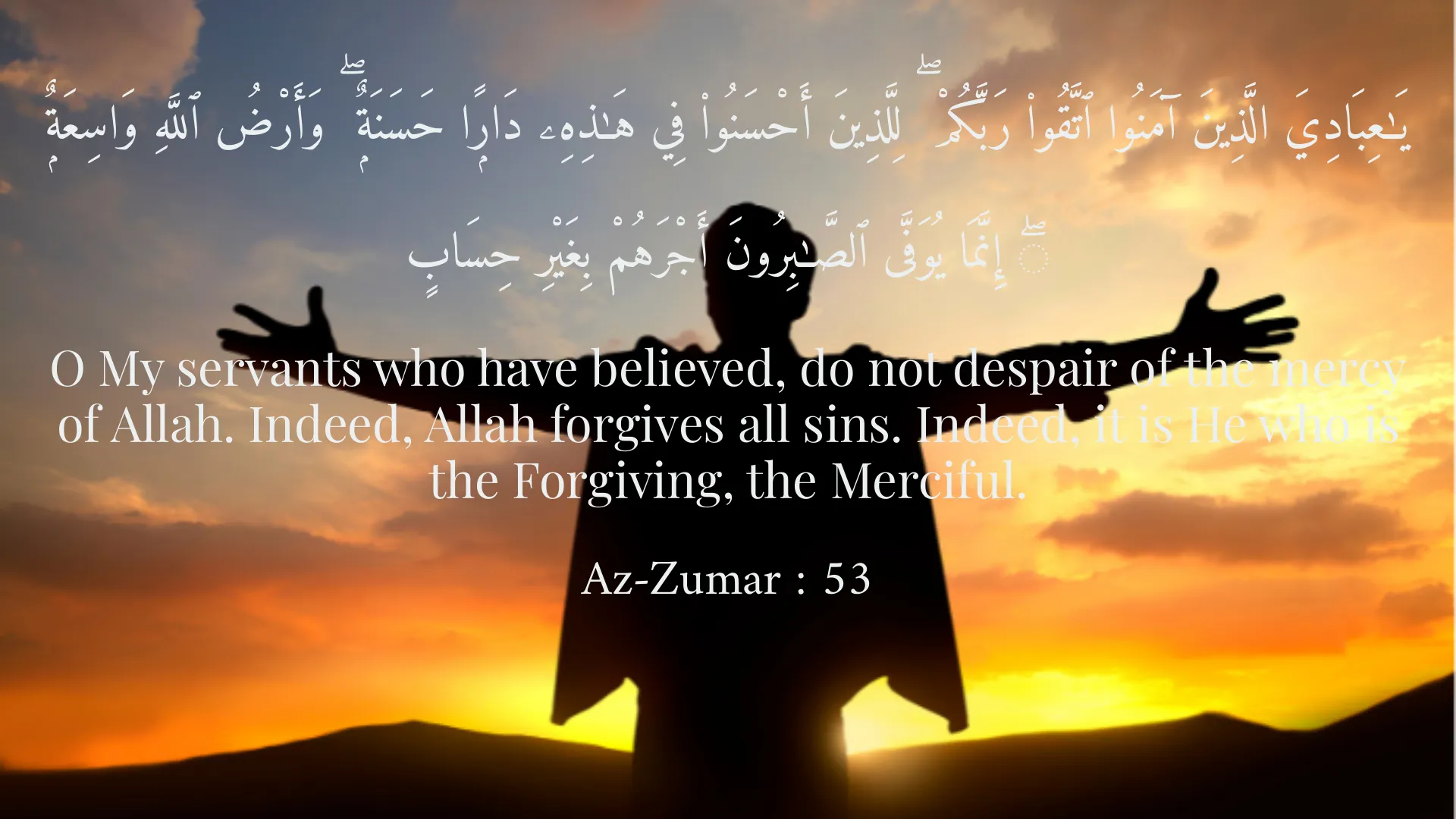
يَـٰعِبَادِيَ الَّذِينَ آمَنُوا ٱتَّقُوا۟ رَبَّكُمْ ۖ لِلَّذِينَ أَحْسَنُوا۟ فِي هَـٰذِهِۦ دَارًۭا حَسَنَةٌۭ ۖ وَأَرْضُ ٱللَّهِ وَاسِعَةٌۭ ۖ إِنَّمَا يُوَفَّى ٱلصَّـٰبِرُونَ أَجْرَهُمْ بِغَيْرِ حِسَابٍ
O My servants who have believed, do not despair of the mercy of Allah. Indeed, Allah forgives all sins. Indeed, it is He who is the Forgiving, the Merciful.
Az-Zumar : 53
وَأَنَّهُ هُوَ أَضْحَى لَكُمْ فِي النَّحَلِكَ قُدُرَا يَشَاءُ وَمَا سَحَرَكُمْ سِوَى
And it is He who, should you draw near to Him, He forgives your sins.
An-Najm : 30
Short Story
One day, a young man named Ali came to Allah with a heart full of sins, seeking forgiveness. He had long carried a sense of despair and sorrow in his heart, thinking that his sins were too great to be forgiven. But by reading the verses of the Quran and understanding God's infinite mercy, he realized that everything is possible. He made a true repentance in his heart for his sins and asked Allah to forgive him. After that, a sense of peace and hope spread within him, and he continued to live his life striving to avoid sin.