Quranic Answer
The question of whether God suffers, feels pain, or experiences grief in the human sense is a profound theological inquiry, and from an Islamic perspective, as elucidated in the Holy Quran, the unequivocal answer is a resounding no. The very essence of God, as described in the Quran, is one of absolute perfection, transcendence, and self-sufficiency, rendering any notion of suffering or deficiency utterly incompatible with His divine nature. God is pure and far removed from any weakness, need, or negative human-like affections. In Islamic theology, God (Allah) is fundamentally different from His creation. He is not bound by the limitations, weaknesses, or imperfections that characterize human or any other created existence. This core principle is known as Tanzih, which means purifying God from any attributes that resemble creation. Suffering, by its very definition, implies a state of vulnerability, weakness, need, or being negatively affected by external circumstances. These are all characteristics of contingent beings, not of the Necessary Existent, the Creator of all things and the source of all perfections. The Quran repeatedly emphasizes Allah's absolute self-sufficiency, a quality captured by names like Al-Ghani (The Self-Sufficient, The Rich). In Surah Fatir (Chapter 35, Verse 15), Allah declares, “O mankind, you are the needy before Allah, while Allah is the Self-Sufficient, the Praiseworthy.” This verse beautifully articulates the fundamental distinction: humanity is inherently dependent and needy, whereas God is entirely independent and free from all needs. If God were to suffer, it would imply a dependency on external factors to avoid suffering, which contradicts His absolute independence. Similarly, the Quran describes Allah as Al-Qayyum (The Self-Subsisting, by whom all subsist), as seen in the majestic Ayatul Kursi (Surah Al-Baqarah, Chapter 2, Verse 255): “Allah - there is no deity except Him, the Ever-Living, the Self-Subsisting, by whom all subsist. Neither slumber nor sleep overtakes Him.” This verse negates even the slightest human frailties like sleep, let alone something as profound as suffering. It portrays a Being whose existence is perfect, continuous, and unaffected by any external or internal changes. Furthermore, the concept of suffering often implies a lack of power or control over one's circumstances. The Quran, however, describes Allah as Al-Qadir (The All-Powerful), Al-Qawiyy (The Most Strong), and Al-Aziz (The All-Mighty, The Irresistible). He has absolute dominion over all things; nothing happens without His knowledge and permission. To suggest that God could suffer would contradict His omnipotence and absolute control. He is not subject to any force, any will, or any event that is not His own. His decrees are absolute, and His will is supreme. Some might mistakenly interpret verses that describe God as “angry” with disbelievers or “loving” those who do good as human-like emotional states. However, these are understood within Islamic theology as divine attributes that manifest in ways befitting God's majesty and transcendence, not as anthropomorphic emotions that imply weakness or change. When God expresses “anger,” it signifies His just retribution or the consequence of disobedience, not a human-like feeling of vexation or distress. When He expresses “love,” it signifies His bestowal of grace, blessings, and acceptance, not a human-like emotional attachment that causes joy or sorrow. These are divine dispositions and actions, not reactive emotional states that imply vulnerability. The actions of human beings, whether righteous or sinful, ultimately affect only themselves. The Quran clearly states in Surah Al-Isra (Chapter 17, Verse 7), “If you do good, you do good for yourselves; and if you do evil, it is to yourselves.” God's sovereignty and perfection are not diminished by human disobedience, nor are they increased by human obedience. Our worship and good deeds are for our own spiritual benefit and salvation, not because God needs them or is affected by their absence. If humanity were to collectively disbelieve and commit evil, it would not cause God to suffer; it would only bring about their own destruction and deserved punishment. Similarly, if all of humanity were to become perfectly righteous, it would not enhance God's perfection, for He is already perfect beyond measure. The purpose of divine commands and prohibitions is to guide humanity towards what is good for them in this life and the hereafter, to establish justice, and to foster a harmonious society. When humans deviate from this path, they invite hardship upon themselves, not upon God. The consequences of human actions, good or bad, are borne by humans. For instance, injustice, oppression, and corruption on Earth lead to societal decay and divine retribution, but this retribution is an act of God's justice, not a result of His suffering from human wrongdoing. In conclusion, the Quran portrays Allah as the Absolute, the Eternal, the Perfect Being, free from all defects, limitations, and human imperfections. The concept of suffering is alien to His divine nature. He is the Creator, the Sustainer, the All-Powerful, and the Self-Sufficient. His attributes are those of perfection, majesty, and transcendence, ensuring that He is infinitely above any human concept of pain, grief, or vulnerability. Our understanding of God must always be filtered through the lens of Tanzih, affirming His uniqueness and His incomparability to anything in creation. This profound understanding brings comfort and certainty to believers, knowing that their Creator is eternally stable, powerful, and utterly beyond human limitations.
Related Verses
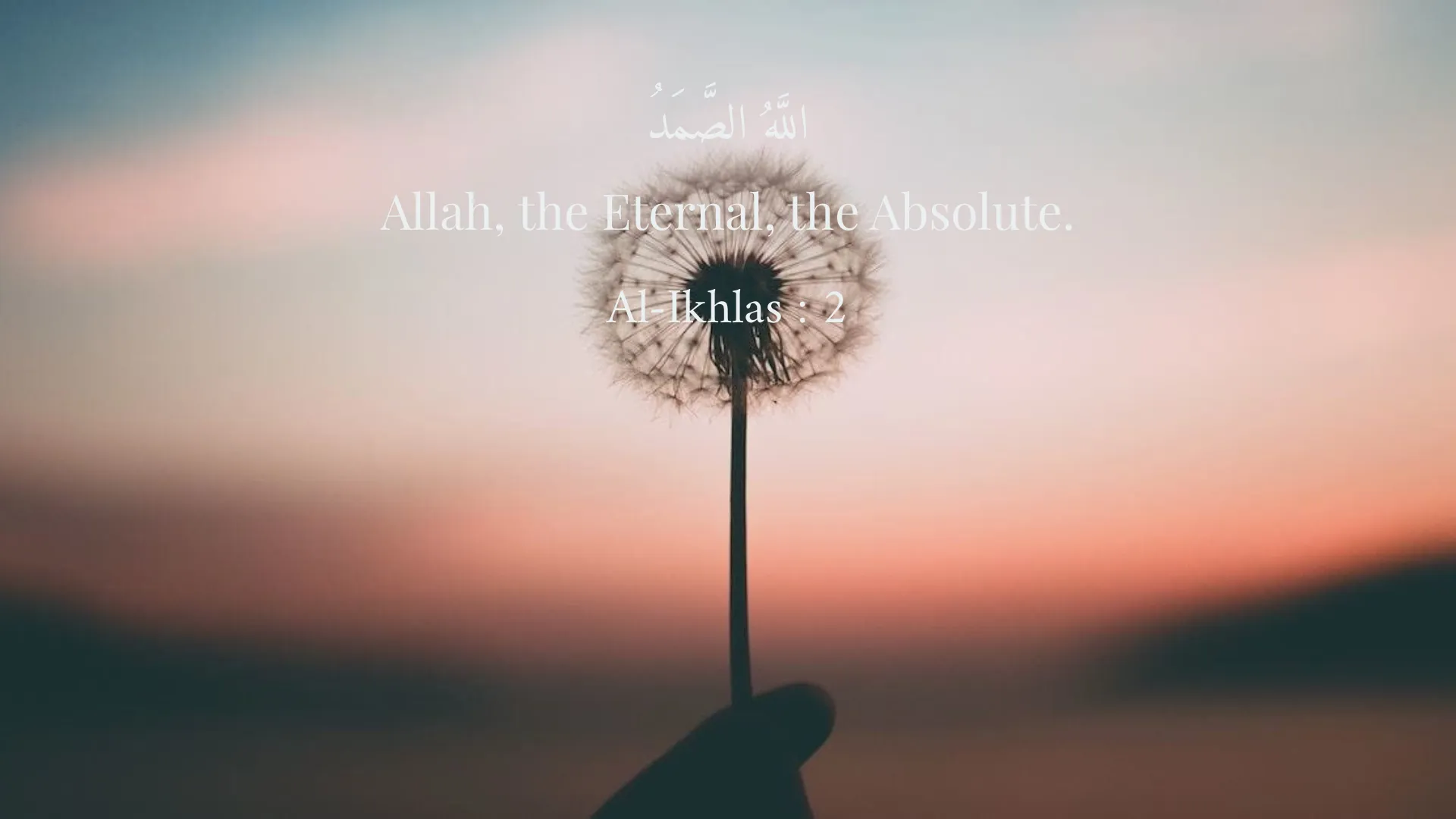
اللَّهُ الصَّمَدُ
Allah, the Eternal, the Absolute.
Al-Ikhlas : 2
اللَّهُ لَا إِلَٰهَ إِلَّا هُوَ الْحَیُّ الْقَیُّومُ ۚ لَا تَأْخُذُهُ سِنَةٌ وَلَا نَوْمٌ ۚ لَهُ مَا فِی السَّمَاوَاتِ وَمَا فِی الْأَرْضِ ۗ مَنْ ذَا الَّذِی یَشْفَعُ عِنْدَهُ إِلَّا بِإِذْنِهِ ۚ یَعْلَمُ مَا بَیْنَ أَیْدِیهِمْ وَمَا خَلْفَهُمْ ۖ وَلَا یُحِیطُونَ بِشَیْءٍ مِنْ عِلْمِهِ إِلَّا بِمَا شَاءَ ۚ وَسِعَ کُرْسِیُّهُ السَّمَاوَاتِ وَالْأَرْضَ ۖ وَلَا یَئُودُهُ حِفْظُهُمَا ۚ وَهُوَ الْعَلِیُّ الْعَظِیمُ
Allah - there is no deity except Him, the Ever-Living, the Self-Subsisting, by whom all subsist. Neither slumber nor sleep overtakes Him. To Him belongs whatever is in the heavens and whatever is on the earth. Who is it that can intercede with Him except by His permission? He knows what is before them and what will be after them, and they encompass not a thing of His knowledge except for what He wills. His Kursi extends over the heavens and the earth, and their preservation tires Him not. And He is the Most High, the Most Great.
Al-Baqarah : 255
يَا أَيُّهَا النَّاسُ أَنْتُمُ الْفُقَرَاءُ إِلَى اللَّهِ ۖ وَاللَّهُ هُوَ الْغَنِیُّ الْحَمِیدُ
O mankind, you are the needy before Allah, while Allah is the Self-Sufficient, the Praiseworthy.
Fatir : 15
Short Story
It is narrated that there was a powerful and wealthy king in his land. One day, while seated in a lush garden, a servant brought news that a poor subject in the town had uttered disrespectful words, believing that the king was unaware of his condition. The king smiled and said, "Do you imagine that the sun diminishes its light if someone hides in darkness? Or that the ocean loses its grandeur if a stone is dropped into it?" He then added, "My wealth and glory are so boundless that neither the praise of subjects adds to it, nor the censure of enemies diminishes it. The deeds and words of each person bring benefit or harm only to themselves and never affect the splendor and majesty of the kingdom. It is as if the morning breeze blows upon the king's tent and passes, without leaving any mark on its foundation or pillars." These words of the king indicated that true power and infinite grandeur are beyond trivial worldly influences, just as God, the true Creator and King of the universe, is pure and transcendent from any suffering or influence caused by human actions. He is the Absolute Self-Sufficient, and all things are dependent on Him.