Quranic Answer
The concept of financial obligations in Islam, particularly embodied in practices such as khums and zakat, is a rich and multifaceted aspect of the faith. These practices not only shape the economic landscape of Muslim communities but also play a significant role in the moral and spiritual development of individuals and societies. In this article, we will explore the meanings, purposes, and implications of khums and zakat as outlined in the Holy Quran, debunking the myth that fulfilling these obligations leads to poverty and emphasizing the blessings these acts bring into the lives of believers. ### Understanding Khums and Zakat In Islam, both khums and zakat are considered obligatory forms of almsgiving, signifying a commitment to social justice and financial responsibility towards one's community. Khums literally means "one-fifth" and is a tax levied on certain types of income, such as war gains or surplus wealth, while zakat, often referred to as "purification", is typically understood as a fixed percentage (usually 2.5%) of a Muslim's savings that must be given to the needy. These financial contributions serve dual purposes: they help alleviate poverty in society while providing spiritual purification for the giver. ### The Quranic Foundation of Khums and Zakat The Quran establishes a profound connection between the act of giving and the blessings that follow. In Surah Al-Anfal, verse 41, Allah commands that a portion of war gains be allotted to Him, His Messenger, and those who pay zakat. This divine directive serves as a reminder that the act of sharing one’s wealth is not merely a social obligation but a sacred duty that ties the believer to their faith and fosters a sense of community. The allocation of financial resources in this manner is indicative of Allah's promise to enrich and bless the lives of those who engage in charitable acts. Furthermore, Surah Al-Baqarah, verse 261, offers a vivid metaphor wherein Allah describes charity and zakat as a seed that produces seven ears, with each ear containing a hundred grains. This imagery not only illustrates the exponential growth and multiplication of blessings that follow the act of giving but also reassures believers that their contributions yield far greater returns than the immediate sacrifice of their wealth. Thus, contrary to the belief that paying khums and zakat leads to financial hardship, these verses underscore a Divine promise of increased sustenance for those who give selflessly. ### The Fallacy of Poverty through Giving The misconception that khums and zakat could lead to economic deprivation stems from a lack of understanding regarding the holistic approach Islam takes towards wealth. In truth, the teachings of the Quran suggest that generosity and charity do not diminish wealth; rather, they enhance it. Wealth in Islam is not perceived merely as a means for individual gain but is envisioned as a resource that should be circulated within society to promote collective well-being. For instance, the act of giving zakat functions as a mechanism for purifying one's wealth, which facilitates the redistribution of resources and ensures that the basic needs of the less fortunate are met. When the well-being of individuals is prioritized over personal wealth accumulation, everyone benefits from a flourishing, financially balanced community. This is a fundamental principle in Islamic economics, where wealth is continuously propelled through acts of charity and community support. ### Spiritual Rewards and Material Blessings The notion of khums and zakat extends beyond financial implications; they are essential components of one’s faith that contribute to spiritual growth and the development of moral character. By engaging in these acts of charity, believers cultivate a sense of empathy and solidarity with the less fortunate, reinforcing the social fabric of the Muslim community. This spiritual dimension elevates the act of giving from a transactional encounter to a rewarding experience that enriches both the giver and the receiver. Additionally, the Quran assures believers that the rewards for their charitable actions are manifold. Not only do they receive blessings in this world, but there are also promises of rewards in the Hereafter. This dual perspective of rewards encourages Muslim communities to prioritize acts of charity over materialism, fostering an environment where wealth is viewed as a tool for goodness rather than mere selfish accumulation. ### Zakat and Social Justice The principle of zakat provides a systematic approach to combating poverty and inequality in society. By mandating that Muslims allocate a portion of their wealth to those in need, zakat functions as a form of social security, ensuring that everyone has access to basic necessities. This redistribution of wealth not only uplifts the underprivileged but also prevents the concentration of wealth in the hands of a few, thereby promoting equity and social justice—a core value in Islamic teachings. Moreover, the benefits of zakat extend beyond immediate financial assistance to the poor. The act reinforces the sense of community by creating bonds of mutual support among individuals. When a culture of giving is encouraged, it fosters a climate of altruism and kindness, allowing social ties to strengthen and communities to thrive collectively. ### Conclusion In conclusion, the financial obligations of khums and zakat are deeply rooted in the teachings of the Quran, promoting not only economic support for vulnerable communities but also fostering spiritual growth for givers. By dismissing the falsehood that these practices can lead to poverty, we instead uncover a vision of mutual support and flourishing through charity. The promise of increased blessings and sustenance from Allah serves as a testament to the transformative potential of zakat and khums in the life of a believer. Ultimately, through the act of giving, Muslims are given the opportunity to nurture both their wealth and their spirituality, contributing to a more just, compassionate, and prosperous society.
Related Verses
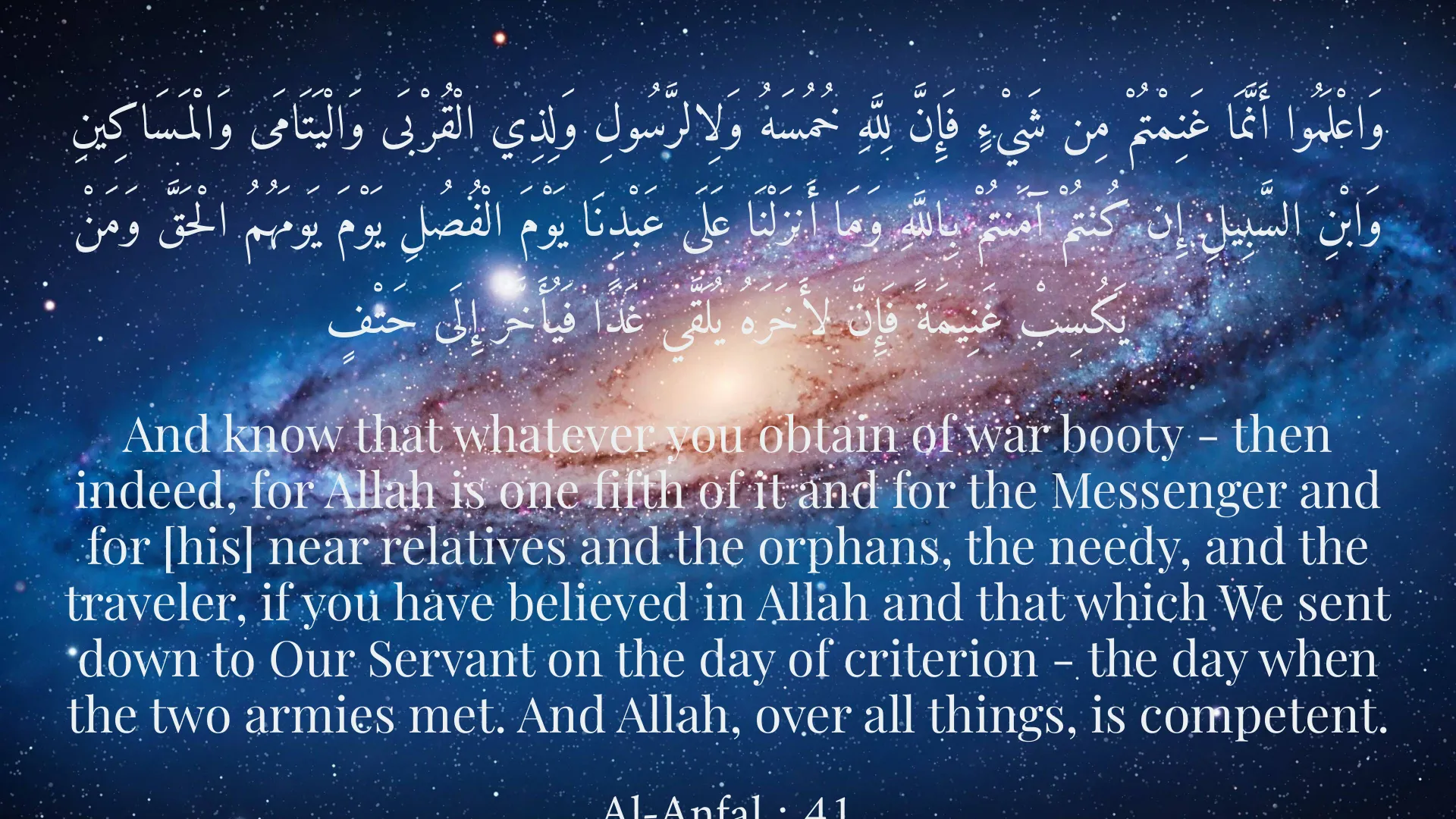
وَاعْلَمُوا أَنَّمَا غَنِمْتُمْ مِن شَيْءٍ فَإِنَّ لِلَّهِ خُمُسَهُ وَلِالرَّسُولِ وَلِذِي الْقُرْبَى وَالْيَتَامَى وَالْمَسَاكِينِ وَابْنِ السَّبِيلِ إِن كُنتُمْ آمَنتُمْ بِاللَّهِ وَمَا أَنزَلْنَا عَلَى عَبْدِنَا يَوْمَ الْفُصُلِ يَوْمَ يَومَهُمُ الْحَقَّ وَمَنْ يَكُسِبْ غَنِيمَةً فَإِنَّ لأَخَرَهُ يُلَقَّي غَدًا فَيُأَخَّرُ إِلَى حَتْفٍ
And know that whatever you obtain of war booty - then indeed, for Allah is one fifth of it and for the Messenger and for [his] near relatives and the orphans, the needy, and the traveler, if you have believed in Allah and that which We sent down to Our Servant on the day of criterion - the day when the two armies met. And Allah, over all things, is competent.
Al-Anfal : 41
مثل الذين ينفقون أموالهم في سبيل الله كمثل حبة أنبتت سبع سنابل في كل سنبلة مئة حبة والله يضاعف لمن يشاء والله واسع عليم
The example of those who spend their wealth in the way of Allah is like a seed of grain that sprouts into seven ears; in every ear is a hundred grains. And Allah multiplies [His reward] for whom He wills. And Allah is All-Encompassing and Knowing.
Al-Baqarah : 261
Short Story
One day, a man named Hasan went to the market and noticed that people were worried about paying their zakat and khums. He remembered the verses of the Quran and decided to give a certain amount as zakat. After some time, Hasan was surprised to find that his zakat had led to blessings in his business and helped him become well-known in his neighborhood. This experience taught him that the more he spent in the way of Allah, the more he would receive blessings.