Quranic Answer
The question, "Does something called 'fate' really exist?" is one of the deepest and most fundamental inquiries that has always occupied the human mind. In Islamic teachings, particularly in the Holy Quran, the concept of destiny or "Qadar" is expounded in a comprehensive and balanced manner that simultaneously conveys the grandeur of Divine knowledge and power, while also emphasizing human free will and responsibility. The definitive answer to this question from a Quranic perspective is "yes"; however, this "fate" is not, as many perceive it, synonymous with the complete negation of human free will or absolute determinism. In fact, a correct understanding of this concept from a Quranic viewpoint does not strip individuals of their agency; rather, it guides them toward diligent effort, hope, and conscious reliance on God. The Holy Quran explicitly states that Allah, the Most High, has complete knowledge and encompassing awareness of all events in the universe, from eternity to eternity. Not a single leaf falls from a tree, nor does a grain grow in the heart of the earth, except with His knowledge and permission. This Divine knowledge also includes all human actions and decisions. In Surah Al-Hadid, verse 22, we read: "No disaster strikes upon the earth or among yourselves except that it is in a register before We bring it into being—indeed that, for Allah, is easy." This verse clearly refers to a general Divine plan and the recording of all matters in the "Preserved Tablet" (Al-Lawh Al-Mahfuz), indicating the comprehensive embrace of Divine knowledge over everything. This is the aspect of Qadar that refers to divine predestination and Allah’s absolute knowledge, a knowledge that encompasses every phenomenon before it occurs. This means that Allah is aware beforehand of everything that is to happen, and this awareness is part of His perfection and majesty. However, alongside this all-encompassing Divine knowledge, the Quran strongly emphasizes the concept of "free will" and "choice" for human beings. Man is a creature endowed with free will, possessing the ability to choose between the path of good and evil, faith and disbelief, and obedience and disobedience. It is this free will that forms the basis of human accountability and responsibility before Allah and the justice of the Day of Judgment. If humans were compelled to act, then reward and punishment would be meaningless, and Divine justice would be called into question. Numerous verses emphasize this choice; for example, in Surah Al-Kahf, verse 29, it states: "So whoever wills—let him believe; and whoever wills—let him disbelieve." This verse explicitly declares that the choice of belief or disbelief rests with the individual, not a predetermined compulsion. This implies that Allah has shown the path and granted humans the power of choice so that they may decide for themselves and bear the responsibility for their decisions. This freedom of choice is the cornerstone of religious and moral obligation in Islam. Explaining these two concepts together is the key to a correct understanding of "fate" in Islam. It can be said that Allah knows what we will do, but this "knowing" does not mean "compelling." Divine knowledge is knowledge of the actualization of our choices, not the deprivation of our choices. In other words, various paths are open before human beings, and Allah knows which path a person will choose by their own will and volition, and what the outcome will be. This is the destiny that is realized through human free will. This understanding brings peace to the human heart, for one knows that what is beyond their control is in the hands of the All-Wise, All-Powerful, and what is within their control requires their diligent effort. This concept imbues humans with hope that they can change the course of their lives toward prosperity by altering their attitudes and actions, while ultimately relying on the boundless wisdom and knowledge of Allah. Thus, Islam regards humans as dynamic and responsible beings who are not merely victims of destiny, but can shape their future through their will and actions, all while placing their trust in the infinite wisdom and knowledge of Allah. The Holy Quran encourages humans to strive, make efforts, and change their own conditions. Surah Ar-Ra'd, verse 11 states: "Indeed, Allah will not change the condition of a people until they change what is in themselves." This verse indicates that happiness and misery, success and failure, depend largely on human choices and efforts. If an individual remains idle and says, "This is my fate," and refrains from striving and exertion, they are effectively turning their back on Quranic teachings and will bear the responsibility for the consequences. Humans are responsible for their actions, and the consequences of their actions return to them. This verse clarifies the philosophy of individual and collective responsibility, highlighting the importance of determination and will in achieving goals and transforming circumstances. Change from within—meaning the rectification of intentions, thoughts, and actions—is a necessary condition for altering external conditions. Therefore, "fate" in the sense of absolute determinism, from which there is no escape, is rejected in Islam. Destiny must be understood in two dimensions: 1. Fixed and Unchangeable Decree (Qadar Mahsoom): This includes matters beyond human control, such as the time and place of birth, gender, nationality, skin color, and certain natural disasters like earthquakes or storms, which are beyond human control. These are part of Divine management in which humans have no role in their occurrence and must believe in their wisdom and accept the Divine decree. Accepting this aspect of Qadar brings peace of mind and frees individuals from unnecessary worries about what is beyond their control. 2. Conditional and Changeable Decree (Qadar Mu'allaq): The vast majority of human destiny falls into this category. Success in education, choosing a spouse, career, physical health (to some extent), and many aspects of life can not only change through human effort and striving, but even prayer (du'a) and supplication can be effective in altering it. This is where human free will plays a central role, and one's actions influence the shaping of their future. For example, if an individual strives for academic success, their probability of success is much higher than someone who makes no effort. Allah has opened the path for humans and guided them towards good deeds and choosing the right path, but there is no compulsion. This aspect of Qadar empowers humans to shape their destiny through responsibility and continuous effort, making the most of the opportunities Allah has granted them. This perspective establishes a balance between reliance on Allah (Tawakkul) and effort and striving. A true believer is one who, while striving relentlessly and utilizing all their capabilities, entrusts the outcome to Allah, knowing that good and evil ultimately rest with Him. They never despair of Divine mercy and trust in God's wisdom even in hardships. This understanding of Qadar brings peace of mind; for one knows that what is beyond their control is in the hands of the All-Wise, All-Powerful, and what is within their control requires their diligent effort. This concept gives hope to humans that they can change the course of their lives towards prosperity by altering their attitudes and actions, while ultimately relying on the boundless wisdom and knowledge of Allah. This balance between predestination and free will provides a profound and practical view of life, encouraging individuals to constantly strive for progress and self-improvement, knowing that every effort will be met with a response from the Divine Will.
Related Verses
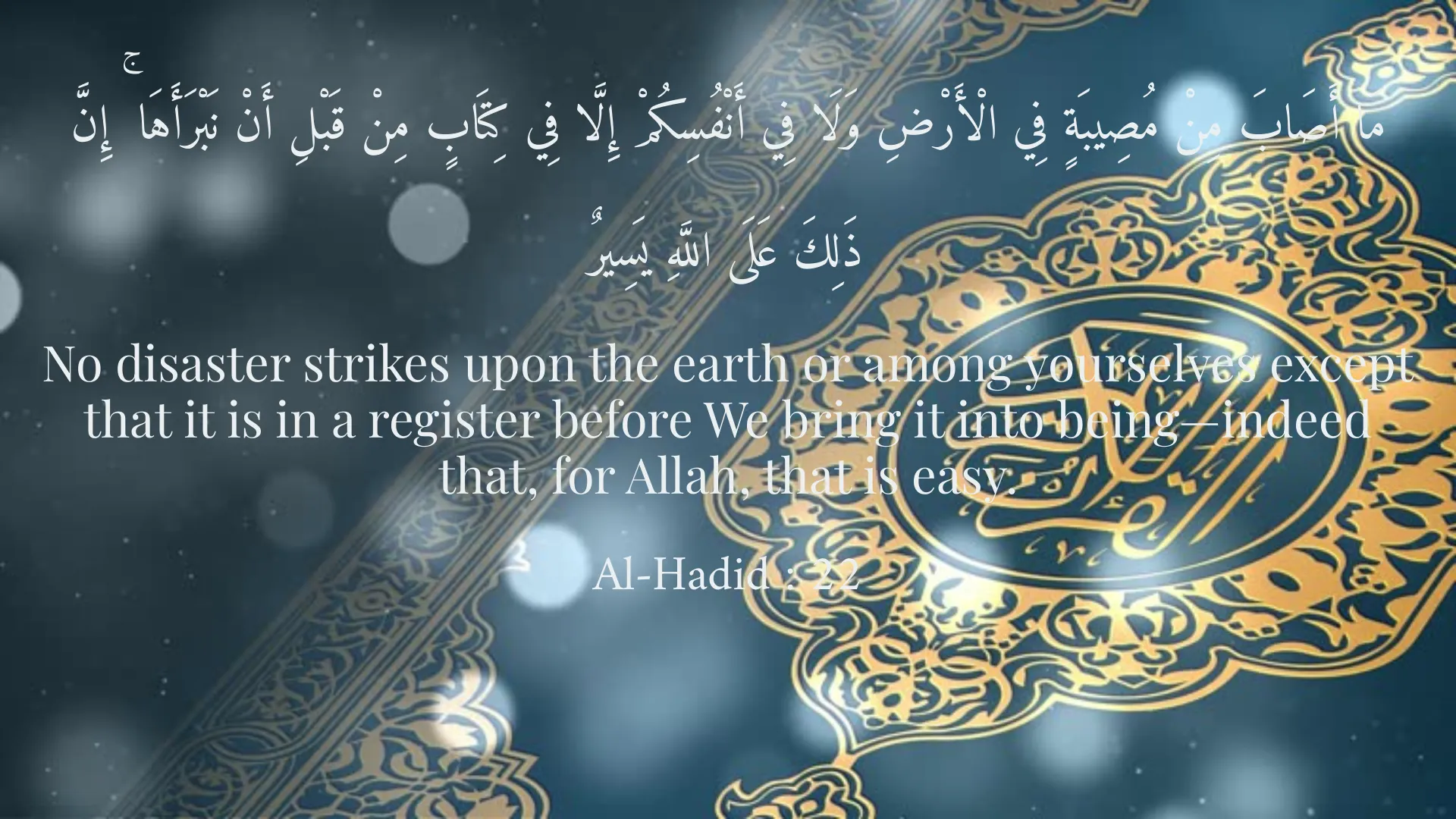
مَا أَصَابَ مِنْ مُصِيبَةٍ فِي الْأَرْضِ وَلَا فِي أَنْفُسِكُمْ إِلَّا فِي كِتَابٍ مِنْ قَبْلِ أَنْ نَبْرَأَهَا ۚ إِنَّ ذَلِكَ عَلَى اللَّهِ يَسِيرٌ
No disaster strikes upon the earth or among yourselves except that it is in a register before We bring it into being—indeed that, for Allah, that is easy.
Al-Hadid : 22
وَقُلِ الْحَقُّ مِنْ رَبِّكُمْ ۖ فَمَنْ شَاءَ فَلْيُؤْمِنْ وَمَنْ شَاءَ فَلْيَكْفُرْ ۚ إِنَّا أَعْتَدْنَا لِلظَّالِمِينَ نَارًا أَحَاطَ بِهِمْ سُرَادِقُهَا ۚ وَإِنْ يَسْتَغِيثُوا يُغَاثُوا بِمَاءٍ كَالْمُهْلِ يَشْوِي الْوُجُوهَ ۚ بِئْسَ الشَّرَابُ وَسَاءَتْ مُرْتَفَقًا
And say, "The truth is from your Lord, so whoever wills—let him believe; and whoever wills—let him disbelieve." Indeed, We have prepared for the wrongdoers a Fire whose walls will encompass them. And if they call for relief, they will be relieved with water like murky oil, which scalds faces. Wretched is the drink, and bad is the resting place.
Al-Kahf : 29
لَهُ مُعَقِّبَاتٌ مِنْ بَيْنِ يَدَيْهِ وَمِنْ خَلْفِهِ يَحْفَظُونَهُ مِنْ أَمْرِ اللَّهِ ۗ إِنَّ اللَّهَ لَا يُغَيِّرُ مَا بِقَوْمٍ حَتَّى يُغَيِّرُوا مَا بِأَنْفُسِهِمْ ۗ وَإِذَا أَرَادَ اللَّهُ بِقَوْمٍ سُوءًا فَلَا مَرَدَّ لَهُ ۚ وَمَا لَهُمْ مِنْ دُونِهِ مِنْ وَالٍ
For him are successive [angels] before him and behind him who guard him by the command of Allah. Indeed, Allah will not change the condition of a people until they change what is in themselves. And when Allah intends for a people ill, there is no repelling it. And there is not for them besides Him any patron.
Ar-Ra'd : 11
وَعِنْدَهُ مَفَاتِحُ الْغَيْبِ لَا يَعْلَمُهَا إِلَّا هُوَ ۚ وَيَعْلَمُ مَا فِي الْبَرِّ وَالْبَحْرِ ۚ وَمَا تَسْقُطُ مِنْ وَرَقَةٍ إِلَّا يَعْلَمُهَا وَلَا حَبَّةٍ فِي ظُلُمَاتِ الْأَرْضِ وَلَا رَطْبٍ وَلَا يَابِسٍ إِلَّا فِي كِتَابٍ مُبِينٍ
And with Him are the keys of the unseen; none knows them except Him. And He knows what is on the land and in the sea. Not a leaf falls but that He knows it. And no grain is there within the darknesses of the earth or [anything] fresh or dry but that it is in a clear register.
Al-An'am : 59
Short Story
It is narrated that in the time of Sa'di of Shiraz, there lived a dervish who always sat in a corner, saying: "Whatever is destined for us will reach us, so why strive?" He constantly prayed that his sustenance would arrive without effort. One day, Sa'di passed by him and saw the dervish complaining about his destitution. Sa'di, with a warm smile, said: "My friend, one must understand destiny properly. Your story is like that of someone who wanted his house to be filled with provisions, but never went to the market, waiting for the fruits to come to his house by themselves. Know that indeed, the Most High is the Sustainer, but He has also paved the way for sustenance to be acquired. Water flows in the stream for the thirsty to drink, but one must pick up a cup and go to the stream. Destiny is not meant to bind a person's hands and feet and prevent them from moving; rather, it calls them towards effort and hope. Reliance on God does not go hand in hand with laziness and idleness. Arise and strive, so that you may both benefit from God's mercy and free your heart from anxiety." The dervish took heed of Sa'di's words, rose, engaged in work, and saw that by God's grace and his own effort, his sustenance became abundant, and he found peace.