Quranic Answer
The Holy Quran, as a divine book of guidance, profoundly and uniquely emphasizes the elevated status of intellect and reasoning on the path to human salvation. From the Quranic perspective, intellect is not merely a tool for cognition, but a divine gift and an inner light that enables humans to comprehend the magnificent signs of the Lord in the universe and within themselves, and to distinguish between truth and falsehood. Numerous verses in the Quran refer to thinking, contemplation, reasoning, and remembrance, calling upon people to utilize their faculty of intellect. Allah frequently admonishes those who do not employ their intellect and blindly follow traditions or their own desires. For instance, phrases like "Afala Ya'qiloon" (Do they not reason?), "La'ayat liqawmin yatafakkaroon" (Indeed, there are signs for a people who reflect), and "Ulul-albab" (People of understanding/intellect) are frequently found in the Quran, all emphasizing the importance of reason and deliberation. Intellect, within this framework, serves as a bridge to attain knowledge of God, comprehend the truth of religion, and discern the right path from deviation. Through their intellect, humans can grasp the astonishing order of the cosmos, the wisdom inherent in creation, and the reasons for the prophethood of messengers. This invaluable tool frees individuals from blind imitation and propels them towards investigation and research. However, despite this emphasis, a crucial question arises: Is intellect alone sufficient for the complete and comprehensive guidance of humanity? The unequivocal answer from the Quran is "No." While intellect is an essential and important tool, it is not, by itself, a "sufficient tool" for guidance. The reasons for this insufficiency lie in several fundamental points: Firstly, the inherent limitations of human intellect: Human intellect, however powerful it may be, possesses inherent limitations. These limitations can be examined from various aspects. Intellect is incapable of grasping all dimensions of existence, especially the unseen (Al-Ghaib) – the hidden and supernatural world. Matters related to the afterlife, the essence of God, the specifics of Paradise and Hell, and many religious laws whose benefits and harms are known only to God, lie beyond the full comprehension of human intellect. When confronted with these issues, intellect can at best theorize and speculate, but it cannot attain absolute certainty. Furthermore, intellect can be influenced by personal desires (hawa al-nafs), cultural and social biases, and environmental conditioning. These factors can distort rational judgments and lead individuals astray. Human history is replete with schools of thought and philosophies built solely on reason that have led to contradictory and even misleading conclusions. Secondly, the necessity of divine revelation: The Holy Quran introduces itself as "Nur" (light), "Huda" (guidance), "Bayan" (clarification), and "Kitabun Mubin" (a clear book). These descriptions clearly indicate that God, for the guidance of humanity, deemed it necessary to provide an external, entirely trustworthy, and infallible guide, in addition to the faculty of intellect. This guide is divine revelation (Wahyy), sent to humanity through prophets. Revelation unveils truths that intellect alone is incapable of discovering. These truths include: comprehensive knowledge of God and His attributes, matters concerning the afterlife, comprehensive moral and legal systems, and worship and connection with the Creator. Therefore, the Quranic perspective is that intellect and revelation are complementary. Intellect is a tool for understanding revelation, reasoning about it, and applying it to daily life. Revelation, in turn, acts as a compass for the intellect; it guides it on the correct path, corrects its potential errors, and bestows upon it insight and knowledge that it could never attain alone. Intellect without revelation is like a ship without a captain in the stormy sea of life, and revelation without intellect might lead to superficiality and rigidity. Consequently, the Quran teaches us that true happiness and complete guidance depend on the synergy of intellect with revelation, utilizing both on the path of servitude and a meaningful life. Intellect illuminates the way, but revelation shows the true destination and direction of that path. This powerful combination enables humans to achieve insight and perfection in both worldly and spiritual matters.
Related Verses
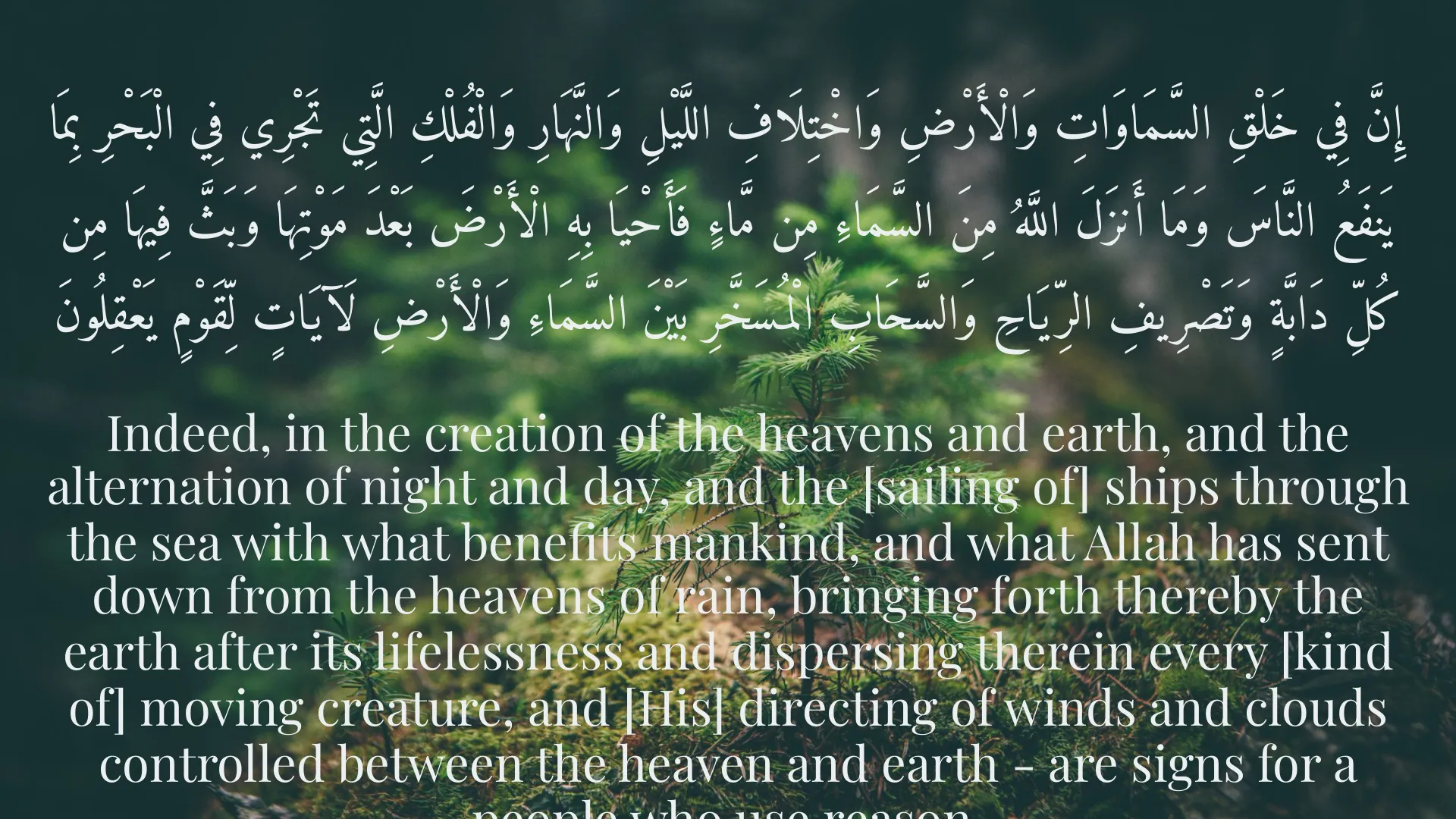
إِنَّ فِي خَلْقِ السَّمَاوَاتِ وَالْأَرْضِ وَاخْتِلَافِ اللَّيْلِ وَالنَّهَارِ وَالْفُلْكِ الَّتِي تَجْرِي فِي الْبَحْرِ بِمَا يَنفَعُ النَّاسَ وَمَا أَنزَلَ اللَّهُ مِنَ السَّمَاءِ مِن مَّاءٍ فَأَحْيَا بِهِ الْأَرْضَ بَعْدَ مَوْتِهَا وَبَثَّ فِيهَا مِن كُلِّ دَابَّةٍ وَتَصْرِيفِ الرِّيَاحِ وَالسَّحَابِ الْمُسَخَّرِ بَيْنَ السَّمَاءِ وَالْأَرْضِ لَآيَاتٍ لِّقَوْمٍ يَعْقِلُونَ
Indeed, in the creation of the heavens and earth, and the alternation of night and day, and the [sailing of] ships through the sea with what benefits mankind, and what Allah has sent down from the heavens of rain, bringing forth thereby the earth after its lifelessness and dispersing therein every [kind of] moving creature, and [His] directing of winds and clouds controlled between the heaven and earth - are signs for a people who use reason.
Al-Baqarah : 164
يَا أَيُّهَا النَّاسُ قَدْ جَاءَتْكُم مَّوْعِظَةٌ مِّن رَّبِّكُمْ وَشِفَاءٌ لِّمَا فِي الصُّدُورِ وَهُدًى وَرَحْمَةٌ لِّلْمُؤْمِنِينَ
O mankind, there has to come to you instruction from your Lord and healing for what is in the breasts and guidance and mercy for the believers.
Yunus : 57
إِنَّ هَٰذَا الْقُرْآنَ يَهْدِي لِلَّتِي هِيَ أَقْوَمُ وَيُبَشِّرُ الْمُؤْمِنِينَ الَّذِينَ يَعْمَلُونَ الصَّالِحَاتِ أَنَّ لَهُمْ أَجْرًا كَبِيرًا
Indeed, this Quran guides to that which is most upright and gives good tidings to the believers who do righteous deeds that they will have a great reward.
Al-Isra : 9
Short Story
In Saadi's Bustan it is narrated: "A venerable sage was asked, 'What is intellect and what are its limits?' The sage replied, 'Intellect is a lamp that burns within a human, illuminating the path. But there is a difference between a lamp that consumes its own oil and a light that draws from the sun. Intellect without revelation is like a lamp in a dark night, illuminating only a small portion of its surroundings, leaving much of the path hidden. But when the light of revelation shines upon it, then it both gains light itself and illuminates the world.' So, there was a learned scholar, who spent his life studying philosophy and logic, never believing anything unless his intellect accepted it. There was no peace in his heart, and he was always searching for ultimate answers. One day, on a journey, he met an enlightened old man who had attained tranquility through divine knowledge and inner wisdom. The scholar asked him, 'O Sheikh, how have you achieved such certainty and peace?' The old man replied, 'My son, human reason and knowledge are precious, but they are like a hand that needs something else to grasp. Intellect can only guide as far as it has seen and understood. But complete truth comes from the unseen world, brought only by the prophets. When you place the light of revelation alongside intellect, then the eye of your heart will open, and you will see the truth in its entirety.' From that day on, the scholar, instead of relying solely on his own reason, turned to the divine word, and it was then that both his intellect became more luminous and his heart found true peace.