Quranic Answer
The question of human identity is one of the most profound and fundamental inquiries that has always occupied the human mind. The Holy Quran, as the divine word and a complete guide for life, provides a comprehensive and multifaceted answer to this essential question, delving beyond physical dimensions into the spiritual and moral aspects of human existence. Human identity in the Quran is defined not merely by physical birth, but by purposeful creation, a special status in the universe, and unparalleled accountability before the Creator. This Quranic perspective imbues humanity with deep meaning, a noble standing, and a clear path towards eternal bliss. Firstly, the Quran emphasizes the divine and exalted origin of humanity. Humans are creatures whom Allah fashioned with His own hands from "clay" or "dust" (earthly elements) and then breathed His infinite "spirit" into them. These two aspects, material and spiritual, are intertwined in human identity from the very beginning, giving them a dual nature. The material aspect connects humans to the earth, nature, and other creatures, enabling them to live in the physical realm. However, the breathing of the divine spirit bestows upon them a special dignity, unparalleled capacities, and a unique position, distinguishing them from other beings and granting them the ability to comprehend the unseen and connect with the divine. In Surah Al-Hijr, verse 29, Allah states: "So when I have fashioned him and breathed into him of My [created] spirit, then fall down to him in prostration." This verse clearly highlights the grandeur of humanity and the presence of a divine essence within their being, an essence that even the exalted angels respect and prostrate before. This "divine spirit" is the source of knowledge, intellect, will, choice, conscience, and discernment in humans, forming the foundation of their spiritual, moral, and transcendent identity. Furthermore, the Quran clarifies the purposeful nature of human creation, emphasizing that human existence is not futile or meaningless. Humans are not merely physical and purely biological beings; they are created with a lofty purpose and a specific ultimate goal: "And I did not create the jinn and mankind except to worship Me" (Adh-Dhariyat, verse 56). Worship here is not limited to performing rituals and outward acts of devotion; it encompasses a broader concept, including a deep understanding of God, obedience to His commands and prohibitions in all aspects of life, living according to divine values, and ultimately, achieving complete submission and surrender to the Creator's will. This exalted purpose gives direction to human identity, imbues their lives with meaning, and teaches them that their existence holds a significance beyond fleeting worldly pleasures, carnal desires, and material ambitions. In this journey, humans, by their own choice, select between the path of truth and falsehood, virtue and vice, and these conscious choices shape their true identity and inner character, determining their eternal destiny. Another vital and unique dimension of human identity in the Quran is the concept of "Khilafah" or divine vicegerency on Earth. In Surah Al-Baqarah, verse 30, we read: "And [mention, O Muhammad], when your Lord said to the angels, 'Indeed, I will make upon the earth a successive authority [Khalifa].'" This vicegerency places immense responsibility on humans: cultivating the earth, upholding justice, proper management of natural and human resources, and leading other creatures in accordance with divine objectives and monotheistic values. As Khalifahs, humans possess the power of discernment, knowledge, free will, and the ability to learn, enabling them to fulfill this significant responsibility and manage the earth in the best possible way. This exalted role defines human identity as active, responsible, possessing the potential for great positive impact in the world, and being an agent of good and righteousness. This role of vicegerency moves humans beyond passivity and compels them towards construction, progress, and the fulfillment of their divine duty. The Quran strongly emphasizes the element of "free will" and "choice" in humans, which are prominent features of their identity. Unlike other creatures that act instinctively and are subject to the compulsion of nature, humans possess the power of choice, and this very power makes them accountable and responsible for their actions. "Indeed, We guided him to the way, whether grateful or ungrateful" (Al-Insan, verse 3). This freedom defines human identity as a being with moral choices and responsible for their own destiny. Reward and punishment in the afterlife are also based on this free will and conscious action. Throughout their life journey, humans are constantly in a struggle between inclinations of good and evil, guidance and misguidance, faith and disbelief, and virtue and vice. Their identity is manifested in their choices, whether towards light or towards darkness. This internal struggle, which the Quran refers to as "Nafs al-Ammara" (the self that incites to evil) and "Nafs al-Lawwamah" (the self-reproaching soul), is a significant part of the human struggle to forge their true identity. Moreover, the Quran refers to the "Fitra" of humanity. Fitra is the pure, divine predisposition upon which Allah created humanity; an innate disposition that naturally inclines towards monotheism and the worship of God, as well as towards justice, truth, and moral virtues. "So direct your face toward the religion, inclining to truth. [Adhere to] the fitrah of Allah upon which He has created [all] people. No change should there be in the creation of Allah" (Ar-Rum, verse 30). This Fitra is an inseparable part of true human identity that can be covered and hidden by sin, heedlessness, worldly attachments, and improper upbringing, but it is never destroyed. The path of self-purification (tazkiyah an-nafs), self-improvement, and remembrance of this Fitra is a way back to one's true, divine, and elevated human identity. Piety (taqwa) and self-awareness regarding this Fitra guide humans towards perfection. Finally, human identity in the Quran is a dynamic, changing, and evolving identity. Throughout their lives, humans shape and mature their identity through their actions, choices, intentions, and efforts. This identity has individual and social dimensions. Humans are not solitary beings; they are an integral part of the larger human society, and their relationships with others, including mutual respect, social justice, benevolence, and empathy, also form an indispensable part of their identity. The Quranic identity invites humans to profound self-knowledge, true knowledge of God, and purposeful living to achieve true and eternal happiness in this world and the hereafter. This identity ultimately culminates in a return to Allah and the reckoning of deeds on the Day of Judgment, where every soul will be revealed with its true and inner identity. Therefore, human identity in the Quran is a marvelous combination of divine origin, elevated purpose, profound responsibility, complete free will, pure Fitra, and eternal destiny, each of which forms an important part of defining "Who am I?" This comprehensive and elevated perspective portrays humans not merely as material and perishable beings, but as spiritual, responsible, free-willed, dynamic, and evolving beings on a path towards absolute perfection, possessing the capacity to manifest divine attributes. This complexity and depth further enhance the beauty of human identity in the Quranic view.
Related Verses
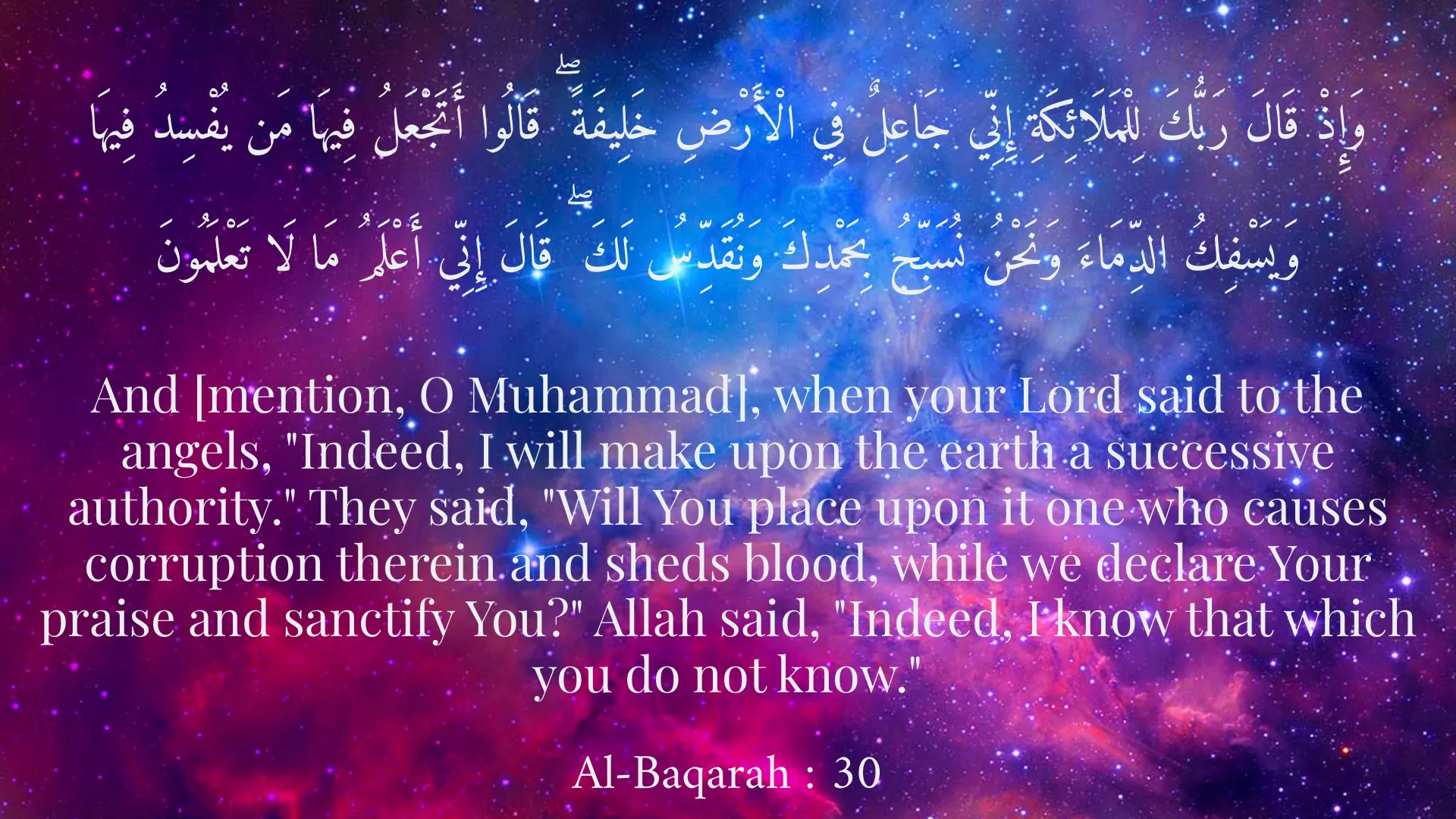
وَإِذْ قَالَ رَبُّكَ لِلْمَلَائِكَةِ إِنِّي جَاعِلٌ فِي الْأَرْضِ خَلِيفَةً ۖ قَالُوا أَتَجْعَلُ فِيهَا مَن يُفْسِدُ فِيهَا وَيَسْفِكُ الدِّمَاءَ وَنَحْنُ نُسَبِّحُ بِحَمْدِكَ وَنُقَدِّسُ لَكَ ۖ قَالَ إِنِّي أَعْلَمُ مَا لَا تَعْلَمُونَ
And [mention, O Muhammad], when your Lord said to the angels, "Indeed, I will make upon the earth a successive authority." They said, "Will You place upon it one who causes corruption therein and sheds blood, while we declare Your praise and sanctify You?" Allah said, "Indeed, I know that which you do not know."
Al-Baqarah : 30
فَإِذَا سَوَّيْتُهُ وَنَفَخْتُ فِيهِ مِن رُّوحِي فَقَعُوا لَهُ سَاجِدِينَ
And when I have proportioned him and breathed into him of My [created] spirit, then fall down to him in prostration.
Al-Hijr : 29
وَمَا خَلَقْتُ الْجِنَّ وَالْإِنسَ إِلَّا لِيَعْبُدُونِ
And I did not create the jinn and mankind except to worship Me.
Adh-Dhariyat : 56
إِنَّا هَدَيْنَاهُ السَّبِيلَ إِمَّا شَاكِرًا وَإِمَّا كَفُورًا
Indeed, We guided him to the way, whether grateful or ungrateful.
Al-Insan : 3
Short Story
It is narrated that one day, a king of great majesty and power proudly boasted of his grand palace and countless treasures, believing his identity was solely defined by his immense possessions. One day, a humble dervish, clad in simple patched garments, passed by his palace. The king, out of curiosity or perhaps to display his grandeur, summoned the dervish and asked, "O wise one, what is your identity? For I, as you see, am the king of this land, possessing everything a man could desire." The dervish smiled gently and replied, "O King, your identity, like mine, is not in what you possess, but in what you are. For this palace and these treasures, though magnificent, are borrowed from the earth and will one day return to it. Your true identity lies in the spirit that animates you, the wisdom you acquire, the justice you dispense, and the kindness you offer. These are the treasures that accompany you beyond this fleeting world." The king pondered the dervish's words deeply. He realized that his true self was not his crown or his gold, but the essence that God had breathed into him, the capacity for good deeds, and the knowledge he could gain. From that day, he sought to cultivate his inner self, understanding that a king's greatest treasure is a noble character and a virtuous soul, which truly defines his identity.