Quranic Answer
The question of how human free will (Ikhtiyar) coexists with God's foreknowledge (Ilm al-Ghaib or divine omniscience) is one of the most profound and delicate theological issues in Islamic thought, and the Quran addresses it with remarkable depth and subtlety. This apparent paradox is often a source of contemplation and sometimes confusion, but the Quranic perspective offers a harmonious reconciliation that affirms both human agency and divine omniscience. At its core, the Quran unequivocally asserts human free will and responsibility. Throughout its verses, individuals are held accountable for their actions, thoughts, and intentions, and are promised rewards for good deeds and consequences for evil ones. This emphasis on accountability inherently necessitates the existence of choice. If human beings were merely puppets acting out a predetermined script, the concepts of justice, reward, punishment, and repentance would lose their meaning entirely. For instance, in Surah Al-Kahf (18:29), Allah states: "And say, 'The truth is from your Lord, so whoever wills - let him believe; and whoever wills - let him disbelieve.'" This verse is a clear declaration of human freedom to choose belief or disbelief, highlighting that faith is a conscious decision. Similarly, Surah Al-Insan (76:3) proclaims: "Indeed, We guided him to the way, whether grateful or ungrateful." This signifies that God has shown humanity the path of guidance, but the decision to follow it or deviate rests squarely with the individual. The numerous commandments and prohibitions in the Quran, coupled with the call to reflection and striving (jihad al-nafs), all underscore the reality of human choice. We are not coerced; rather, we are empowered to make decisions and are subsequently responsible for them. The very purpose of life, as presented in the Quran, is a test (ibtila'), and a test is only meaningful if the tested subject has genuine choices and the capacity to make them. Simultaneously, the Quran just as emphatically affirms God's absolute and all-encompassing knowledge. Allah is Al-Alim (The All-Knowing) and Al-Khabir (The All-Aware). His knowledge is not limited by time or space; He knows what has been, what is, and what will be, down to the minutest detail. Surah Al-An'am (6:59) beautifully illustrates this point: "And with Him are the keys of the unseen; none knows them except Him. And He knows what is on the land and in the sea. Not a leaf falls but that He knows it. And no grain is there within the darknesses of the earth or [anything] fresh or dry but that it is in a clear register." This verse powerfully conveys the boundless scope of divine knowledge, encompassing every event, every thought, and every intention before it even occurs. This perfect foreknowledge is an intrinsic part of His divine perfection and sovereignty (rububiyyah). The concept of Al-Lawh Al-Mahfuz (The Preserved Tablet) further reinforces this, as it is understood as the divine record where everything that will happen is eternally inscribed, serving as a testament to God's complete knowledge. The reconciliation lies in understanding the nature of divine knowledge. God's foreknowledge is not a causative force. It is crucial to distinguish between "knowing" and "causing." When God knows what we will choose, He knows it because He is infinitely aware of all possibilities and the eventual outcome of our free choices. His knowledge does not compel us to act in a certain way; rather, it reflects what we, through our own free will, will choose to do. Imagine a perfect, all-knowing observer who can predict every move of a complex chess game before it begins. His perfect prediction doesn't force the players to make those moves; they still make their choices freely according to their understanding and strategy. Similarly, Allah's knowledge of our future actions does not negate our freedom to perform those actions. He knows because He has created us with the capacity for choice and knows precisely how we will exercise that capacity. His knowledge is a reflection of reality as it will unfold, not a determinant of it. Furthermore, the Quran introduces the concept of Qadar (divine decree) and Qada (divine judgment or execution). Qadar is not fatalism in the sense that our actions are rigidly predetermined and we have no role. Instead, Qadar is the divinely established order and framework of the universe, within which human free will operates. It includes the universal laws of cause and effect, the consequences of actions, and the inherent nature of things. God's universal will (Mashiyah) allows for human will to exist and function. When the Quran states, "And you do not will except that Allah wills, Lord of the worlds" (At-Takwir 81:29), it implies that human will is contingent upon and operates within the permissive, overarching will of God. It means our ability to will and act is a gift from God, and our choices are only effective because God allows them to be within the grand scheme of creation. It does not mean God forces our specific choices or denies us genuine agency. Our choices are real, and their consequences are real and eternally recorded. In essence, divine knowledge is akin to a perfect record of choices that will be made, not a script that must be followed without deviation. Humans are given intellect, reason, and divine guidance (through Prophets and revealed books) to discern right from wrong. They are then empowered to act upon their discernment. The Quran emphasizes the importance of intention (niyyah) and effort (sa'y), both of which are meaningless without free will. Our striving and choices determine our path, and God's knowledge encompasses these very choices and their outcomes. This theological approach allows for perfect divine justice, where individuals are rewarded or punished justly based on their conscious choices, while simultaneously affirming the absolute sovereignty and omniscience of Allah. It is a profound mystery, understood not as a contradiction, but as a harmonious interplay between the Creator's infinite wisdom and the purposeful autonomy granted to His creation. It fosters active engagement with life, encouraging good deeds and sincere repentance, rather than passive fatalism.
Related Verses
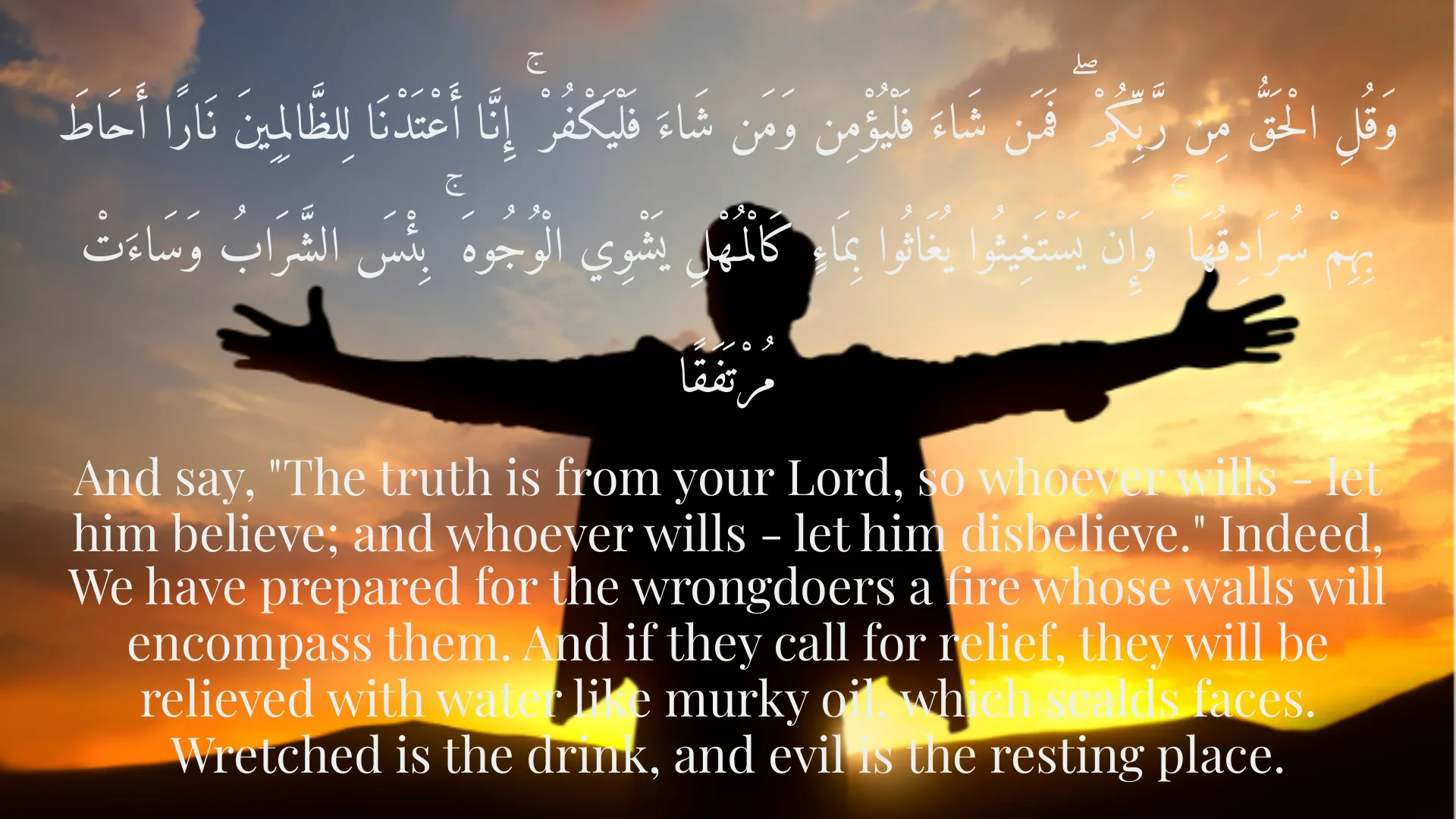
وَقُلِ الْحَقُّ مِن رَّبِّكُمْ ۖ فَمَن شَاءَ فَلْيُؤْمِن وَمَن شَاءَ فَلْيَكْفُرْ ۚ إِنَّا أَعْتَدْنَا لِلظَّالِمِينَ نَارًا أَحَاطَ بِهِمْ سُرَادِقُهَا ۚ وَإِن يَسْتَغِيثُوا يُغَاثُوا بِمَاءٍ كَالْمُهْلِ يَشْوِي الْوُجُوهَ ۚ بِئْسَ الشَّرَابُ وَسَاءَتْ مُرْتَفَقًا
And say, "The truth is from your Lord, so whoever wills - let him believe; and whoever wills - let him disbelieve." Indeed, We have prepared for the wrongdoers a fire whose walls will encompass them. And if they call for relief, they will be relieved with water like murky oil, which scalds faces. Wretched is the drink, and evil is the resting place.
Al-Kahf : 29
وَعِندَهُ مَفَاتِحُ الْغَيْبِ لَا يَعْلَمُهَا إِلَّا هُوَ ۚ وَيَعْلَمُ مَا فِي الْبَرِّ وَالْبَحْرِ ۚ وَمَا تَسْقُطُ مِن وَرَقَةٍ إِلَّا يَعْلَمُهَا وَلَا حَبَّةٍ فِي ظُلُمَاتِ الْأَرْضِ وَلَا رَطْبٍ وَلَا يَابِسٍ إِلَّا فِي كِتَابٍ مُّبِينٍ
And with Him are the keys of the unseen; none knows them except Him. And He knows what is on the land and in the sea. Not a leaf falls but that He knows it. And no grain is there within the darknesses of the earth or [anything] fresh or dry but that it is in a clear register.
Al-An'am : 59
لَهُ مُعَقِّبَاتٌ مِّن بَيْنِ يَدَيْهِ وَمِنْ خَلْفِهِ يَحْفَظُونَهُ مِنْ أَمْرِ اللَّهِ ۗ إِنَّ اللَّهَ لَا يُغَيِّرُ مَا بِقَوْمٍ حَتَّىٰ يُغَيِّرُوا مَا بِأَنفُسِهِمْ ۗ وَإِذَا أَرَادَ اللَّهُ بِقَوْمٍ سُوءًا فَلَا مَرَدَّ لَهُ ۖ وَمَا لَهُم مِّن دُونِهِ مِن وَالٍ
For him [man] are successive [angels] before him and behind him who guard him by the command of Allah. Indeed, Allah will not change the condition of a people until they change what is in themselves. And when Allah intends for a people ill, there is no repelling it. And there is not for them besides Him any protector.
Ar-Ra'd : 11
Short Story
Once, in the verdant gardens of Shiraz, two travelers embarked on a journey. One was ever diligent, meticulously planning his route, preparing provisions, and seeking the safest paths. The other, relying solely on fate, ventured forth carelessly, saying, "Whatever is destined, shall be." Both encountered hardships. The diligent traveler, through his foresight and effort, navigated through challenges with resilience, for he had prepared. The careless one, however, faced dire consequences, blaming only destiny. A wise old man, witnessing their differing fortunes, remarked: "Indeed, God knows all that shall transpire, even before it takes form. Yet, He has also bestowed upon humanity the power of choice and endeavor. The diligent one, though God knew his path, actively chose the path of effort, and thus his destiny unfolded through his actions. The careless one, too, lived out his destiny, but it was shaped by his own neglectful choices. For truly, the divine decree is not a chain on the hand of man, but a grand tapestry upon which each thread of choice is woven by the weaver himself, known beforehand to the Master Weaver."