Quranic Answer
In the rich and profound teachings of the Holy Quran, two of the most prominent and crucial divine attributes, namely God's 'Justice' (Adl) and 'Mercy' (Rahmah), are presented as mutually dependent and complementary. These two attributes, which form the basis of creation and the governance of the universe, are not in conflict with each other. Rather, they are intricately and wisely intertwined, reflecting the infinite perfection and wisdom of God. The Quran, by repeatedly mentioning the names 'Ar-Rahman' (The Most Merciful) and 'Ar-Raheem' (The Ever Merciful) at the beginning of every surah (except Surah At-Tawbah) and in numerous verses, emphasizes the boundless expanse of divine mercy. This mercy 'encompasses all things' (Al-A'raf: 156) and precedes divine wrath. On the other hand, many verses also attest to Allah's absolute justice, indicating that Allah never wrongs anyone, not even 'the weight of a dust particle' (An-Nisa: 40), and everyone receives recompense or punishment precisely according to their deeds. Divine Mercy: The Foundation and Context of Existence Divine mercy is, in essence, the foundation and substratum of creation and the management of the world. Without Allah's mercy, no creature would exist, and no life would flow. This mercy manifests in a wide array of divine expressions: 1. Creation and Sustenance: By His infinite mercy, Allah has created humanity and all beings, guaranteeing their sustenance. Providing the basic necessities of life, such as air, water, food, and shelter, are all manifestations of His vast mercy. 2. Guidance and Prophethood: Among the greatest manifestations of divine mercy is the sending of prophets and the revelation of divine scriptures for the guidance of humanity. Through this, Allah has shown humanity the path to salvation and deliverance, saving them from error and darkness. The Quran itself is a mercy from Allah that brings light and guidance to mankind. 3. Repentance and Forgiveness: One of the most beautiful manifestations of Allah's mercy is the perpetually open door of repentance and forgiveness. Allah calls sinful servants to return and regret their misdeeds, promising to forgive all sins, provided there is sincere repentance (Az-Zumar: 53). This forgiveness and second chance demonstrate the pinnacle of divine mercy and compassion, which triumphs over harshness and vengeance. 4. Ease in Ordinances: The laws and ordinances of Islamic Sharia are also established with the aim of facilitating ease and removing hardship from servants. Allah states in the Quran: "Allah intends for you ease and does not intend for you hardship" (Al-Baqarah: 185). This itself is a sign of the inherent mercy within divine laws, which are ultimately for the benefit and welfare of humanity. Divine Justice: The Guarantor of Order and Rights Divine justice means that Allah never wrongs anyone, and He has created and governs everything based on truth and wisdom. No one is oppressed before Him, and every action, whether good or bad, has consequences. Manifestations of divine justice include: 1. Order and Balance in Creation: The universe is created based on precise order, balance, and meticulously calculated laws. From the smallest particle to the largest galaxy, everything is in its proper place, and this precise order is a sign of the Creator's justice and wisdom. Without justice, chaos and disorder would prevail in the world. 2. Reward and Punishment in the Hereafter: The Day of Judgment is the full manifestation of divine justice. On that Day, everyone's deeds will be precisely weighed, and each person will be recompensed or punished according to their actions (Al-Anbiya: 47). No one will be wronged, and the accountability will be exact and fair. This justice completes the meaning of human responsibility and guarantees the implementation of moral laws in this world. 3. Divine Laws and Limits: The establishment of limits and laws in Sharia aims to establish justice in society. These laws protect individual rights, prevent oppression, and maintain social order. Punishments are also instituted to deter further corruption and injustice, ensuring the security and peace of society, which is itself a form of general mercy. The Complementary Relationship of Justice and Mercy Divine justice and mercy are not contradictory; rather, they are complementary. Justice gives meaning to mercy, and mercy refines justice. * Mercy Through Justice: Sometimes, justice itself is mercy. For example, punishing an oppressor, while being just, is a mercy for the oppressed and for society suffering from their oppression. If the oppressor is not punished, others may be encouraged to commit similar injustices, and this injustice would destroy the mercy that should encompass the general public. Therefore, the implementation of justice against oppressors is a mercy for the righteous and for establishing social order. * Justice Within the Framework of Mercy: Divine mercy is not arbitrary; rather, it is applied based on His wisdom and justice. Allah forgives sinners, but not without reason. This forgiveness usually follows sincere repentance and turning back, which itself is a form of justice in dealing with the servant. Divine mercy extends to those who deserve it or strive towards it. If divine mercy were arbitrary, the concept of free will and accountability would be lost. * Perfection in Attributes: Divine justice ensures that everyone receives what they deserve, and divine mercy provides the opportunity for humans to become worthy of divine mercy through self-correction and reform. Indeed, divine justice gives humanity hope that their good deeds will not be wasted, and divine mercy offers the chance to return to the light through repentance, even after sinning. By His justice, Allah preserves the world from corruption and injustice, and by His mercy, He opens the doors of hope and salvation to His servants. These two attributes symbolize Allah's perfect and flawless governance for the creation and life of humanity. Conclusion In summary, the Quran demonstrates that justice and mercy are two sides of the same coin, both stemming from the perfection of God's existence. Divine justice guarantees order, rights, and precise accountability, while divine mercy provides the context for creation, guidance, and forgiveness. These two attributes, together, present a comprehensive picture of a Lord who is both absolutely just and infinitely merciful, whose every action is based on wisdom and ultimate good. Understanding this relationship helps humanity to both fear divine punishment and not despair of His mercy, encouraging them to always walk the path of moderation and servitude.
Related Verses
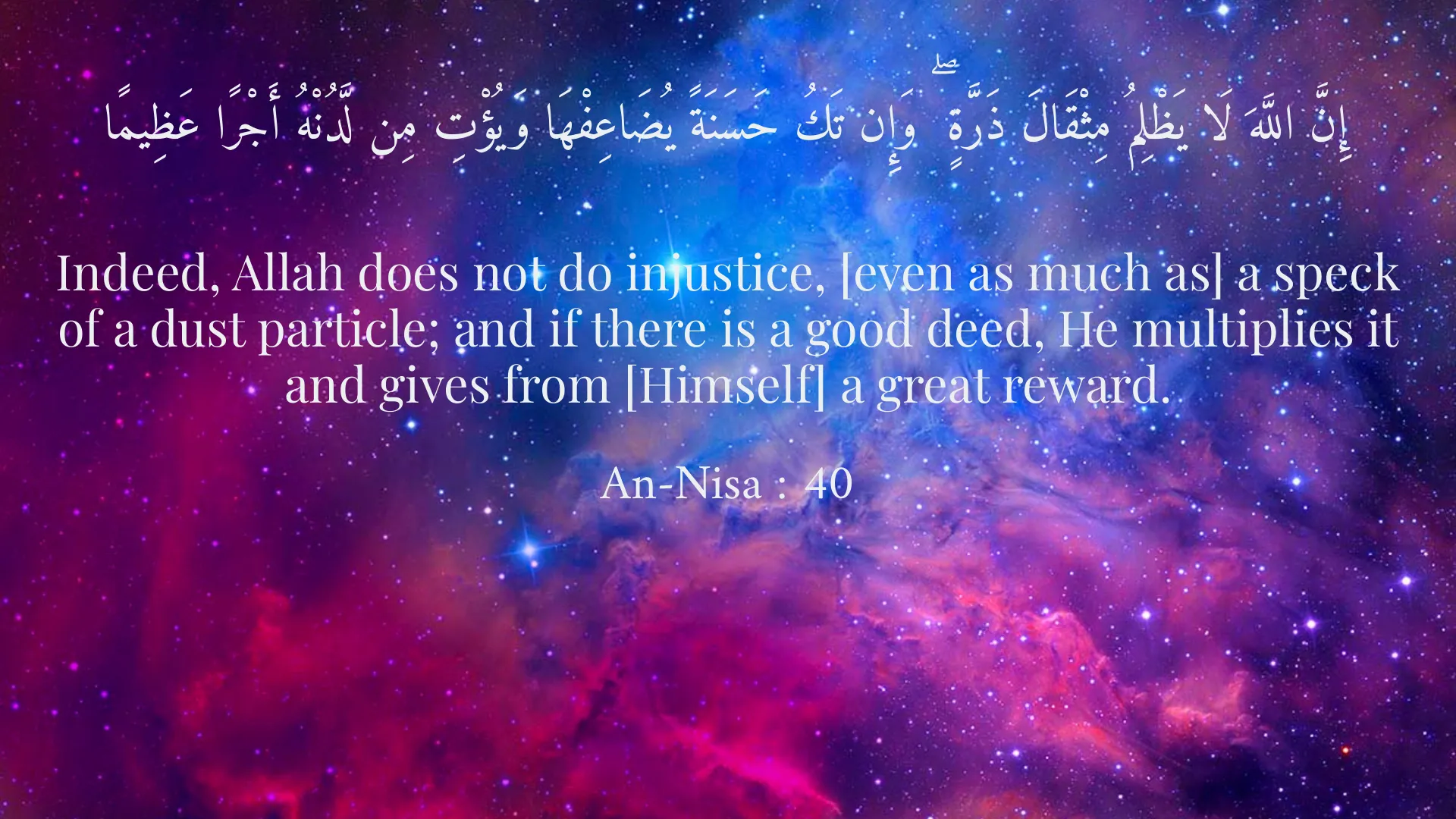
إِنَّ اللَّهَ لَا يَظْلِمُ مِثْقَالَ ذَرَّةٍ ۖ وَإِن تَكُ حَسَنَةً يُضَاعِفْهَا وَيُؤْتِ مِن لَّدُنْهُ أَجْرًا عَظِيمًا
Indeed, Allah does not do injustice, [even as much as] a speck of a dust particle; and if there is a good deed, He multiplies it and gives from [Himself] a great reward.
An-Nisa : 40
وَاكْتُبْ لَنَا فِي هَٰذِهِ الدُّنْيَا حَسَنَةً وَفِي الْآخِرَةِ إِنَّا هُدْنَا إِلَيْكَ ۚ قَالَ عَذَابِي أُصِيبُ بِهِ مَنْ أَشَاءُ ۖ وَرَحْمَتِي وَسِعَتْ كُلَّ شَيْءٍ ۚ فَسَأَكْتُبُهَا لِلَّذِينَ يَتَّقُونَ وَيُؤْتُونَ الزَّكَاةَ وَالَّذِينَ هُم بِآيَاتِنَا يُؤْمِنُونَ
And ordain for us in this world [that which is] good and in the Hereafter; indeed, we have turned to You.” He said, “My punishment — I afflict with it whom I will, but My mercy encompasses all things.” So I will decree it for those who fear Allah and give zakah and those who believe in Our verses.
Al-A'raf : 156
قُلْ يَا عِبَادِيَ الَّذِينَ أَسْرَفُوا عَلَىٰ أَنفُسِهِمْ لَا تَقْنَطُوا مِن رَّحْمَةِ اللَّهِ ۚ إِنَّ اللَّهَ يَغْفِرُ الذُّنُوبَ جَمِيعًا ۚ إِنَّهُ هُوَ الْغَفُورُ الرَّحِيمُ
Say, 'O My servants who have transgressed against themselves [by sinning], do not despair of the mercy of Allah. Indeed, Allah forgives all sins. Indeed, it is He who is the Forgiving, the Merciful.'
Az-Zumar : 53
Short Story
It is narrated that a just king brought a prisoner before him and commanded his execution. The prisoner, having no hope for his life, began to insult the king in his utter despair. The king asked a wise vizier, “What is he saying?” The vizier, with wisdom and benevolence, replied, “O King! He is saying: 'Paradise is for those who suppress their anger and forgive people.'” The king, moved by these words, pardoned the prisoner. Then another vizier, who was envious of the wise vizier, said, “O King! He lied. This man was cursing you.” The king smiled and replied, “His lie, which brought benefit, is better than your truth, which would have brought harm. That falsehood was more beautiful than this truth, for it brought about reconciliation, while your truth caused discord.” This tale by Saadi beautifully illustrates how at times, wisdom and mercy can precede the mere execution of justice, yielding better outcomes, which is precisely the divine wisdom that intertwines justice with mercy.