Quranic Answer
The question, "If God is all-knowing, why does He allow us to make mistakes?" delves into one of the most profound theological discussions concerning divine attributes and human existence. It’s a natural inquiry that arises when contemplating the absolute knowledge of Allah and the apparent imperfections in human conduct. From an Islamic perspective, the answer lies in the multifaceted wisdom of God's creation and the purpose He has ordained for humanity, rather than any contradiction in His omniscience. First and foremost, it is crucial to affirm Allah's absolute knowledge (Al-Alim, Al-Khabir). The Quran repeatedly emphasizes that God encompasses all knowledge, past, present, and future, visible and unseen. He knows every thought, every intention, and every action before it even manifests. This divine knowledge is not a passive observation but an active and intricate part of His perfect plan for the universe. For instance, Surah Al-An'am (6:59) states: "And with Him are the keys of the unseen; none knows them except Him. And He knows what is on the land and in the sea. Not a leaf falls but that He knows it. And no grain is there within the darknesses of the earth or [anything] green or dry but that it is in a clear register." This verse eloquently illustrates the comprehensive nature of His knowledge, extending to the minutest details of existence. However, God's foreknowledge does not negate human free will. This is a critical distinction in Islamic theology. Allah knows what choices we will make, but He does not compel us to make them. We are given the faculty of choice, the ability to discern between right and wrong, and the capacity to act upon our decisions. Surah Al-Kahf (18:29) highlights this profound truth: "And say, 'The truth is from your Lord, so whoever wills - let him believe; and whoever wills - let him disbelieve.'" This verse clearly delineates human agency. The universe, in its grand design, is not a deterministic automaton where every action is pre-programmed without conscious input. Instead, it is a realm where human beings are empowered with moral responsibility and the freedom to choose their path. The allowance of mistakes is intricately linked to the very purpose of human life on Earth: a test and a trial (Ibtila' or Fitnah). Life is not merely an existence but a journey of discernment, growth, and accountability. Allah created humans with the potential for both good and evil, and it is through the exercise of their free will, facing temptations, making decisions, and sometimes erring, that their true character is revealed. Surah Al-Ankabut (29:2-3) directly addresses this: "Do people think that they will be left alone because they say, 'We believe,' and will not be tested? But We have certainly tested those before them, and Allah will surely make evident those who are truthful, and He will surely make evident the liars." Mistakes, therefore, are not divine oversights but integral components of this test. They serve to distinguish those who are truly committed to goodness and obedience from those who are not. Without the possibility of error, there would be no genuine struggle, no merit in righteousness, and no meaning in striving for excellence. Moreover, mistakes serve as profound teachers. They provide opportunities for introspection, learning, and self-correction. When we err, we are presented with a chance to recognize our weaknesses, seek forgiveness, and resolve to improve. This process of repentance (Tawbah) is a cornerstone of Islamic spirituality and is deeply cherished by Allah. Surah Taha (20:82) states: "And indeed, I am the Forgiving to him who repents and believes and does righteousness and then continues in guidance." This divine invitation to repent underscores God's boundless mercy (Ar-Rahman, Ar-Rahim). He allows us to stumble, not to punish us without recourse, but to enable us to realize our dependence on Him, to humble ourselves, and to return to the straight path with renewed resolve. The door of repentance is always open, illustrating Allah's desire for our ultimate success and salvation. The consequences of our actions, good or bad, are also a vital aspect of why mistakes are permitted. Allah's justice (Al-Adl) dictates that every soul will be held accountable for its deeds. Surah Az-Zalzalah (99:7-8) powerfully declares: "So whoever does an atom's weight of good will see it, and whoever does an atom's weight of evil will see it." This accountability is meaningless if there is no genuine choice involved. Our mistakes, therefore, are recorded, and we will face their outcomes. This knowledge serves as a deterrent against wrongdoing and an incentive for striving towards virtue. The existence of these consequences further emphasizes the reality of our free will and the responsibility that comes with it. Finally, the allowance of mistakes is a manifestation of Allah's attributes of mercy, forgiveness, and wisdom. If humanity were created infallible, there would be no scope for the divine attributes of Al-Ghaffar (The Forgiver) or At-Tawwab (The Acceptor of Repentance) to be fully manifested in relation to humans. Our capacity for error, and subsequent repentance, allows us to experience the depth of God's compassion and grace. It fosters humility, self-awareness, and a constant seeking of divine guidance. In conclusion, God, in His infinite wisdom and omniscience, allows humans to make mistakes not because He is unaware or unable to prevent them, but because it is integral to the purpose of human creation. It is a necessary component of the test of life, a catalyst for spiritual growth, an opportunity for repentance and seeking divine mercy, and the very foundation of human accountability and free will. Our imperfections and errors, when met with sincere repentance and a striving for betterment, become pathways to deeper understanding, profound humility, and a stronger connection with our Creator. This divine permission for error is thus a sign of His boundless wisdom, justice, and mercy, designed to elevate humanity to its highest potential.
Related Verses
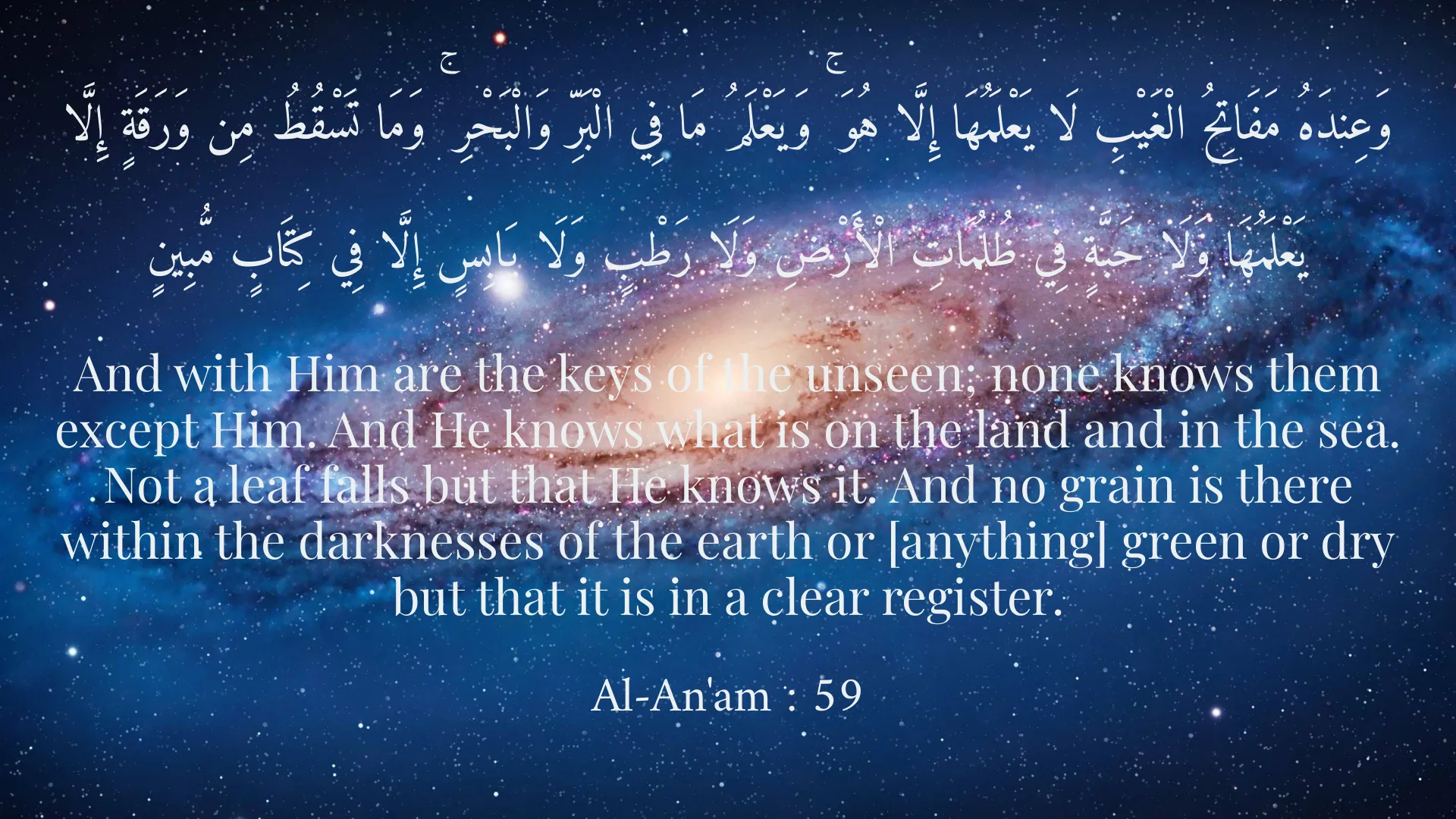
وَعِندَهُ مَفَاتِحُ الْغَيْبِ لَا يَعْلَمُهَا إِلَّا هُوَ ۚ وَيَعْلَمُ مَا فِي الْبَرِّ وَالْبَحْرِ ۚ وَمَا تَسْقُطُ مِن وَرَقَةٍ إِلَّا يَعْلَمُهَا وَلَا حَبَّةٍ فِي ظُلُمَاتِ الْأَرْضِ وَلَا رَطْبٍ وَلَا يَابِسٍ إِلَّا فِي كِتَابٍ مُّبِينٍ
And with Him are the keys of the unseen; none knows them except Him. And He knows what is on the land and in the sea. Not a leaf falls but that He knows it. And no grain is there within the darknesses of the earth or [anything] green or dry but that it is in a clear register.
Al-An'am : 59
وَقُلِ الْحَقُّ مِن رَّبِّكُمْ ۖ فَمَن شَاءَ فَلْيُؤْمِن وَمَن شَاءَ فَلْيَكْفُرْ ۚ إِنَّا أَعْتَدْنَا لِلظَّالِمِينَ نَارًا أَحَاطَ بِهِمْ سُرَادِقُهَا ۚ وَإِن يَسْتَغِيثُوا يُغَاثُوا بِمَاءٍ كَالْمُهْلِ يَشْوِي الْوُجُوهَ ۚ بِئْسَ الشَّرَابُ وَسَاءَتْ مُرْتَفَقًا
And say, 'The truth is from your Lord, so whoever wills - let him believe; and whoever wills - let him disbelieve.' Indeed, We have prepared for the wrongdoers a fire whose walls will encompass them. And if they call for relief, they will be relieved with water like murky oil, which scalds faces. Wretched is the drink, and bad is the resting place.
Al-Kahf : 29
أَحَسِبَ النَّاسُ أَن يُتْرَكُوا أَن يَقُولُوا آمَنَّا وَهُمْ لَا يُفْتَنُونَ
Do people think that they will be left alone because they say, 'We believe,' and will not be tested?
Al-Ankabut : 2
وَإِنِّي لَغَفَّارٌ لِّمَن تَابَ وَآمَنَ وَعَمِلَ صَالِحًا ثُمَّ اهْتَدَىٰ
And indeed, I am the Forgiving to him who repents and believes and does righteousness and then continues in guidance.
Taha : 82
فَمَن يَعْمَلْ مِثْقَالَ ذَرَّةٍ خَيْرًا يَرَهُ
So whoever does an atom's weight of good will see it,
Az-Zalzalah : 7
وَمَن يَعْمَلْ مِثْقَالَ ذَرَّةٍ شَرًّا يَرَهُ
And whoever does an atom's weight of evil will see it.
Az-Zalzalah : 8
Short Story
It is narrated that a wise and learned Shaykh had a young and talented student. Although bright, the student sometimes, out of pride or haste, ignored his master's advice. One day, the master said to him, "My son, on the path of seeking knowledge, never imagine that you have reached perfection. Many thoughts that now seem correct to you will later, through experience and trial, prove to be mistaken. Do not be afraid of making mistakes, but beware of repeating them without learning a lesson." The young student pondered what wisdom lay in his master's words, for he considered himself flawless. One day, the master asked him to go to the mountains and retrieve a specific plant, emphasizing, "Do not deviate from the main path, for the side trails are full of traps and dangers." The student, thinking he knew a shorter way, disregarded his master's advice and took a shortcut. It wasn't long before he got lost among the rocks, slipped, and injured his foot. In that darkness and cold, he deeply regretted his decision and realized that his master had forbidden him from that path not out of ignorance but out of knowledge and wisdom. With great difficulty, he managed to reach the main path and returned to his master with a wounded foot. The master looked at him with a kind and sympathetic gaze and said, "My son, I knew what had befallen you. Although you suffered pain and hardship, you have now gained a wisdom that a hundred books could not teach you. Every mistake that occurs due to ignorance, if accompanied by learning and repentance, is a step towards perfection." The student lowered his head, apologized to his master, and vowed never again to consider himself wiser than his teachers' wisdom or divine commands. From then on, whenever he made a mistake, instead of despairing, he learned from it and, with humility and greater effort, moved towards righteousness. Through the blessings of this bitter experience, he achieved greatness. This story reminds us that God, with His perfect knowledge, allows us to make mistakes so that by experiencing wrong paths and repenting from them, we are guided towards a deeper understanding of truth and the correct way of life, and appreciate divine guidance.