Quranic Answer
Understanding the concept of faith (Iman) in the Holy Quran is a profound and multifaceted endeavor that cannot be reduced to a single factor. The Quran refers to both knowledge (ma'rifat, cognition, awareness) and fear (khawf) in the formation and deepening of faith, but the roles played by each of these factors have fundamental differences. In reality, faith in the Quran is neither merely a product of blind fear nor solely the result of dry, emotionless awareness. Rather, these two, alongside the crucial element of divine love (mahabbah), interact dynamically and complementarily to form the foundation of true faith. First and foremost, the Holy Quran repeatedly and consistently invites humanity to reflection (tafakkur), contemplation (tadabbur), reasoning (ta'aqqul), and the pursuit of knowledge ('ilm). Countless verses throughout the Quran urge humans to ponder the creation of the heavens and the earth, the complex order of the universe, the creation of humanity itself, and historical events. Through this contemplation, individuals are meant to realize the infinite greatness, wisdom, knowledge, and power of God. This emphasis on observation, reflection, and logical inference demonstrates that knowledge and awareness are the cornerstone of authentic faith. Quranic faith is a faith based on insight and understanding, not blind imitation or mere emotional acceptance. When a person, with insight and through divine signs (Ayat al-Afaqi wal-Anfusi – signs in the horizons and within themselves) as well as through divine revelation (Quranic verses), attains knowledge of the Lord, the seeds of faith are sown in their heart. This knowledge includes the recognition of Tawhid (Oneness of God), God's perfect attributes (such as absolute power, infinite knowledge, expansive mercy, boundless wisdom), and the understanding of the Day of Judgment and the purpose of creation. The deeper and more comprehensive this knowledge, the more rooted and firm the faith will be. Allah states in the Quran that those with understanding are those who reflect on the creation of the heavens and the earth, realizing the greatness of their Lord, and say: 'Our Lord, You did not create this in vain' (Al-Imran, 191). It is this reflection and knowledge that lead a person to acknowledge the truth of the Creator and to submit to Him. On the other hand, the Quran also addresses the concept of 'khawf' (fear), but not as a fear that originates faith, rather as a fear that completes and strengthens faith, guiding individuals towards piety (taqwa) and abstaining from sin. This type of fear is often referred to as 'khashyah,' which signifies a fear accompanied by respect, awe, and deep knowledge. The Quran explicitly states: 'Only those fear Allah, from among His servants, who have knowledge' (Fatir, 28). This verse clearly indicates that khashyah is a product of knowledge, not its generator. The more a person comprehends God's greatness, power, and justice, the more they become apprehensive of disobeying Him and of the consequences of their sins. This apprehension is a constructive fear that encourages adherence to divine limits and avoidance of prohibitions. It instills vigilance and responsibility for one's actions, preventing heedlessness and rebellion. In essence, the fear of divine punishment and of losing God's pleasure is not the starting point of faith, but rather a driving force for its endurance and growth, keeping individuals steadfast on the path of servitude and piety. Furthermore, the pivotal role of 'mahabbah' (love) in faith must not be overlooked. The Quran declares: 'But those who believe are stronger in love for Allah' (Al-Baqarah, 165). This love is the fruit of recognizing God's beautiful and perfect attributes: knowing God as the Most Merciful, the Most Compassionate, the Provider, the Subtle, and the Generous. This love represents the deepest and most enduring dimension of faith, drawing individuals towards God with passion and devotion. In fact, knowledge serves as the gateway to the realm of faith, khashyah acts as a guardian and guide to keep one from straying, and love is the primary driving force that propels a person with enthusiasm and warmth towards divine proximity. True faith in the Quran is a delicate balance of these three pillars: a deep knowledge that illuminates the heart, a constructive reverence that regulates behavior, and a burning love that elevates the soul. Therefore, it can be concluded that faith in the Quran is fundamentally based on knowledge and awareness. This knowledge is acquired through contemplation of divine signs and reflection on revelation. The fear spoken of in the Quran is a fear accompanied by respect and awareness (khashyah), which is a product and outcome of knowledge, not its origin. This khashyah guides a person towards piety and avoidance of sin and, together with hope (raja') and love for Allah, brings faith to its perfection. Genuine faith is not built upon terror of an unknown force but upon a deep and rational understanding of the Creator of the universe and a loving connection with Him. It is this profound understanding that illuminates the heart with divine light, keeps a person away from the path of error, and ultimately leads to a life full of tranquility, meaning, and purpose.
Related Verses
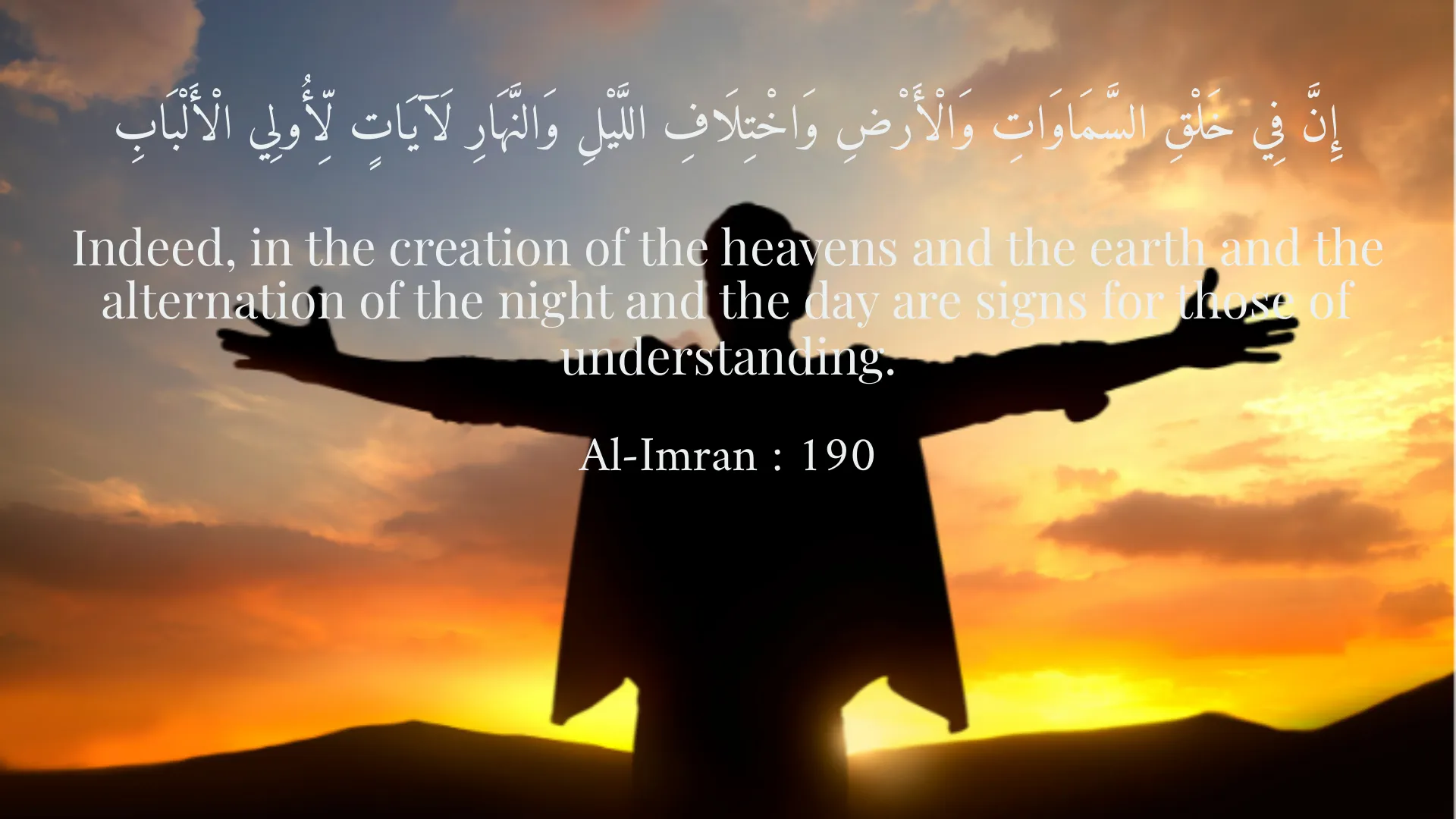
إِنَّ فِي خَلْقِ السَّمَاوَاتِ وَالْأَرْضِ وَاخْتِلَافِ اللَّيْلِ وَالنَّهَارِ لَآيَاتٍ لِّأُولِي الْأَلْبَابِ
Indeed, in the creation of the heavens and the earth and the alternation of the night and the day are signs for those of understanding.
Al-Imran : 190
الَّذِينَ يَذْكُرُونَ اللَّهَ قِيَامًا وَقُعُودًا وَعَلَىٰ جُنُوبِهِمْ وَيَتَفَكَّرُونَ فِي خَلْقِ السَّمَاوَاتِ وَالْأَرْضِ رَبَّنَا مَا خَلَقْتَ هَٰذَا بَاطِلًا سُبْحَانَكَ فَقِنَا عَذَابَ النَّارِ
Who remember Allah while standing or sitting or [lying] on their sides and contemplate the creation of the heavens and the earth, [saying], 'Our Lord, You did not create this in vain; exalted are You [above such a thing]; then protect us from the punishment of the Fire.'
Al-Imran : 191
وَمِنَ النَّاسِ وَالدَّوَابِّ وَالْأَنْعَامِ مُخْتَلِفٌ أَلْوَانُهُ كَذَٰلِكَ ۗ إِنَّمَا يَخْشَى اللَّهَ مِنْ عِبَادِهِ الْعُلَمَاءُ ۗ إِنَّ اللَّهَ عَزِيزٌ غَفُورٌ
And among the people and the animals and the grazing livestock are various colors. Thus only those who have knowledge among His servants fear Allah. Indeed, Allah is Exalted in Might and Forgiving.
Fatir : 28
وَمِنَ النَّاسِ مَن يَتَّخِذُ مِن دُونِ اللَّهِ أَندَادًا يُحِبُّونَهُمْ كَحُبِّ اللَّهِ ۖ وَالَّذِينَ آمَنُوا أَشَدُّ حُبًّا لِّلَّهِ ۗ وَلَوْ يَرَى الَّذِينَ ظَلَمُوا إِذْ يَرَوْنَ الْعَذَابَ أَنَّ الْقُوَّةَ لِلَّهِ جَمِيعًا وَأَنَّ اللَّهَ شَدِيدُ الْعَذَابِ
And [yet], among the people are those who take other than Allah as equals [to Him]. They love them as they should love Allah. But those who believe are stronger in love for Allah. And if only those who have wronged would consider when they see the punishment that all power belongs to Allah and that Allah is severe in punishment...
Al-Baqarah : 165
Short Story
It is narrated in Saadi's Gulistan that a just and wise king was restless at night, and sleep eluded his eyes. His minister asked, 'O King, with all this power and wealth, what has kept you awake?' The king replied, 'I reflect on the grandeur of this world, the majesty of creation, and the power of the Creator. The deeper I delve into this profound knowledge, the more my awe (khashyah) of accountability and my love for the Creator increase in my heart. It is this knowledge that compels me to stay awake at night in gratitude and remembrance, not the fear of losing my throne. Many obey out of fear of the sword, but those who bow in humility out of knowledge of God's majesty, their faith is more enduring and their hearts more tranquil.'