Quranic Answer
The concept of 'historical determinism' posits that the course of historical events is predetermined and inevitable, with human will and choice playing little significant role in shaping it. Conversely, 'free will' refers to the power of choice and freedom of volition, through which humans can influence their own destiny and that of their society. A careful examination of the verses of the Holy Quran reveals that Quranic teachings do not align with or accept historical determinism in its absolute sense, which would negate human free will entirely. While the Quran acknowledges God's absolute knowledge and divine decree (Qada' and Qadar), it places significant emphasis on the pivotal role of human will, choice, and action in shaping individual and collective destiny. The Quran repeatedly stresses human accountability for their actions. If everything were deterministic and pre-ordained, with humans having no free will, then concepts like responsibility, reward, punishment, enjoining good, and forbidding evil would lose all meaning. Verses such as "For it [the soul] will have [the consequence of] what it has gained, and upon it [the consequence of] what it has incurred" (Al-Baqarah: 286) clearly demonstrate that every person will face the results of their own deeds. This principle, 'as you sow, so shall you reap,' is the cornerstone of the system of reward and punishment in the Quran, and without human agency, this system would be meaningless. In the Quran, humans are portrayed as beings with free will, capable of choosing between good and evil, truth and falsehood, and their reward or punishment is based on these choices. Furthermore, the Quran refers to divine laws (Sunan Allah) in history, according to which societies rise or fall. However, these traditions are fixed and unchangeable laws that are intertwined with human actions and choices, rather than being an absolute determinism from which there is no escape. The noble verse "Indeed, Allah will not change the condition of a people until they change what is in themselves" (Ar-Ra'd: 11) is a key principle in this regard. This verse explicitly states that the condition of a society does not change unless that society changes itself. This change can be positive (towards righteousness and piety) or negative (towards corruption and oppression). This verse clearly affirms the role of collective will and human decisions in changing the destiny of a people and the course of history. If absolute historical determinism governed, there would be no need for the call of prophets, the sending of heavenly books, and the effort to reform society, because whatever was destined to happen would occur regardless of human will and action. Moreover, the stories of prophets and past nations in the Quran are full of lessons that show how people's choices and decisions—whether in accepting the truth or turning away from it—determined their destiny. The destruction of oppressive nations and the salvation of believers were direct consequences of their own choices and behaviors. These historical events are presented as models for subsequent generations to learn from the mistakes of the past and choose a better path for themselves. This emphasis on learning lessons is itself proof of the existence of free will and the possibility of change in the course of history. Divine knowledge and Qada' and Qadar in the Quran do not negate human free will. Divine knowledge means that God has always known all choices and their outcomes from eternity. This knowledge does not imply coercion. It is similar to us knowing the result of an exam, but this knowledge does not force the student to give specific answers. Qada' and Qadar also refer to God's overall plan and design for the universe, within which humans act with their free will. God has established laws in the world such that if humans act according to them, they achieve positive results, and if they act against them, they face negative consequences. These laws, again, operate based on human choice and action, rather than coercing them into a predetermined direction. Therefore, it can be concluded that the Holy Quran opposes any interpretation of historical determinism that would negate human responsibility and free will. In the Quranic view, humans are free, responsible, and volitional beings who, through their choices and actions, shape their own destiny and a part of the course of history. At the same time, this free will operates within the framework of divine knowledge, wisdom, and the governing laws of the universe. This balance between Qada' and Qadar and free will is one of the most beautiful and profound Quranic teachings, which grants humanity both hope and responsibility; hope for changing destiny for the better and responsibility for their choices and actions.
Related Verses
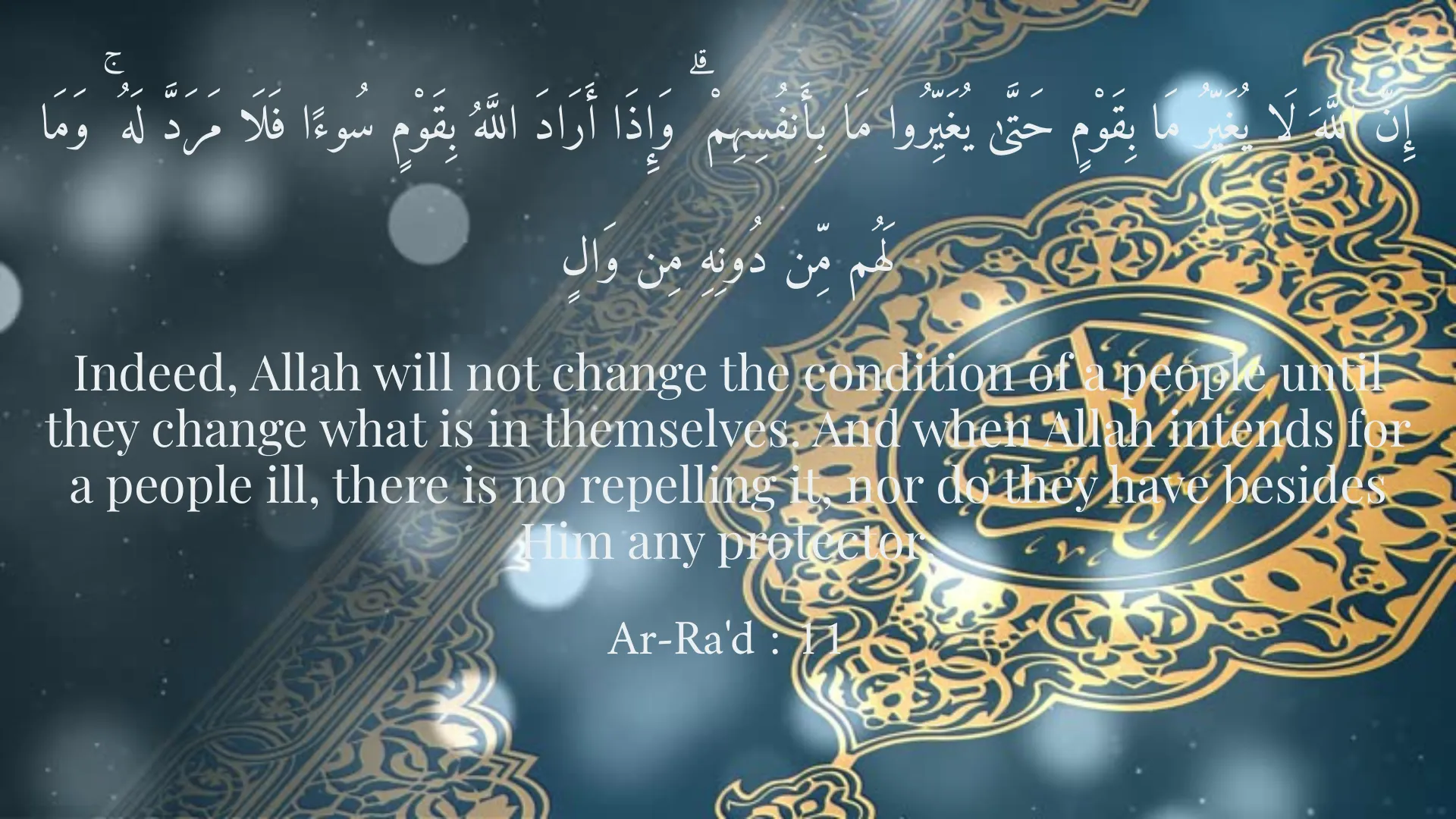
إِنَّ اللَّهَ لَا يُغَيِّرُ مَا بِقَوْمٍ حَتَّىٰ يُغَيِّرُوا مَا بِأَنفُسِهِمْ ۗ وَإِذَا أَرَادَ اللَّهُ بِقَوْمٍ سُوءًا فَلَا مَرَدَّ لَهُ ۚ وَمَا لَهُم مِّن دُونِهِ مِن وَالٍ
Indeed, Allah will not change the condition of a people until they change what is in themselves. And when Allah intends for a people ill, there is no repelling it, nor do they have besides Him any protector.
Ar-Ra'd : 11
وَقُلِ الْحَقُّ مِن رَّبِّكُمْ ۖ فَمَن شَاءَ فَلْيُؤْمِن وَمَن شَاءَ فَلْيَكْفُرْ ۚ إِنَّا أَعْتَدْنَا لِلظَّالِمِينَ نَارًا أَحَاطَ بِهِمْ سُرَادِقُهَا ۚ وَإِن يَسْتَغِيثُوا يُغَاثُوا بِمَاءٍ كَالْمُهْلِ يَشْوِي الْوُجُوهَ ۚ بِئْسَ الشَّرَابُ وَسَاءَتْ مُرْتَفَقًا
And say, 'The truth is from your Lord, so whoever wills - let him believe; and whoever wills - let him disbelieve.' Indeed, We have prepared for the wrongdoers a fire whose walls will encompass them. And if they call for relief, they will be relieved with water like murky oil, which scalds faces. Wretched is the drink, and bad is the resting place.
Al-Kahf : 29
لَا يُكَلِّفُ اللَّهُ نَفْسًا إِلَّا وُسْعَهَا ۚ لَهَا مَا كَسَبَتْ وَعَلَيْهَا مَا اكْتَسَبَتْ ۗ رَبَّنَا لَا تُؤَاخِذْنَا إِن نَّسِينَا أَوْ أَخْطَأْنَا ۚ رَبَّنَا وَلَا تَحْمِلْ عَلَيْنَا إِصْرًا كَمَا حَمَلْتَهُ عَلَى الَّذِينَ مِن قَبْلِنَا ۚ رَبَّنَا وَلَا تُحَمِّلْنَا مَا لَا طَاقَةَ لَنَا بِهِ ۖ وَاعْفُ عَنَّا وَاغْفِرْ لَنَا وَارْحَمْنَا ۚ أَنتَ مَوْلَانَا فَانصُرْنَا عَلَى الْقَوْمِ الْكَافِرِينَ
Allah does not charge a soul except [with that within] its capacity. It will have [the consequence of] what it has gained, and upon it [the consequence of] what it has incurred. Our Lord, do not impose blame upon us if we have forgotten or erred. Our Lord, and lay not upon us a burden like that which You laid upon those before us. Our Lord, and burden us not with that which we have no ability to bear. And pardon us; and forgive us; and have mercy upon us. You are our protector, so give us victory over the disbelieving people.
Al-Baqarah : 286
Short Story
It is narrated in Sa'di's Golestan that a king and his sagacious vizier were discussing people's destinies. The king said, "In my opinion, everyone's destiny is predetermined, and nothing can alter it." The vizier replied with a kind smile, "O King, if that were truly the case, then why do you strive to strengthen your army and establish justice in your realm? Why do you instruct the farmer to sow wheat and tell the merchant not to fear bankruptcy?" The king pondered for a moment. The vizier continued, "A good destiny is the reward of effort and pure intention, and a bad destiny is the result of inaction and corruption. God shows the way and grants intellect and free will, but traversing this path is by our own feet of endeavor and volition. If everyone were to sit idly, saying 'whatever is destined will be,' no building would ever be constructed, and no knowledge would ever be acquired. History, too, is the stage for these very choices and efforts." The king took heed of the wise vizier's words and understood more than ever the importance of striving and foresight in governing the affairs of the kingdom.