Quranic Answer
One of the most fundamental and profound questions that has occupied the human mind throughout history is the concept of salvation and ultimate redemption. In the framework of the Holy Quran, this topic is presented with a comprehensive and inclusive approach that transcends superficial affiliations and mere religious labels. The glorious Quran, as a guide for life and a source of guidance for humanity, articulates the criteria for salvation in a way that clearly demonstrates divine justice and mercy, paving the way for salvation for everyone, regardless of their apparent religious denomination or ethnicity. From the Quranic perspective, the central axis of salvation and redemption rests on two fundamental pillars: first, sincere belief in the One God and the Day of Judgment; and second, the performance of righteous and good deeds. These two pillars are like two wings that carry a human being towards eternal bliss. Belief in God means understanding His Oneness (Tawhid) – that there is no partner, equal, or likeness to Him, and that only He is worthy of worship. This belief must not only be verbal but rooted deeply in the human soul, illuminating the heart. Belief in the Day of Judgment means faith in the accounting of deeds, the reward for the virtuous, and the punishment for the wrongdoers, which in itself is a strong motivation for moving along the path of righteousness and piety. It is noteworthy that the Holy Quran explicitly states in several verses that salvation is not exclusively confined to a specific group or followers of a particular religion with a defined name. Rather, anyone who believes in God and the Last Day and performs righteous deeds will receive their reward from God, and there will be no fear concerning them, nor will they grieve. Verses such as Surah Al-Baqarah (2:62) and Surah Al-Ma'idah (5:69) clearly emphasize this meaning. These verses place believers (Muslims), Jews, Christians, and Sabeans on the same footing, identifying belief in God, the Last Day, and righteous deeds as the criteria for salvation. This perspective demonstrates the vastness of divine mercy and justice, which is by no means based on superficial religious titles or identities, but rather on the truth of heartfelt faith and the quality of actions. Interpreting these verses implies that Almighty God never looks at people's outward appearances but considers the depth of their faith, intentions, and deeds. Individuals who, in their time, believed in God's prophets and lived and performed righteous deeds according to the divine law revealed to them, will be rewarded by God. This includes followers of past prophets who adhered to the true religion in their era. After the advent of the Prophet of Islam, Muhammad (peace be upon him), the divine message reached its peak of perfection, and 'Islam,' meaning complete submission to God's will and commands, was introduced as the most complete and final divine religion. For those to whom the message of Islam has reached clearly and fully, and who have grasped its truth, accepting it is the path to salvation. However, for those to whom the message, for any reason, did not reach properly or who failed to comprehend it, God will hold them accountable based on His infinite knowledge and justice. He burdens no soul beyond its capacity and never commits injustice against anyone. Another crucial point is the comprehensive meaning of 'Islam.' The word 'Islam' signifies submission and surrender to the divine will and command. In this broader sense, all divine prophets, from Adam to the Seal of Prophets, were 'Muslims,' meaning submitters to God's will. Therefore, any human being throughout history who, with a pure heart and sound natural inclination (fitra), sought truth, submitted to truth, and performed good deeds, is truly considered a 'Muslim' in the actual sense, even if not formally identified as a follower of the religion of Islam. God looks not only at names and titles but at the very essence and inner movement of human beings. The Holy Quran explicitly states that the only sin, which if one dies upon without repentance, is unforgivable, is 'Shirk' – associating partners with God. This indicates that deviation from monotheism and the worship of One God is the greatest impediment to salvation. However, other sins, upon repentance and return to God, are forgivable. This point once again emphasizes the paramount importance of monotheism and sincere faith as the backbone of salvation. In summary, salvation and redemption in the Holy Quran are not limited to a specific religious label or name but possess universal and profound criteria: sincere belief in God and the Day of Judgment, coupled with the performance of righteous deeds and avoidance of associating partners with God. This teaching not only demonstrates God's boundless mercy but also portrays His justice, where everyone is held accountable according to their knowledge and actions, and no injustice is done to anyone. This message is an invitation to a broader understanding of humanity's relationship with its Creator, where purity of intention and righteousness of action are paramount.
Related Verses
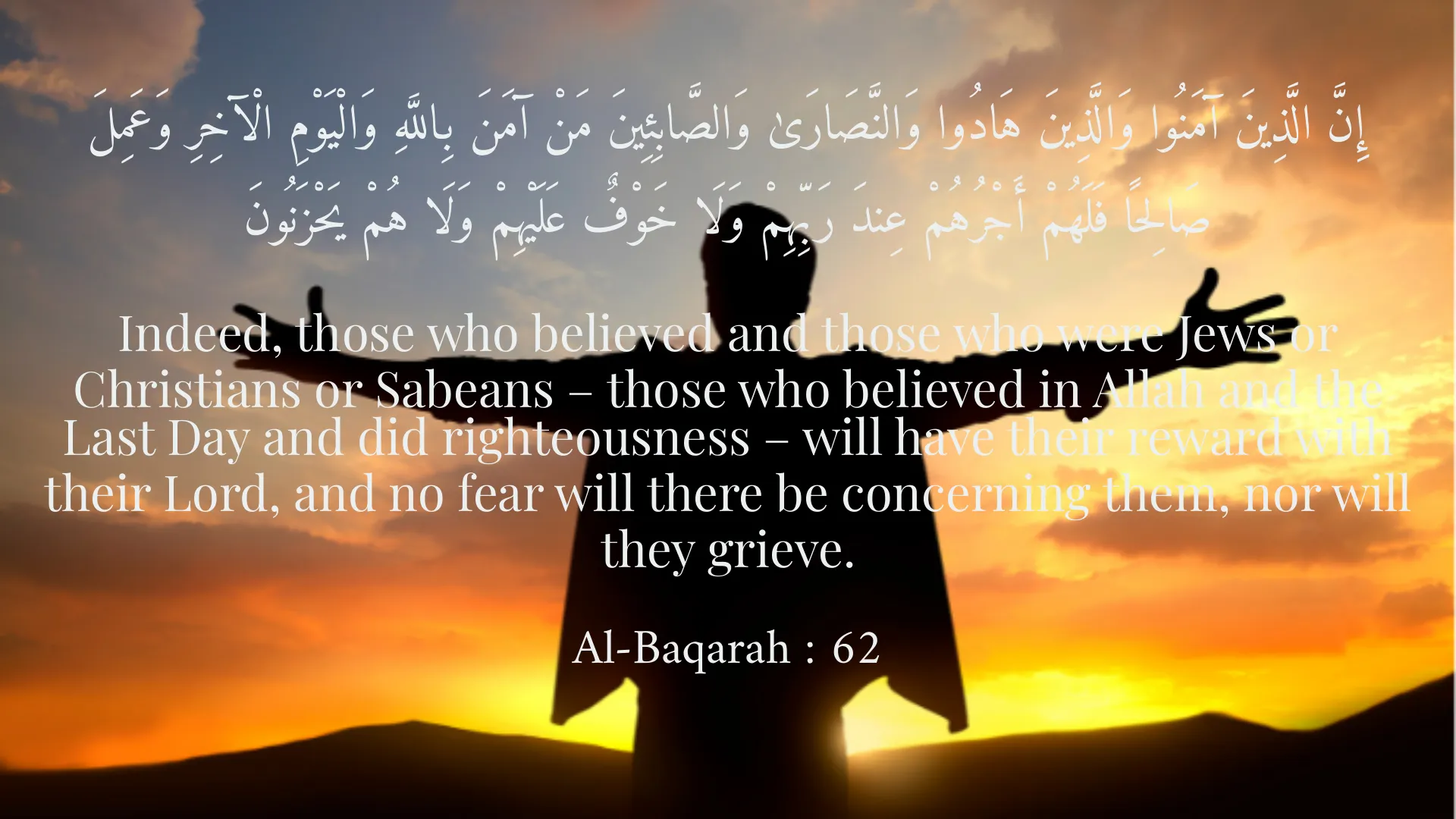
إِنَّ الَّذِينَ آمَنُوا وَالَّذِينَ هَادُوا وَالنَّصَارَىٰ وَالصَّابِئِينَ مَنْ آمَنَ بِاللَّهِ وَالْيَوْمِ الْآخِرِ وَعَمِلَ صَالِحًا فَلَهُمْ أَجْرُهُمْ عِندَ رَبِّهِمْ وَلَا خَوْفٌ عَلَيْهِمْ وَلَا هُمْ يَحْزَنُونَ
Indeed, those who believed and those who were Jews or Christians or Sabeans – those who believed in Allah and the Last Day and did righteousness – will have their reward with their Lord, and no fear will there be concerning them, nor will they grieve.
Al-Baqarah : 62
لَّيْسَ بِأَمَانِيِّكُمْ وَلَا أَمَانِيِّ أَهْلِ الْكِتَابِ ۗ مَن يَعْمَلْ سُوءًا يُجْزَ بِهِ وَلَا يَجِدْ لَهُ مِن دُونِ اللَّهِ وَلِيًّا وَلَا نَصِيرًا
It will not be according to your wishful thinking nor the wishful thinking of the People of the Scripture. Whoever does evil will be recompensed for it, and he will not find besides Allah any protector or helper.
An-Nisa : 123
وَمَن يَعْمَلْ مِنَ الصَّالِحَاتِ مِن ذَكَرٍ أَوْ أُنثَىٰ وَهُوَ مُؤْمِنٌ فَأُولَٰئِكَ يَدْخُلُونَ الْجَنَّةَ وَلَا يُظْلَمُونَ نَقِيرًا
And whoever does righteous deeds, whether male or female, while being a believer – those will enter Paradise, and will not be wronged, [even by so much as] the speck on a date seed.
An-Nisa : 124
Short Story
It is narrated that one day, a pious and God-fearing king was sitting in the presence of Sheikh Sa'di (may Allah have mercy on him) and said with pride, "I perform so many prayers, fast regularly, and adhere to the religion of my forefathers; isn't Paradise certain for me?" The Sheikh smiled and said, "O King! Salvation and redemption are not by the multitude of outward acts of worship, nor by the name and label of a religion, but rather by the essence of faith, purity of heart, and goodness of deeds. Perhaps a simple dervish, living in obscurity with a heart full of love for God and a hand open to creation, is closer to God than a king who, despite all outward appearances of piety, harbors hidden arrogance and pride in his heart, and whose actions reveal oppression towards his subjects. God looks at broken hearts and helping hands, not at crowns, thrones, or colorful robes." The king pondered over these words and realized that the path to salvation passes through the heart and deeds, not merely through titles and lineage.